A sensitivity study of the neutral-neutral reactions C + C3 and C + C5 in cold dense interstellar clouds
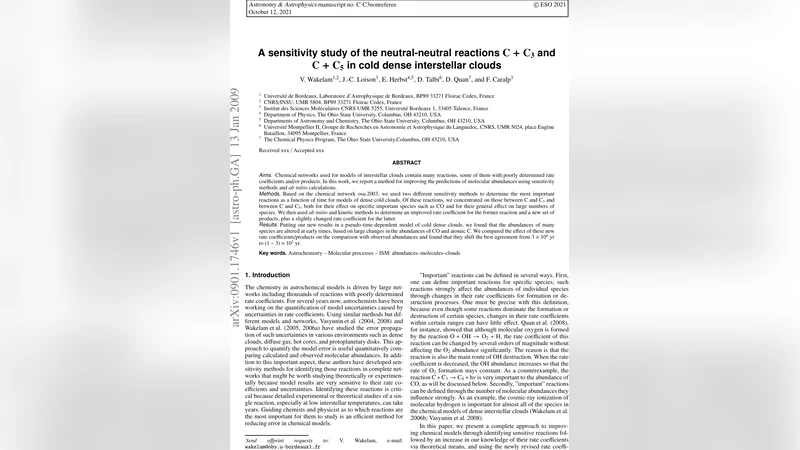
Chemical networks used for models of interstellar clouds contain many reactions, some of them with poorly determined rate coefficients and/or products. In this work, we report a method for improving the predictions of molecular abundances using sensitivity methods and ab initio calculations. Based on the chemical network osu.2003, we used two different sensitivity methods to determine the most important reactions as a function of time for models of dense cold clouds. Of these reactions, we concentrated on those between C and C3 and between C and C5, both for their effect on specific important species such as CO and for their general effect on large numbers of species. We then used ab initio and kinetic methods to determine an improved rate coefficient for the former reaction and a new set of products, plus a slightly changed rate coefficient for the latter. Putting our new results in a pseudo-time-dependent model of cold dense clouds, we found that the abundances of many species are altered at early times, based on large changes in the abundances of CO and atomic C. We compared the effect of these new rate coefficients/products on the comparison with observed abundances and found that they shift the best agreement from 3e4 yr to (1-3)e5 yr.
💡 Research Summary
The paper addresses a fundamental source of uncertainty in astrochemical models of cold, dense interstellar clouds: poorly constrained reaction rate coefficients and product channels for many gas‑phase processes. Using the widely adopted osu.2003 chemical network as a baseline, the authors first apply two complementary sensitivity‑analysis techniques. The first is a local, time‑dependent sensitivity coefficient that quantifies how a small perturbation in each reaction’s rate affects the abundance of every species at a given epoch. The second is a global Monte‑Carlo approach in which all rate coefficients are randomly varied within plausible uncertainty ranges and the resulting spread in model outputs is statistically examined. Both methods converge on two neutral‑neutral reactions—C + C₃ and C + C₅—as having disproportionate influence on the early‑time chemistry (10³–10⁴ yr), especially on the abundances of CO and atomic carbon, which in turn cascade to affect hundreds of other molecules.
To resolve the identified deficiencies, the authors perform high‑level ab initio calculations. For C + C₃ they map the potential energy surface using coupled‑cluster theory with single, double, and perturbative triple excitations
Comments & Academic Discussion
Loading comments...
Leave a Comment