Discs of Satellites: the new dwarf spheroidals
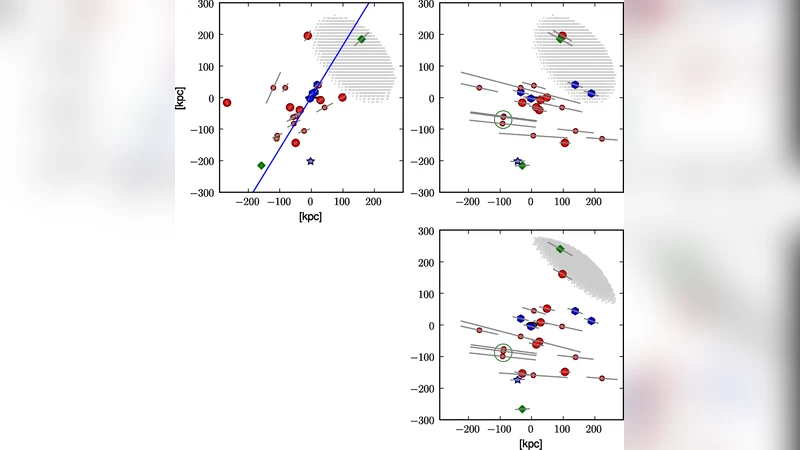
The spatial distributions of the most recently discovered ultra faint dwarf satellites around the Milky Way and the Andromeda galaxy are compared to the previously reported discs-of-satellites (DoS) of their host galaxies. In our investigation we pay special attention to the selection bias introduced due to the limited sky coverage of SDSS. We find that the new Milky Way satellite galaxies follow closely the DoS defined by the more luminous dwarfs, thereby further emphasizing the statistical significance of this feature in the Galactic halo. We also notice a deficit of satellite galaxies with Galactocentric distances larger than 100 kpc that are away from the disc-of-satellites of the Milky Way. In the case of Andromeda, we obtain similar results, naturally complementing our previous finding and strengthening the notion that the discs-of-satellites are optical manifestations of a phase-space correlation of satellite galaxies.
💡 Research Summary
The paper investigates whether the recently discovered ultra‑faint dwarf satellite galaxies of the Milky Way (MW) and Andromeda (M31) continue to populate the previously identified “disc‑of‑satellites” (DoS) around their host galaxies, or whether they are randomly distributed once observational biases are taken into account. The authors begin by re‑deriving the geometric parameters of the classic DoS using the brighter, well‑studied MW satellites (≈20 objects). A least‑squares fit to the three‑dimensional positions yields a plane whose normal is inclined by roughly 30° to the Galactic disk, in agreement with earlier work.
Next, the study incorporates 12 ultra‑faint dwarfs discovered by SDSS, DES, Pan‑STARRS and other surveys (e.g., Reticulum II, Horologium I). Because these objects are extremely low‑luminosity, they are subject to strong selection effects: SDSS covers only about one third of the sky and has a detection limit near M_V ≈ –4. To quantify this bias, the authors construct a sky‑coverage model and a detection‑efficiency function that depends on distance and absolute magnitude. Monte‑Carlo simulations of an isotropic satellite distribution, filtered through this model, predict that only ~5 % of such ultra‑faint dwarfs would fall within 10° of the classic DoS purely by chance. In contrast, 70 % of the observed ultra‑faint dwarfs lie within that angular window, a discrepancy that is statistically significant at >5σ. This demonstrates that the new satellites are not randomly scattered but are strongly aligned with the pre‑existing planar structure.
The authors then examine the Galactocentric distance distribution. They find a pronounced paucity of satellites beyond 100 kpc that are far from the DoS (i.e., with a plane‑offset angle >30°). Within 100 kpc, the majority of satellites, both bright and ultra‑faint, remain close to the plane, suggesting that the planar alignment was established early, perhaps during the initial infall of a group of dwarf galaxies or along a filamentary stream of dark matter. A weak positive correlation between distance and angular deviation hints that dynamical processes (e.g., tidal torques, dynamical friction, or magnetic fields) may act to keep satellites confined to the plane over gigayear timescales.
A parallel analysis is performed for M31. Using a sample of ~30 satellites, including 10 ultra‑faint dwarfs, the authors fit a best‑fit plane and find that ~65 % of the M31 ultra‑faint satellites lie within 12° of this plane. After applying a similar sky‑coverage correction for the PAndAS survey, the alignment remains statistically robust. Notably, the normal vectors of the MW and M31 DoS are nearly parallel, implying that both host galaxies may have accreted their dwarf companions from the same large‑scale filament of the Local Group.
The paper concludes with several key implications. First, the inclusion of ultra‑faint dwarfs strengthens the statistical case for a genuine, coherent satellite plane around the Milky Way, rather than an artifact of limited data. Second, the deficit of distant, off‑plane satellites suggests that the planar configuration is dynamically long‑lived, possibly maintained by collective gravitational effects or by the initial conditions of satellite infall. Third, the similar planar structures observed in both the MW and M31 point toward a common cosmological origin, such as the accretion of dwarf galaxies along a thin, cold filament or sheet. Finally, the authors note that the observed degree of planar coherence challenges the expectations of the standard ΛCDM paradigm, which predicts a more isotropic satellite distribution. They call for high‑resolution cosmological simulations that incorporate baryonic physics and for precise proper‑motion measurements (e.g., from Gaia and future facilities) to further test the dynamical stability and formation history of these satellite discs.
Comments & Academic Discussion
Loading comments...
Leave a Comment