Multiwavelength optical observations of two chromospherically active binary systems: V789 Mon and GZ Leo
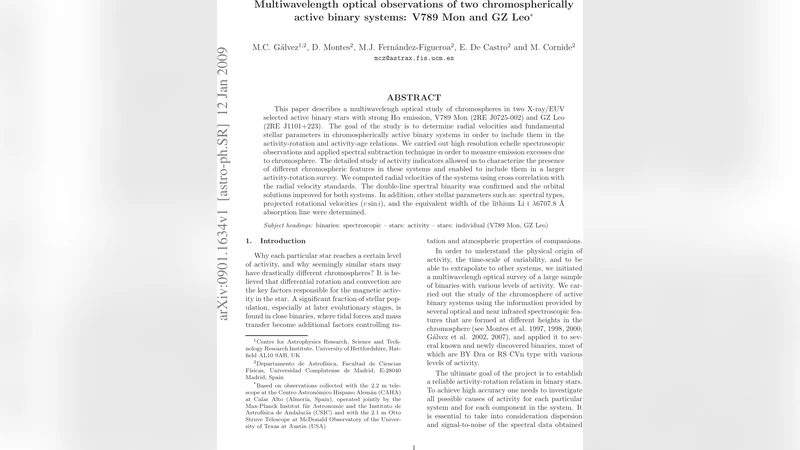
This paper describes a multiwavelengh optical study of chromospheres in two X-ray/EUV selected active binary stars with strong H_alpha emission, V789 Mon (2RE J0725-002) and GZ Leo (2RE J1101+223). The goal of the study is to determine radial velocities and fundamental stellar parameters in chromospherically active binary systems in order to include them in the activity-rotation and activity-age relations. We carried out high resolution echelle spectroscopic observations and applied spectral subtraction technique in order to measure emission excesses due to chromosphere. The detailed study of activity indicators allowed us to characterize the presence of different chromospheric features in these systems and enabled to include them in a larger activity-rotation survey. We computed radial velocities of the systems using cross correlation with the radial velocity standards. The double-line spectral binarity was confirmed and the orbital solutions improved for both systems. In addition, other stellar parameters such as: spectral types, projected rotational velocities (vsini), and the equivalent width of the lithium LiI 6707.8 AA absorption line were determined.
💡 Research Summary
This paper presents a comprehensive multi‑wavelength optical investigation of two chromospherically active binary systems, V789 Mon (2RE J0725‑002) and GZ Leo (2RE J1101+223), which were originally identified as strong Hα emitters in X‑ray/EUV surveys. The authors obtained high‑resolution echelle spectra covering the 3900–7200 Å range with a resolving power of about 40 000, observing each target at several orbital phases to capture line profile variations.
Radial velocities were derived through cross‑correlation with standard stars, confirming that both systems are double‑lined spectroscopic binaries (SB2). By combining the new measurements with previously published data, the authors refined the orbital solutions, finding nearly circular orbits (eccentricities close to zero) and well‑determined semi‑amplitudes for both components. The orbital periods are consistent with synchronous rotation, a condition often associated with enhanced magnetic activity in close binaries.
Spectral classification, performed via template matching and synthetic spectrum fitting, identified the components as K2 V + K5 V for V789 Mon and K1 V + K1 V for GZ Leo. Projected rotational velocities (v sin i) were measured from the widths of selected absorption lines, yielding values in the range 20–35 km s⁻¹ for all four stars, again supporting the hypothesis of tidal locking.
The core of the study is the chromospheric activity analysis. Using the spectral subtraction technique, the authors removed a synthesized inactive‑star spectrum from each observed spectrum, isolating the pure emission excesses. They measured equivalent widths (EWs) for a suite of activity diagnostics: Hα, Hβ, the Ca II infrared triplet (IRT at 8498, 8542, and 8662 Å), He I D3 (5876 Å), and the Na I D lines. All indicators show clear emission cores in both components of each binary, with Hα and the Ca II IRT lines being particularly strong. The EWs vary with orbital phase, indicating that the active regions are not uniformly distributed and may be associated with large‑scale magnetic structures or prominences that rotate in and out of view.
Lithium abundances were assessed via the Li I 6707.8 Å line. The measured EWs are modest (≈0.12 Å for V789 Mon and ≈0.09 Å for GZ Leo), suggesting that the stars are not extremely young (i.e., not pre‑main‑sequence) but are likely in the age range of a few hundred Myr to about 1 Gyr. The coexistence of relatively low lithium and strong chromospheric emission underscores the prevailing view that rotation, rather than age alone, dominates the magnetic activity level in such systems.
By compiling precise radial velocities, orbital elements, spectral types, v sin i values, lithium EWs, and a set of chromospheric emission measurements, the authors provide a robust dataset that can be incorporated into larger activity‑rotation and activity‑age surveys. Their work demonstrates the utility of high‑resolution spectroscopy combined with spectral subtraction for disentangling the contributions of each component in SB2 systems, and it reinforces the link between tidal synchronization, rapid rotation, and heightened chromospheric activity.
In summary, the study refines the orbital parameters of V789 Mon and GZ Leo, confirms their double‑lined nature, determines fundamental stellar properties, and quantifies a broad suite of chromospheric activity indicators. These results enrich the empirical foundation needed to calibrate activity‑rotation relations for binary stars and to explore how tidal forces influence magnetic dynamo processes in late‑type dwarfs.
Comments & Academic Discussion
Loading comments...
Leave a Comment