Vortices in self-gravitating gaseous discs
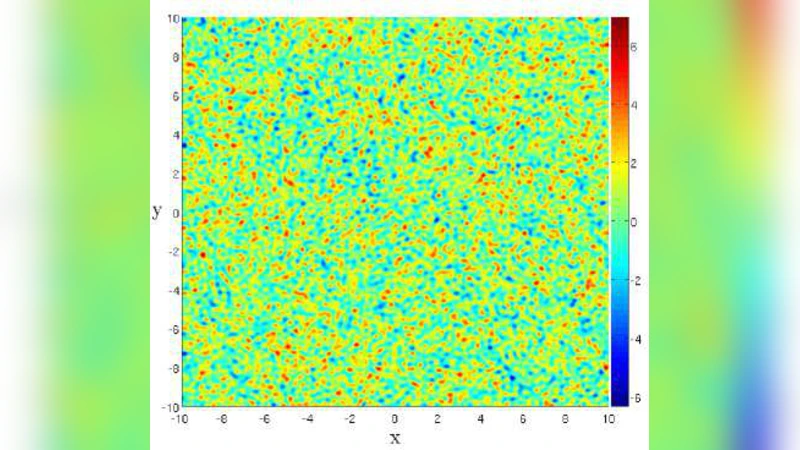
(abridged) Vortices are believed to play a role in the formation of km-sized planetesimals. However, vortex dynamics is commonly studied in non-self-gravitating discs. The main goal here is to examine the effects of disc self-gravity on vortex dynamics. For this purpose, we employ the 2D self-gravitating shearing sheet approximation. A simple cooling law with a constant cooling time is adopted, such that the disc settles down into a quasi-steady gravitoturbulent state. In this state, vortices appear as transient structures undergoing recurring phases of formation, growth to sizes comparable to a local Jeans scale and eventual shearing and destruction due to the combined effects of self-gravity and background Keplerian shear. Each phase typically lasts about 2 orbital periods or less. As a result, in self-gravitating discs the overall dynamical picture of vortex evolution is irregular consisting of many transient vortices at different evolutionary stages and, therefore, with various sizes up to the local Jeans scale. Vortices generate density waves during evolution, which turn into shocks. Therefore, the dynamics of density waves and vortices are coupled implying that, in general, one should consider both vortex and spiral density wave modes in order to get a proper understanding of self-gravitating disc dynamics. Our results suggest that given such an irregular and rapidly varying character of vortex evolution in self-gravitating discs, it may be difficult for such vortices to effectively trap dust particles. Further study of the behaviour of dust particles embedded in a self-gravitating gaseous disc is, however, required to strengthen this conclusion.
💡 Research Summary
The paper investigates how the self‑gravity of a gaseous protoplanetary disc influences the life cycle of vortices, a topic that has largely been explored in non‑self‑gravitating discs. Using the two‑dimensional shearing‑sheet approximation with periodic boundary conditions, the authors model a local patch of a Keplerian disc. A simple cooling prescription with a constant cooling time τc is applied, allowing the disc to settle into a quasi‑steady gravitoturbulent state in which the Toomre Q parameter hovers around unity. In this state, small vorticity perturbations spontaneously appear, grow under the combined action of self‑gravity and background shear, and reach a size comparable to the local Jeans length λJ≈c_s²/(πGΣ). Once a vortex attains this scale, the Keplerian shear begins to tear it apart, while self‑gravity simultaneously drives a collapse‑like deformation. The combined effect leads to rapid shearing and destruction of the vortex after typically less than two orbital periods (≈2Ω⁻¹). Consequently, the disc hosts a constantly changing population of transient vortices at various evolutionary stages, each with a lifetime of only a few orbits.
During their growth and dissolution, vortices emit spiral density waves. In the linear regime these waves exchange energy with the vortex; in the nonlinear regime they steepen into shocks that propagate through the disc, depositing additional angular momentum and heating the gas. Thus vortex dynamics and density‑wave dynamics are tightly coupled, and a realistic description of a self‑gravitating disc must treat both modes simultaneously.
The authors discuss the implications for dust trapping, a key step in planetesimal formation. In non‑self‑gravitating discs, long‑lived, large‑scale vortices can create pressure maxima that concentrate solid particles, facilitating their growth to kilometre size. In the self‑gravitating case, however, vortices are short‑lived, limited in size by the Jeans scale, and repeatedly shredded by shear. This irregular, rapidly varying vortex environment is unlikely to maintain the pressure bumps needed for efficient dust accumulation. While the shocks generated by vortex‑driven density waves could produce transient high‑density regions that might aid dust concentration, the overall efficiency is expected to be low. The paper therefore suggests that self‑gravity may suppress vortex‑mediated dust trapping, although definitive conclusions require dedicated simulations that include a dust component and fully three‑dimensional dynamics.
In summary, the study demonstrates that self‑gravity imposes a hard upper limit on vortex size, shortens vortex lifetimes, and forces a strong coupling between vortex and spiral‑density‑wave modes. These effects reshape the turbulent structure of gravitoturbulent discs and cast doubt on the role of vortices as robust dust traps in such environments. Future work should incorporate dust–gas interactions, a range of cooling timescales, and three‑dimensional effects to quantify how, if at all, vortices contribute to planetesimal formation in self‑gravitating protoplanetary discs.
Comments & Academic Discussion
Loading comments...
Leave a Comment