The cluster birthline in M33
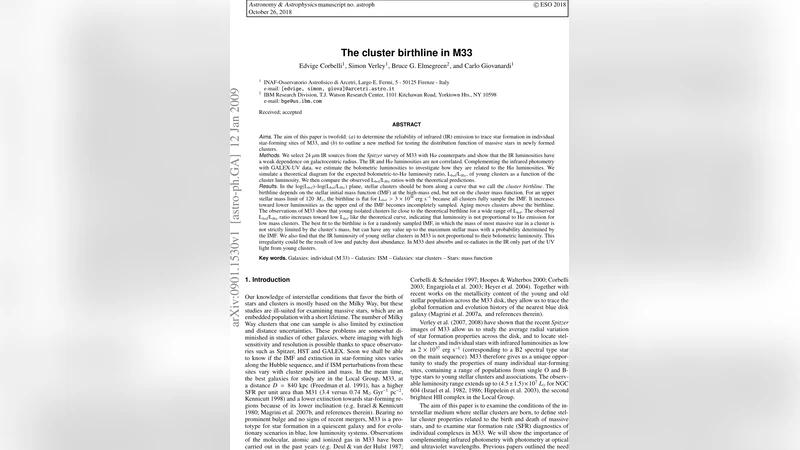
We test the reliability of infrared (IR) emission to trace star formation in individual star-forming sites of M33, and outline a new method for testing the distribution function of massive stars in newly formed clusters. We select IR sources from the Spitzer survey of M33 and show that the IR and Halpha luminosities are not correlated. Complementing the infrared photometry with GALEX-UV data, we estimate the source bolometric luminosities. For a given stellar IMF we simulate a theoretical curve for the expected bolometric-to-Halpha luminosity ratio, along which stellar clusters are born. We call this the cluster birthline in the Lbol–Lbol/LHal plane. The birthline is flat for Lbol>3x10^{39}erg/s because all clusters fully sample the IMF and it increases toward lower luminosities as the upper end of the IMF becomes incompletely sampled. The observations of M33 show that young isolated clusters lie close to the theoretical birthline for a wide range of Lbol. The luminosity is not proportional to Halpha emission for low mass clusters and aging moves clusters above the birthline. The best fit to the birthline is for a randomly sampled IMF, in which the mass of most massive star in a cluster is not strictly limited by the cluster’s mass. We also find that the IR luminosity of young stellar clusters in M33 is not proportional to their bolometric luminosity. This irregularity could be the result of low and patchy dust abundance in M33.
💡 Research Summary
The paper investigates how reliably infrared (IR) emission traces star formation in individual star‑forming sites of the nearby spiral galaxy M33 and introduces a novel diagnostic – the “cluster birthline” – to probe the distribution of massive stars in newly formed clusters. The authors first select a sample of compact IR sources from the Spitzer 24 µm survey of M33, cross‑matching them with H α, GALEX far‑ and near‑UV, and optical data. By combining the UV and IR fluxes they estimate each source’s bolometric luminosity (L_bol), which represents the total stellar output.
To interpret the relationship between L_bol and the H α luminosity (L_Hα), they construct theoretical expectations based on an assumed stellar initial mass function (IMF). Two sampling scenarios are considered: (1) a “deterministic” or regular sampling where the most massive star that can form in a cluster is limited by the cluster’s total mass, and (2) a “random” sampling where stellar masses are drawn purely probabilistically from the IMF, allowing even low‑mass clusters to occasionally host very massive stars. Using population‑synthesis models (e.g., Starburst99) they compute, for each scenario, the expected L_bol/L_Hα ratio as a function of L_bol. The resulting curve is termed the cluster birthline and is plotted in the L_bol versus L_bol/L_Hα plane.
The theoretical birthline has a characteristic shape: for high‑luminosity clusters (L_bol > 3 × 10^39 erg s⁻¹) the IMF is fully sampled, so the ratio L_bol/L_Hα remains roughly constant, producing a flat segment. At lower L_bol the upper IMF becomes incompletely sampled; the most massive stars are missing in many clusters, causing L_Hα to drop faster than L_bol and the ratio to rise sharply.
When the observed M33 clusters are placed on this diagram, they cluster tightly around the predicted birthline across a wide luminosity range. Low‑mass clusters show a larger scatter, consistent with stochastic IMF sampling and with evolutionary effects: as clusters age, the most massive O‑type stars die, H α emission declines, and the points move upward away from the birthline. The authors find that the random‑sampling IMF reproduces the observed distribution far better than the deterministic model, implying that the mass of the most massive star in a cluster is not strictly capped by the cluster’s total mass. This challenges the often‑used “maximum stellar mass–cluster mass” relation and supports a picture where stochasticity plays a dominant role in the early stellar content of clusters.
A further key result concerns the IR emission itself. Contrary to the common assumption that IR luminosity scales linearly with total stellar output, the authors find that L_IR is not proportional to L_bol, especially for low‑luminosity clusters. They attribute this to the low metallicity and patchy dust distribution in M33: many young clusters lack sufficient dust to absorb UV/optical photons and re‑emit them in the IR, leading to a wide range of L_IR/L_bol ratios. Consequently, using IR alone as a star‑formation rate (SFR) indicator in such environments can severely underestimate the true SFR, and multi‑wavelength corrections are essential.
In summary, the study (1) demonstrates that IR and H α luminosities are decoupled on the scale of individual clusters in M33, (2) introduces the cluster birthline as a powerful tool to assess cluster age, mass, and IMF sampling simultaneously, (3) provides strong observational support for a randomly sampled IMF in this galaxy, and (4) highlights the limitations of IR‑based SFR diagnostics in low‑dust, low‑metallicity systems. The methodology and the birthline concept can be applied to other nearby galaxies, offering a new avenue to test star‑formation theories and the universality of the IMF.
Comments & Academic Discussion
Loading comments...
Leave a Comment