Role of galactic gaseous halos in recycling enriched winds from bulges to disks: A new bulge-disk chemical connection
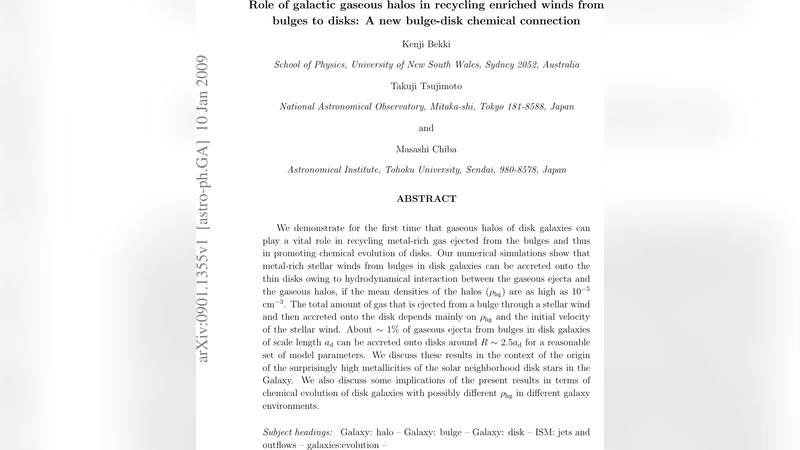
We demonstrate for the first time that gaseous halos of disk galaxies can play a vital role in recycling metal-rich gas ejected from the bulges and thus in promoting chemical evolution of disks. Our numerical simulations show that metal-rich stellar winds from bulges in disk galaxies can be accreted onto the thin disks owing to hydrodynamical interaction between the gaseous ejecta and the gaseous halos, if the mean densities of the halos (rho_ hg) are as high as 10^{-5} cm^{-3}. The total amount of gas that is ejected from a bulge through a stellar wind and then accreted onto the disk depends mainly on rho_ hg and the initial velocity of the stellar wind. About ~ 1% of gaseous ejecta from bulges in disk galaxies of scale length a_d can be accreted onto disks around R ~ 2.5 a_ d for a reasonable set of model parameters. We discuss these results in the context of the origin of the surprisingly high metallicities of the solar neighborhood disk stars in the Galaxy. We also discuss some implications of the present results in terms of chemical evolution of disk galaxies with possibly different rho_ hg in different galaxy environments.
💡 Research Summary
The paper presents a novel mechanism by which the gaseous halos of disk galaxies can recycle metal‑rich stellar winds expelled from central bulges back onto the thin disks, thereby influencing the chemical evolution of the disks. Using three‑dimensional Smoothed Particle Hydrodynamics (SPH) simulations, the authors model a galaxy consisting of a stellar disk, a bulge, and an extended hot gaseous halo. The key parameters explored are the mean halo density (ρ_hg) and the initial velocity of the bulge wind (v_wind). Simulations are run for ρ_hg ranging from 10⁻⁶ to 10⁻⁴ cm⁻³ and v_wind from 200 to 600 km s⁻¹, covering plausible conditions for Milky Way‑type galaxies.
The results show that when ρ_hg ≥ 10⁻⁵ cm⁻³, the wind interacts hydrodynamically with the halo gas, experiences strong deceleration and compression, and is subsequently redirected toward the disk plane by the combined effect of gravity and centrifugal forces. About 1 % of the total mass ejected from the bulge is finally accreted onto the disk, predominantly at radii around 2.5 times the disk scale length (R ≈ 2.5 a_d). This accreted material is highly enriched, providing a direct source of metals for the outer disk. If the halo density is lower, the wind expands freely into intergalactic space and the recycling efficiency drops dramatically. Similarly, wind velocities that are too high allow the outflow to escape the halo, while velocities that are too low cause the wind to collide with the inner disk before any halo interaction, eliminating the long‑range redistribution effect.
The authors argue that this halo‑mediated recycling can naturally explain the surprisingly high metallicities observed in solar‑neighbourhood stars, which are difficult to reproduce with conventional “inside‑out” chemical evolution models that consider only gas inflow from the intergalactic medium and local star formation. Moreover, the efficiency of this process depends sensitively on the halo density, which is expected to vary with environment: galaxies in dense groups or clusters may possess more compressed, higher‑density halos, leading to stronger bulge‑to‑disk metal transfer, whereas isolated field galaxies may have more tenuous halos and thus rely more on external gas accretion.
The paper also discusses several implications and limitations. The simulations neglect magnetic fields, radiation pressure, and the possible contribution of multiple wind sources (e.g., supernova‑driven outflows), and they treat the halo as a smooth, static medium. Consequently, the quantitative recycling fractions should be regarded as lower‑order estimates. The authors propose future work that includes magnetohydrodynamic (MHD) simulations, a more realistic multi‑phase halo structure, and direct observational tests such as X‑ray measurements of halo densities and high‑resolution spectroscopic surveys of stellar metallicity gradients.
In summary, this study demonstrates that gaseous halos can act as a conduit for metal‑rich bulge winds, delivering a non‑negligible (~1 %) fraction of enriched material to the outer disk. This process adds a previously unaccounted for source of metals to disk chemical evolution models, offers a plausible explanation for the high metallicity of the solar neighbourhood, and predicts an environmental dependence of disk metallicities linked to halo density. Further theoretical refinements and observational validation are needed, but the work opens a promising new avenue for understanding the interplay between bulge activity, halo gas, and disk chemical enrichment.
Comments & Academic Discussion
Loading comments...
Leave a Comment