Resolving the obscuring torus in NGC 1068 with the power of infrared interferometry: Revealing the inner funnel of dust
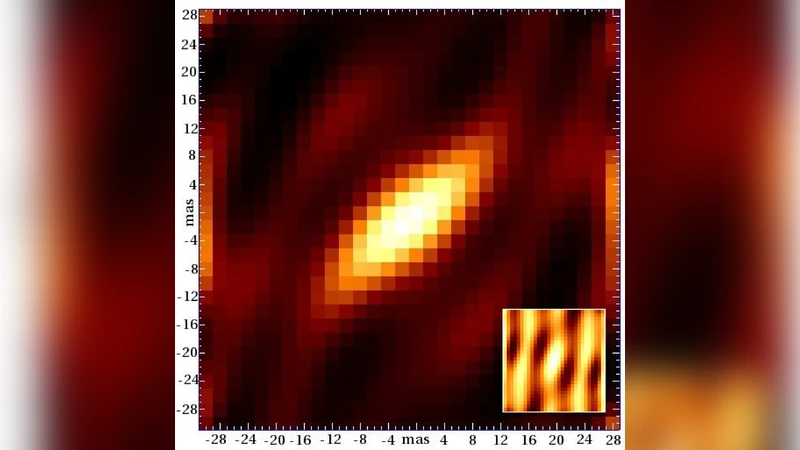
We present new interferometric data obtained with MIDI (MID infrared Interferometric instrument) for the Seyfert II galaxy NGC 1068, with an extensive coverage of sixteen uv points. These observations resolve the nuclear mid-infrared emission from NGC 1068 in unprecedented detail with a maximum resolution of 7 mas. For the first time, sufficient uv points have been obtained, allowing us to generate an image of the source using maximum entropy image reconstruction. The features of the image are similar to those obtained by modelling. We find that the mid-infrared emission can be represented by two components, each with a Gaussian brightness distribution. The first, identified as the inner funnel of the obscuring torus, is hot (800K), 1.35 parsec long, and 0.45 parsec thick in FWHM at a PA=-42 degrees (from north to east). It has an absorption profile different than standard interstellar dust and with evidence for clumpiness. The second component is 3 by 4 pc in FWHM with T=300K, and we identify it with the cooler body of the torus. The compact component is tilted by 45 degrees with respect to the radio jet and has similar size and orientation to the observed water maser distribution. We show how the dust distribution relates to other observables within a few parsecs of the core of the galaxy such as the nuclear masers, the radio jet, and the ionization cone. We compare our findings to a similar study of the Circinus galaxy and other relevant studies. Our findings shed new light on the relation between the different parsec-scale components in NGC 1068 and the obscuring torus.
💡 Research Summary
The authors present a landmark mid‑infrared interferometric study of the Seyfert II galaxy NGC 1068 using the MIDI instrument on the VLTI. By acquiring sixteen well‑distributed uv points, they achieve an unprecedented angular resolution of 7 mas (≈0.5 pc) and, for the first time for this object, generate a direct image of the nuclear emission through maximum‑entropy reconstruction. The reconstructed image reveals two distinct Gaussian components that together account for the observed visibilities.
The first component, termed the “inner funnel,” is compact, hot (≈800 K), elongated (1.35 pc length, 0.45 pc width, FWHM) and oriented at a position angle of –42° (north‑to‑east). Its silicate absorption profile deviates from that of standard interstellar dust, and the data show signatures of clumpiness, suggesting a non‑uniform dust distribution. This funnel is tilted by roughly 45° with respect to the radio jet and shares both size and orientation with the distribution of nuclear water masers, implying a physically connected rotating structure that may channel material into the jet and maser region.
The second component is more extended (≈3 × 4 pc FWHM), cooler (≈300 K), and is identified with the bulk of the obscuring torus. Its geometry is consistent with a relatively thick, dusty toroidal envelope surrounding the inner funnel.
By comparing the interferometric results with high‑resolution radio, maser, and optical data, the authors construct a coherent picture of the central few parsecs: the inner funnel forms the base of the ionisation cone, the tilted geometry explains the observed misalignment between the jet and the torus, and the clumpy dust may be responsible for the anisotropic obscuration seen in NGC 1068.
The paper also places these findings in context with similar work on the Circinus galaxy, where a comparable two‑component, clumpy torus has been reported. This parallel strengthens the argument that parsec‑scale AGN tori are generically composed of a hot, compact inner structure and a cooler, more extended outer envelope, both exhibiting significant inhomogeneity.
Methodologically, the study demonstrates the power of mid‑infrared interferometry to resolve sub‑parsec structures in nearby active galaxies, moving beyond purely model‑dependent interpretations. The successful image reconstruction validates the uv coverage strategy and the maximum‑entropy algorithm for complex, partially resolved sources.
In conclusion, the paper provides compelling observational evidence that the obscuring torus in NGC 1068 is not a simple, uniform doughnut but a multi‑component, tilted, and clumpy system. The inner funnel, closely aligned with the maser disk and offset from the jet, likely plays a crucial role in feeding the central engine and shaping the ionisation cone, while the outer torus supplies the bulk of the obscuring material. These results have significant implications for unified models of AGN, emphasizing the need to incorporate geometric complexity and clumpiness when interpreting infrared, radio, and optical observations of active galactic nuclei.
Comments & Academic Discussion
Loading comments...
Leave a Comment