Time-dependent H2 formation and protonation
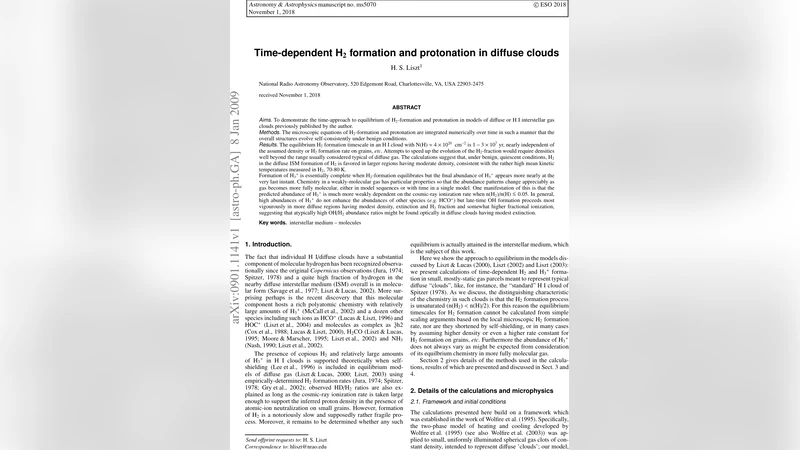
Methods: The microscopic equations of H2-formation and protonation are integrated numerically over time in such a manner that the overall structures evolve self-consistently under benign conditions. Results: The equilibrium H2 formation timescale in an H I cloud with N(H) ~ 4x10^{20}/cm^2 is 1-3 x 10^7 yr, nearly independent of the assumed density or H2 formation rate constant on grains, etc. Attempts to speed up the evolution of the H2-fraction would require densities well beyond the range usually considered typical of diffuse gas. The calculations suggest that, under benign, quiescent conditions, formation of H2 is favored in larger regions having moderate density, consistent with the rather high mean kinetic temperatures measured in H2, 70-80 K. Formation of H3+ is essentially complete when H2-formation equilibrates but the final abundance of H3+ appears more nearly at the very last instant. Chemistry in a weakly-molecular gas has particular properties so that the abundance patterns change appreciably as gas becomes more fully molecular, either in model sequences or with time in a single model. One manifestation of this is that the predicted abundance of H3+ is much more weakly dependent on the cosmic-ray ionization rate when n(H2)/n(H) < 0.05. In general, high abundances of H3+ do not enhance the abundances of other species (e.g. HCO+) but late-time OH formation proceeds most vigourously in more diffuse regions having modest density, extinction and H2 fraction and somewhat higher fractional ionization, suggesting that atypically high OH/H2 abundance ratios might be found optically in diffuse clouds having modest extinction.
💡 Research Summary
The paper presents a time‑dependent, self‑consistent numerical integration of the microscopic reaction network governing H₂ formation on dust grains and the subsequent protonation leading to H₃⁺ in a typical diffuse interstellar cloud. By adopting “benign” physical conditions—moderate densities (tens to a few hundred cm⁻³), kinetic temperatures of 70–80 K, total hydrogen column densities around 4 × 10²⁰ cm⁻², and a canonical cosmic‑ray ionization rate of ~10⁻¹⁶ s⁻¹—the authors explore how the chemistry evolves from an initially atomic medium to a partially molecular state.
The most striking result is the remarkably long H₂ formation timescale. Even when the grain‑surface formation rate coefficient is varied, the model consistently yields an equilibrium H₂ fraction (≈50 % of total hydrogen) after 1–3 × 10⁷ yr. This timescale is essentially independent of the assumed gas density, implying that simply increasing the density within the usual range for diffuse gas does not appreciably accelerate H₂ production. Only densities far beyond typical diffuse values would lead to a noticeable reduction in the formation time. Consequently, under quiescent conditions the bulk of H₂ is expected to accumulate in extended regions of moderate density rather than in compact, high‑density clumps.
H₃⁺ formation follows closely on the heels of H₂. As H₂ builds up, H⁺ produced by cosmic‑ray ionization reacts with H₂ to form H₃⁺, which then reaches near‑steady state almost simultaneously with the H₂ equilibrium. However, the final peak abundance of H₃⁺ appears at the very last stages of the calculation, reflecting the fact that the reaction network continues to evolve even after the H₂ fraction has essentially stopped changing. An important nuance emerges for low molecular fractions (n(H₂)/n(H) < 0.05): in this regime the H₃⁺ abundance is only weakly sensitive to the cosmic‑ray ionization rate ζ. The reason is that the bottleneck is the availability of H₂ itself, not the ionization input. Once the gas becomes more fully molecular, the dependence on ζ strengthens dramatically.
The study also examines the downstream chemical consequences of a high H₃⁺ abundance. Contrary to naive expectations, elevated H₃⁺ does not automatically boost the abundances of other commonly observed ions such as HCO⁺. The formation of HCO⁺ is limited by the availability of CO and by temperature‑dependent reaction pathways, so its abundance remains relatively decoupled from that of H₃⁺. In contrast, OH shows a pronounced late‑time surge, especially in regions that retain relatively low extinction, modest density, and a slightly higher fractional ionization. OH is produced efficiently through a sequence involving O⁺ + H₂ and subsequent reactions with H⁺, processes that are enhanced when the ionization fraction is elevated. This leads to the prediction that diffuse clouds with modest visual extinction may exhibit unusually high OH/H₂ ratios, a phenomenon that has indeed been reported in some optical absorption studies.
The authors further discuss the non‑linear character of the chemistry as the gas transitions from atomic to molecular. As the H₂ fraction rises past ~0.1, the electron density drops sharply, altering the balance of ion–neutral reactions and causing abrupt changes in the abundances of many species. This “chemical transition” manifests both in model sequences that vary physical parameters and in the temporal evolution of a single model, offering a diagnostic tool for distinguishing truly diffuse clouds from those in an intermediate, partially molecular phase.
Finally, the paper connects the theoretical findings with observations. The predicted kinetic temperature of 70–80 K for the H₂‑bearing gas matches the rotational excitation temperatures derived from UV absorption lines. The weak dependence of H₃⁺ on ζ at low molecular fractions helps explain why observed H₃⁺ column densities in diffuse sightlines do not always scale directly with the inferred cosmic‑ray ionization rates. Moreover, the suggestion that OH formation is most vigorous in low‑extinction, modest‑density environments provides a natural explanation for the occasional detection of high OH/H₂ ratios in optical spectra of diffuse clouds.
In summary, this work delivers a comprehensive, time‑dependent picture of H₂ and H₃⁺ chemistry in diffuse interstellar clouds, highlighting the long H₂ formation timescale, the nuanced role of cosmic‑ray ionization, the limited impact of H₃⁺ on other ion abundances, and the conditions that favor late‑time OH production. These insights refine our understanding of molecular evolution in the low‑density interstellar medium and offer concrete predictions that can be tested with current and future spectroscopic observations.
Comments & Academic Discussion
Loading comments...
Leave a Comment