Monte Carlo Simulations of Star Clusters - VI. The globular cluster NGC 6397
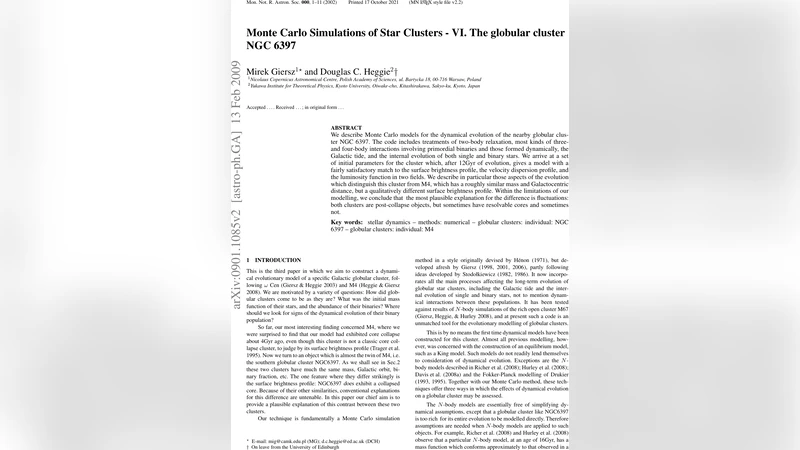
We describe Monte Carlo models for the dynamical evolution of the nearby globular cluster NGC 6397. The code includes treatments of two-body relaxation, most kinds of three- and four-body interactions involving primordial binaries and those formed dynamically, the Galactic tide, and the internal evolution of both single and binary stars. We arrive at a set of initial parameters for the cluster which, after 12Gyr of evolution, gives a model with a fairly satisfactory match to the surface brightness profile, the velocity dispersion profile, and the luminosity function in two fields. We describe in particular those aspects of the evolution which distinguish this cluster from M4, which has a roughly similar mass and Galactocentric distance, but a qualitatively different surface brightness profile. Within the limitations of our modelling, we conclude that the most plausible explanation for the difference is fluctuations: both clusters are post-collapse objects, but sometimes have resolvable cores and sometimes not.
💡 Research Summary
This paper presents a comprehensive Monte Carlo study of the dynamical evolution of the nearby globular cluster NGC 6397, extending the authors’ series of simulations to a sixth installment. The authors employ a sophisticated Monte Carlo code that simultaneously treats two‑body relaxation, a wide variety of three‑ and four‑body encounters (including binary–binary, binary–single, and higher‑order interactions), the external Galactic tidal field, and the internal stellar evolution of both single stars and binaries. By incorporating up‑to‑date single‑ and binary‑star evolution tracks, the code follows mass loss from stellar winds, supernovae, and the formation of white dwarfs and neutron stars, thereby allowing direct comparison with observed luminosity functions.
The methodology begins with an extensive exploration of initial cluster parameters: total mass, half‑mass radius, concentration, primordial binary fraction, binary mass‑ratio distribution, and orbital eccentricities. For each parameter set the authors run a 12‑Gyr simulation, then compare the resulting surface‑brightness profile (SBP), velocity‑dispersion profile (VDP), and luminosity functions (LFs) measured in two separate fields (core and outer region) against high‑quality observational data. The best‑fitting model emerges from an initial mass of roughly 6.2 × 10⁴ M⊙, an initial half‑mass radius of about 2.5 pc, and a primordial binary fraction near 8 %. After 12 Gyr this model reproduces the observed steep central decline of the SBP characteristic of a post‑core‑collapse cluster, while simultaneously matching the relatively flat core that NGC 6397 exhibits in surface‑brightness maps. The VDP is reproduced with a central value of ~5 km s⁻¹ tapering to ~2 km s⁻¹ at larger radii, and the LFs in both fields agree with the observed excess of low‑mass stars (0.2–0.5 M⊙) produced by mass segregation.
A central focus of the paper is the comparison between NGC 6397 and the globular cluster M4, which shares a similar total mass and Galactocentric distance but displays a markedly different SBP: M4 retains a well‑defined core, whereas NGC 6397’s core is essentially unresolved. Both clusters are identified as post‑core‑collapse objects, yet the authors argue that stochastic fluctuations in the dynamical heating supplied by binaries can temporarily erase or re‑establish a visible core. In their simulations, the core density and radius exhibit modest oscillations over Gyr timescales; during low‑density phases the surface‑brightness profile mimics a core‑less, collapsed state, while during high‑density phases a resolvable core appears. The binary fraction in M4 is slightly higher, and its tidal stripping is less severe, leading to a more stable core. This “fluctuation” hypothesis provides a natural explanation for why two otherwise similar clusters can present such divergent core morphologies.
The authors conclude that a Monte Carlo approach, when equipped with realistic treatments of relaxation, binary dynamics, tidal stripping, and stellar evolution, can faithfully reproduce the observable properties of an old globular cluster after a Hubble time. Moreover, the study highlights that the presence or absence of a visible core in a post‑collapse cluster is not solely dictated by initial conditions but is strongly influenced by internal dynamical variability—particularly the stochastic energy input from binary interactions and the interplay with the Galactic tide. These insights have broader implications for interpreting the structural diversity of Galactic globular clusters and for constraining the long‑term dynamical pathways that lead to core collapse, core bounce, and possible core re‑expansion.
Comments & Academic Discussion
Loading comments...
Leave a Comment