Superdense massive galaxies in the Nearby Universe
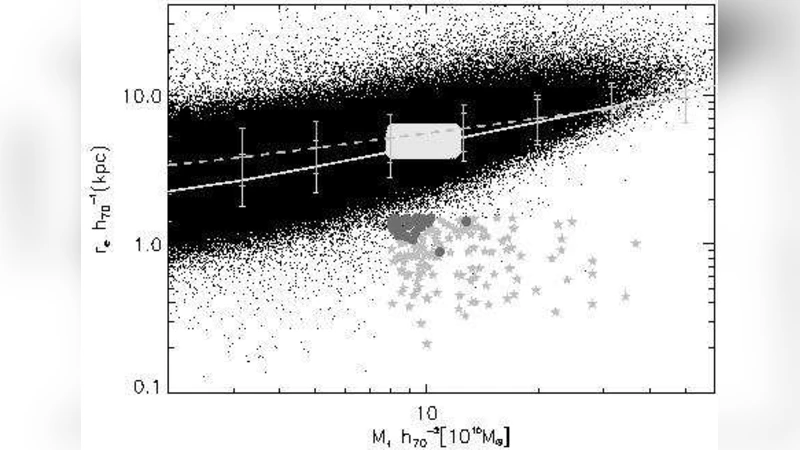
Superdense massive galaxies (r_e1 kpc; M10^{11} Msun) were common in the early universe (z>1.5). Within some hierarchical merging scenarios, a non-negligible fraction (1-10%) of these galaxies is expected to survive since that epoch retaining their compactness and presenting old stellar populations in the present universe. Using the NYU Value-Added Galaxy Catalog from the SDSS Data Release 6 we find only a tiny fraction of galaxies (~0.03%) with r_e<1.5 kpc and M_*>8x10^{10} Msun in the local Universe (z<0.2). Surprinsingly, they are relatively young (~2 Gyr) and metal-rich ([Z/H]~0.2). The consequences of these findings within the current two competing size evolution scenarios for the most massive galaxies (“dry” mergers vs “puffing up” due to quasar activity) are discussed.
💡 Research Summary
**
The paper investigates whether the compact, massive galaxies that were abundant at high redshift (z > 1.5) still exist in the nearby universe and, if so, what their physical properties are. These “super‑dense massive galaxies” (SDMGs) have effective radii of order 1 kpc and stellar masses around 10¹¹ M☉. Hierarchical models that include dry (gas‑poor) mergers predict that a non‑negligible fraction—typically quoted as 1–10 %—of the original high‑z population should survive to the present day, retaining their compactness while aging passively.
Data and Sample Selection
The authors use the NYU Value‑Added Galaxy Catalog derived from SDSS Data Release 6. From the full low‑redshift (z < 0.2) sample of roughly 500,000 galaxies they apply two stringent cuts: (i) an effective radius rₑ < 1.5 kpc, measured from Sérsic profile fits to the SDSS imaging, and (ii) a stellar mass M_* > 8 × 10¹⁰ M☉, calculated using the SDSS photometry and standard mass‑to‑light ratios. These criteria are deliberately conservative to accommodate measurement uncertainties while still isolating truly compact massive systems.
Observed Frequency
Only about 150 objects satisfy both criteria, corresponding to a fraction of ≈0.03 % of the local massive galaxy population. This observed abundance is two to three orders of magnitude lower than the 1–10 % survival rate expected from most dry‑merger based hierarchical models.
Stellar Populations
Full‑spectral fitting (e.g., STARLIGHT, STECKMAP) of the SDSS spectra yields mean light‑weighted ages of ~2 Gyr and metallicities of
Comments & Academic Discussion
Loading comments...
Leave a Comment