The beat Cepheids in the Magellanic Clouds: an analysis from the EROS-2 database
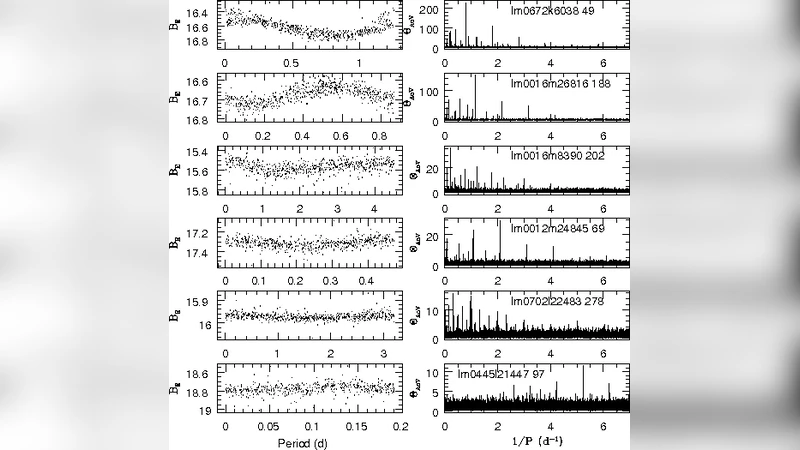
A number of microlensing dark-matter surveys have produced tens of millions of light curves of individual background stars. These data provide an unprecedented opportunity for systematic studies of whole classes of variable stars and their host galaxies. We aim to use the EROS-2 survey of the Magellanic Clouds to detect and study the population of beat Cepheids (BCs) in both Clouds. BCs pulsating simultaneously in the first overtone and fundamental modes (FO/F) or in the second and first overtone modes (SO/FO) are of particular interest. Using special software designed to search for periodic variables, we have scanned the EROS-2 data base for variables in the typical period range of Cepheids. Metallicities of FO/F objects were then calculated from linear nonadiabatic convective stellar models. We identify 74 FO/F BCs in the LMC and 41 in the SMC, and 173 and 129 SO/FO pulsators in the LMC and SMC, respectively; 185 of these stars are new discoveries. For nearly all the FO/F objects we determine minimum, mean, and maximum values of the metallicity. The EROS data have expanded the samples of known BCs in the LMC by 31%, in the SMC by 110%. The FO/F objects provide independent measures of metallicities in these galaxies. The mean value of metallicity is 0.0045 in the LMC and 0.0018 in the SMC.
💡 Research Summary
The paper exploits the extensive time‑series photometry from the EROS‑2 microlensing survey to conduct the most comprehensive census of beat Cepheids (BCs) in the Large and Small Magellanic Clouds (LMC and SMC). Beat Cepheids are double‑mode pulsators that simultaneously excite two radial modes; the authors focus on two specific mode pairs: fundamental plus first overtone (FO/F) and first plus second overtone (SO/FO).
A dedicated variable‑star detection pipeline was applied to the EROS‑2 database, scanning the typical Cepheid period range (≈0.2–10 days). The pipeline performs Lomb‑Scargle periodograms, Fourier decomposition, and multi‑frequency fitting to isolate stars with two statistically significant periods. By examining period ratios (P₁/P₀) and amplitude ratios, the authors separate FO/F from SO/FO candidates. Cross‑matching with existing catalogs (OGLE, MACHO, earlier EROS releases) confirms the reliability of the detections and identifies 185 newly discovered BCs.
The final sample comprises 74 FO/F BCs in the LMC and 41 in the SMC, together with 173 SO/FO BCs in the LMC and 129 in the SMC. This represents a 31 % increase in the known LMC BC population and a 110 % increase for the SMC, dramatically expanding the statistical basis for subsequent analysis.
To extract metallicities, the authors employ linear non‑adiabatic convective pulsation models that incorporate OPAL opacities and time‑dependent convection. A grid of stellar models spanning masses of 3–7 M⊙, effective temperatures, and metallicities (Z) is computed. For each grid point the instability strips and period ratios are calculated, allowing observed FO/F period pairs to be mapped onto the theoretical grid. This yields a minimum, mean, and maximum Z for each FO/F star. The ensemble averages are Z≈0.0045 for the LMC and Z≈0.0018 for the SMC, values that agree with independent spectroscopic determinations and confirm the SMC’s lower metal content.
The study also discusses data‑quality aspects: the dual‑band (R, B) observations of EROS‑2 enable colour‑dependent extinction corrections; systematic errors are mitigated through cross‑validation with OGLE and MACHO light curves. The authors note that the spread in derived metallicities reflects genuine spatial chemical inhomogeneities within each Cloud, hinting at complex star‑formation histories.
In conclusion, this work demonstrates that large‑scale microlensing surveys, originally designed for dark‑matter searches, are powerful tools for variable‑star astrophysics. By combining a robust detection algorithm with state‑of‑the‑art pulsation models, the authors provide a high‑precision, homogeneous metallicity probe for the Magellanic Clouds. The expanded BC catalog will serve as a valuable benchmark for future theoretical work on stellar pulsation, as well as for calibrating distance scales and refining models of galactic chemical evolution. The methodology outlined here can be readily applied to other time‑domain surveys (e.g., LSST, Gaia) to uncover and exploit multi‑mode pulsators across the Local Group.
Comments & Academic Discussion
Loading comments...
Leave a Comment