The metallicity of the most distant quasars
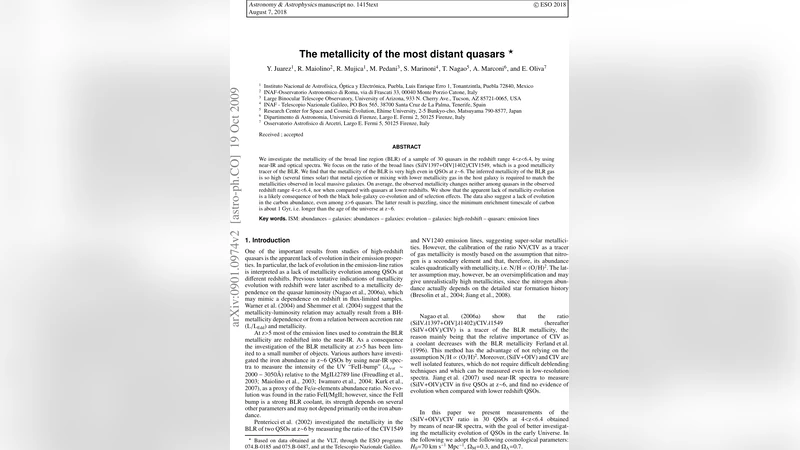
We investigate the metallicity of the broad line region (BLR) of a sample of 30 quasars in the redshift range 4<z<6.4, by using near-IR and optical spectra. We focus on the ratio of the broad lines (SiIV1397+OIV]1402)/CIV1549, which is a good metallicity tracer of the BLR. We find that the metallicity of the BLR is very high even in QSOs at z6. The inferred metallicity of the BLR gas is so high (several times solar) that metal ejection or mixing with lower metallicity gas in the host galaxy is required to match the metallicities observed in local massive galaxies. On average, the observed metallicity changes neither among quasars in the observed redshift range 4<z<6.4, nor when compared with quasars at lower redshifts. We show that the apparent lack of metallicity evolution is a likely consequence of both the black hole-galaxy co-evolution and of selection effects. The data also suggest a lack of evolution in the carbon abundance, even among z>6 quasars. The latter result is puzzling, since the minimum enrichment timescale of carbon is about 1 Gyr, i.e. longer than the age of the universe at z6.
💡 Research Summary
The paper investigates the chemical enrichment of the broad‑line region (BLR) in a sample of thirty quasars spanning the redshift interval 4 < z < 6.4. Using a combination of near‑infrared (NIR) and optical spectroscopy, the authors focus on the line‑ratio (Si IV 1397 + O IV] 1402)/C IV 1549, a well‑established metallicity indicator for BLR gas. After careful data reduction, continuum fitting, and multi‑Gaussian decomposition of the broad emission lines, they convert the measured ratios into metallicities with the aid of photo‑ionization models (CLOUDY) that assume typical BLR densities (n_H ≈ 10^10 cm⁻³) and ionization parameters (U ≈ 10⁻²).
The main result is that virtually all objects, including those at z ≈ 6, exhibit supersolar metallicities—generally 3–5 Z⊙, and in some cases even higher. This high metal content is present despite the universe being less than one gigayear old at z ≈ 6. Moreover, when the authors compare the metallicities of quasars across the full redshift range 4 < z < 6.4, they find no statistically significant trend; the average metallicity remains constant. A similar lack of evolution is observed when these high‑z quasars are compared with lower‑redshift (z < 4) samples drawn from the literature.
The authors interpret the apparent “metallicity plateau” as a consequence of two intertwined effects. First, the co‑evolution of supermassive black holes and their host galaxies implies that a quasar becomes optically luminous only after its central region has already undergone rapid star formation and chemical enrichment. Consequently, the quasars that are bright enough to be selected in flux‑limited surveys are biased toward systems that already possess high metallicities. Second, the BLR may not be fully mixed with the more metal‑poor interstellar medium of the host galaxy; instead, it could retain the imprint of a centrally concentrated, highly enriched gas reservoir.
A particularly intriguing finding is the constancy of the carbon abundance. Since the (Si IV+O IV])/C IV ratio also traces the relative carbon content, the data suggest that carbon enrichment is already at its peak even at z > 6. This is puzzling because the dominant source of carbon in galaxies—low‑mass asymptotic giant branch (AGB) stars—requires a minimum enrichment timescale of ~0.5–1 Gyr, longer than the cosmic age at z ≈ 6. The authors discuss several possible resolutions: (i) an early stellar initial mass function (IMF) heavily weighted toward massive stars that can produce carbon on shorter timescales, (ii) rapid recycling of carbon through powerful quasar‑driven outflows or jets, and (iii) a possible underestimation of the contribution from fast‑evolving intermediate‑mass stars in current chemical evolution models.
The paper also addresses systematic uncertainties. The metallicity estimates depend sensitively on the assumed BLR physical conditions (density, ionization parameter, microturbulence), and the line‑ratio method carries an intrinsic error of roughly ±0.3 dex. Additional sources of error include line blending, signal‑to‑noise limitations, and atmospheric correction residuals. The authors argue that future observations with next‑generation facilities such as JWST/NIRSpec and ELT/MOSAIC, which will deliver higher spectral resolution and signal‑to‑noise, can reduce these uncertainties. Simultaneous measurement of multiple metallicity diagnostics (e.g., N V/C IV, Fe II/Mg II) will also help break model degeneracies.
In conclusion, the study provides compelling evidence that the BLR of the most distant quasars is already highly metal‑rich and that there is essentially no observable metallicity evolution from z ≈ 6 down to lower redshifts. This result supports a picture in which massive galaxies experience an early, intense burst of star formation that rapidly enriches their central regions, and it underscores the importance of selection effects in shaping the observed quasar population. The unexpected early carbon enrichment challenges conventional chemical‑evolution timelines and points to the need for revised models of early star formation, stellar yields, and feedback processes. The authors highlight that continued high‑quality spectroscopic surveys of the highest‑redshift quasars will be essential for refining our understanding of galaxy and black‑hole growth in the first billion years of cosmic history.
Comments & Academic Discussion
Loading comments...
Leave a Comment