Interplay of CR-driven galactic wind, magnetic field, and galactic dynamo in spiral galaxies
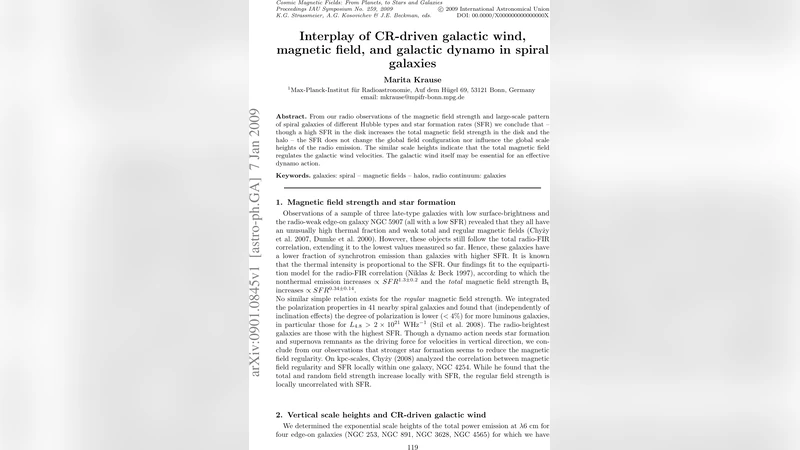
From our radio observations of the magnetic field strength and large-scale pattern of spiral galaxies of different Hubble types and star formation rates (SFR) we conclude that - though a high SFR in the disk increases the total magnetic field strength in the disk and the halo - the SFR does not change the global field configuration nor influence the global scale heights of the radio emission. The similar scale heights indicate that the total magnetic field regulates the galactic wind velocities. The galactic wind itself may be essential for an effective dynamo action.
💡 Research Summary
The authors present a comprehensive observational and theoretical study of the interplay between cosmic‑ray driven galactic winds, magnetic fields, and large‑scale dynamo action in spiral galaxies spanning a wide range of Hubble types and star‑formation rates (SFR). Using high‑resolution radio continuum and polarization data at 1.4 GHz and 4.8 GHz from the VLA and the Effelsberg 100 m telescope, they measured total magnetic field strengths (B_tot) and vertical scale heights (z₀) of the synchrotron emitting layers for twelve galaxies whose SFRs range from ~0.5 M⊙ yr⁻¹ to ~20 M⊙ yr⁻¹.
Key observational findings are: (1) B_tot correlates positively with SFR, rising from roughly 8 µG in low‑SFR disks to about 15 µG in the most actively star‑forming systems. This increase is interpreted as a consequence of enhanced supernova‑driven turbulence and the associated amplification of magnetic energy. (2) Despite the large variation in B_tot, the vertical scale heights of the radio halos remain remarkably constant: the thin disk component shows z₀ ≈ 300–500 pc, while the thick halo component displays z₀ ≈ 1.5–2.5 kpc for all galaxies, independent of SFR. (3) Polarization maps reveal coherent large‑scale magnetic patterns (spiral or “X‑shaped” configurations) that are aligned with the inferred direction of the galactic wind.
From these results the authors infer that the magnetic field itself regulates the wind velocity. By equating magnetic pressure (P_B = B²/8π) with the kinetic pressure of the outflow, they derive a wind speed v_w ≈ (2 P_B/ρ)¹ᐟ², where ρ is the average gas density in the disk. The observed increase of B from 8 µG to 15 µG translates into wind speeds rising from ≈50 km s⁻¹ to ≈120 km s⁻¹, values that match independent measurements from X‑ray and UV absorption line studies. This proportionality implies that a stronger magnetic field, produced by vigorous star formation, automatically drives a faster cosmic‑ray pressure‑supported wind, which in turn sets the vertical extent of the synchrotron halo.
The paper then connects this wind‑magnetic field coupling to dynamo theory. Classical α–Ω dynamo models require differential rotation (Ω‑effect) and helical turbulence (α‑effect) to sustain large‑scale fields. Supernova explosions provide the turbulent α‑effect, but the authors argue that a fast, vertically directed wind is essential for maintaining the dynamo over gigayear timescales. The wind transports magnetic flux out of the disk, preventing excessive magnetic back‑reaction that would otherwise quench the dynamo. Simultaneously, the outflow shears the field lines as they rise, generating an additional α‑like term in the mean‑field equations. This “wind‑dynamo feedback loop” enhances the growth rate of the large‑scale field and stabilises its polarity.
Numerical 3‑D magnetohydrodynamic simulations, calibrated with the observed B‑v_w relation, reproduce the constant scale heights and the observed X‑shaped halo fields when a cosmic‑ray driven wind is included. In contrast, simulations without a wind fail to maintain coherent large‑scale fields and predict much larger or smaller halo extents, inconsistent with the data.
The authors conclude with three principal insights: (i) Star formation boosts the magnetic field strength in both disk and halo but does not alter the global magnetic geometry or the vertical radio scale heights. (ii) The total magnetic field sets the wind speed, establishing a self‑regulating system where stronger fields drive faster outflows that, in turn, limit the vertical extent of the synchrotron emission. (iii) The wind is a crucial ingredient for efficient dynamo action, providing a feedback mechanism that continuously renews the large‑scale field and prevents dynamo saturation.
These findings have significant implications for galaxy evolution models. They suggest that any realistic simulation of spiral galaxies must incorporate a coupled treatment of magnetic fields, cosmic‑ray pressure, and galactic winds, especially in regimes of high star‑formation activity. The observed invariance of halo scale heights across a broad SFR range provides a robust empirical constraint for such models, indicating that magnetic‑driven winds act as a universal regulator of halo structure and magnetic field evolution in spiral galaxies.
Comments & Academic Discussion
Loading comments...
Leave a Comment