Discovery of two distinct red clumps in NGC419: a rare snapshot of a cluster at the onset of degeneracy
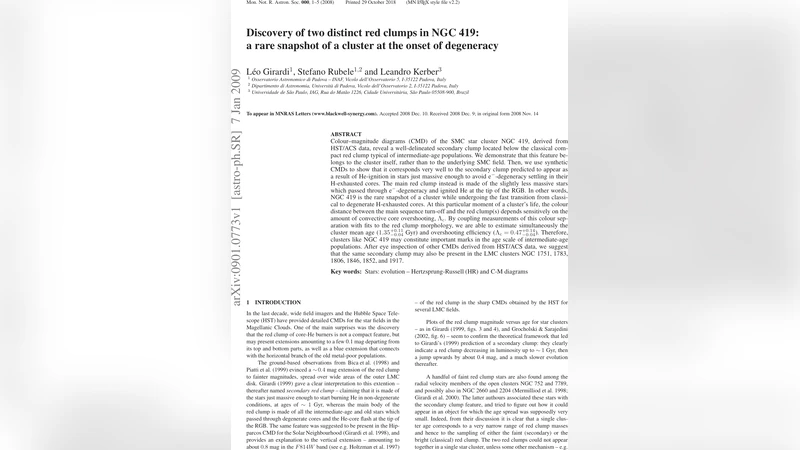
Colour-magnitude diagrams (CMD) of the SMC star cluster NGC419, derived from HST/ACS data, reveal a well-delineated secondary clump located below the classical compact red clump typical of intermediate-age populations. We demonstrate that this feature belongs to the cluster itself, rather than to the underlying SMC field. Then, we use synthetic CMDs to show that it corresponds very well to the secondary clump predicted to appear as a result of He-ignition in stars just massive enough to avoid electron-degeneracy settling in their H-exhausted cores. The main red clump instead is made of the slightly less massive stars which passed through electron-degeneracy and ignited He at the tip of the RGB. In other words, NGC419 is the rare snapshot of a cluster while undergoing the fast transition from classical to degenerate H-exhausted cores. At this particular moment of a cluster’s life, the colour distance between the main sequence turn-off and the red clump(s) depends sensitively on the amount of convective core overshooting, Lambda_c. By coupling measurements of this colour separation with fits to the red clump morphology, we are able to estimate simultaneously the cluster mean age (1.35(-0.04,+0.11) Gyr) and overshooting efficiency (Lambda_c=0.47(-0.04,+0.14)). Therefore, clusters like NGC419 may constitute important marks in the age scale of intermediate-age populations. After eye inspection of other CMDs derived from HST/ACS data, we suggest that the same secondary clump may also be present in the LMC clusters NGC1751, 1783, 1806, 1846, 1852, and 1917.
💡 Research Summary
The authors present a detailed study of the Small Magellanic Cloud (SMC) star cluster NGC 419 using high‑quality photometry from the Hubble Space Telescope’s Advanced Camera for Surveys (ACS). By constructing a precise colour‑magnitude diagram (CMD), they identify not only the classic compact red clump (RC) that marks core‑helium burning in intermediate‑age populations, but also a well‑defined secondary clump situated roughly 0.4 mag fainter. Careful spatial and density analyses demonstrate that this secondary feature is intrinsic to the cluster rather than a contaminating field population.
The existence of two distinct RCs is interpreted in the framework of stellar evolution theory. Stars just massive enough to avoid electron‑degeneracy in their hydrogen‑exhausted cores (≈1.8 M⊙) ignite helium while still on the red‑giant branch, producing a fainter, more compact clump. Slightly less massive stars (≈1.7 M⊙) develop a degenerate core, ascend to the tip of the red‑giant branch, undergo the helium flash, and then settle into the brighter, canonical red clump. NGC 419 is caught at the brief evolutionary moment when both groups coexist, which theoretical models predict to occur at an age of about 1.3 Gyr.
A central goal of the paper is to exploit this rare configuration to break the degeneracy between cluster age and the efficiency of convective core overshooting (parameterised by Λc). The colour separation between the main‑sequence turn‑off (MSTO) and the RCs is highly sensitive to Λc: larger overshooting extends the core, lengthens the main‑sequence lifetime, and shifts the MSTO to redder, brighter colours. The authors generate synthetic CMDs spanning a grid of ages (1.2–1.5 Gyr) and overshooting values (Λc = 0.2–0.6), and compare them with the observed morphology of both clumps and the MSTO‑RC colour gap. The best‑fit solution yields a mean cluster age of 1.35 Gyr (−0.04 + 0.11 Gyr) and an overshooting efficiency of Λc = 0.47 (−0.04 + 0.14), notably higher than the Λc≈0.2–0.3 commonly assumed for intermediate‑age populations.
Beyond NGC 419, the authors perform a visual inspection of ACS CMDs for several Large Magellanic Cloud (LMC) clusters (NGC 1751, 1783, 1806, 1846, 1852, and 1917) and find suggestive evidence of similar secondary clumps. This implies that the double‑RC phenomenon may be a relatively common marker for clusters in the narrow age window of ≈1.2–1.5 Gyr.
The study delivers two major contributions. First, it demonstrates that the simultaneous presence of a primary and secondary red clump provides a powerful diagnostic to determine both age and convective overshooting in a single step, overcoming the limitations of traditional MSTO‑RC analyses. Second, it offers a direct observational confirmation of the theoretical transition from non‑degenerate to degenerate helium ignition, furnishing a stringent test of stellar interior physics. Consequently, clusters exhibiting double red clumps can serve as crucial calibrators for the age scale of intermediate‑age stellar populations and for refining models of core mixing processes.
Comments & Academic Discussion
Loading comments...
Leave a Comment