Magnetic pinch-type instability in stellar radiative zones
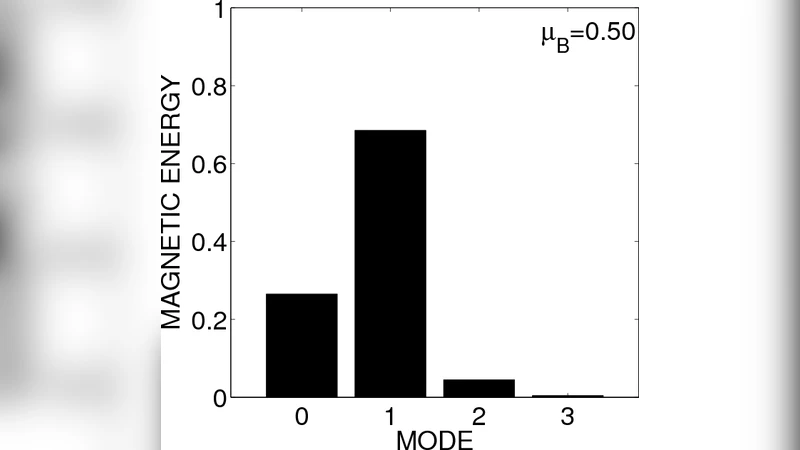
The solar tachocline is shown as hydrodynamically stable against nonaxisymmetric disturbances if it is true that no cos^{4}\theta term exists in its rotation law. We also show that the toroidal field of 200 Gauss amplitude which produces the tachocline in the magnetic theory of Ruediger & Kitchatinov (1997) is stable against nonaxisymmetric MHD disturbances – but it becomes unstable for rotation periods slightly slower than 25 days. The instability of such weak fields lives from the high thermal diffusivity of stellar radiation zones compared with the magnetic diffusivity. The growth times, however, result as very long (of order of 10^5 rotation times). With estimations of the chemical mixing we find the maximal possible field amplitude to be ~500 Gauss in order to explain the observed lithium abundance of the Sun. Dynamos with such low field amplitudes should not be relevant for the solar activity cycle. With nonlinear simulations of MHD Taylor-Couette flows it is shown that for the rotation-dominated magnetic instability the resulting eddy viscosity is only of the order of the molecular viscosity. The Schmidt number as the ratio of viscosity and chemical diffusion grows to values of ~20. For the majority of the stellar physics applications, the magnetic-dominated Tayler instability will be quenched by the stellar rotation.
💡 Research Summary
The paper investigates the stability of the solar tachocline and the magnetic pinch‑type (Tayler) instability in stellar radiative zones, focusing on how rotation and weak toroidal magnetic fields interact to produce or suppress non‑axisymmetric disturbances.
First, the authors examine the hydrodynamic stability of the tachocline using a rotation law of the form ω(θ)=Ω₀(1‑a cos²θ‑b cos⁴θ). By setting the higher‑order term b to zero—consistent with helioseismic observations—they perform a linear stability analysis for azimuthal wave numbers m=0 and m=1. The result is that, for realistic values of the differential rotation parameter a (≈0.2), all modes are damped; the tachocline is therefore hydrodynamically stable against non‑axisymmetric perturbations as long as the cos⁴θ contribution is absent.
Next, the magnetic aspect is addressed. Building on the magnetic tachocline model of Rüdiger & Kitchatinov (1997), a toroidal field of about 200 G is assumed to be present in the tachocline. Linear magnetohydrodynamic (MHD) stability calculations reveal that this field remains stable for a solar rotation period of 25 days, but becomes unstable for slightly longer periods. The instability is of the pinch‑type (Tayler) with azimuthal mode m=1. Crucially, the growth rate is governed by the enormous disparity between thermal diffusivity (χ) and magnetic diffusivity (η) in radiative zones. Because χ≫η, the instability grows on a timescale of roughly 10⁵ rotation periods, i.e., it is extremely slow compared with dynamical processes.
The authors then connect the instability to chemical mixing, particularly the observed lithium abundance in the solar photosphere. Lithium is destroyed on a timescale of a few million years, so any mixing that would deplete it faster than observed must be limited. By estimating the turbulent viscosity (ν_t) and turbulent chemical diffusivity (D_t) produced by the instability, they find ν_t≈ν (the molecular viscosity) and D_t≈ν_t/20, giving a Schmidt number Sc≈20. This low level of mixing implies that the toroidal field cannot exceed about 500 G; stronger fields would generate excessive mixing and contradict the lithium constraint.
To explore the nonlinear regime, the paper presents three‑dimensional MHD simulations of Taylor‑Couette flow with imposed toroidal fields. The simulations confirm that when rotation dominates (Ω/Ω_A>1, where Ω_A is the Alfvén frequency), the growth of the Tayler instability is strongly quenched. In this rotation‑dominated regime the resulting eddy viscosity remains of order the molecular value, and the Schmidt number stays near 20. Conversely, in the magnetic‑dominated regime (Ω/Ω_A<1) the instability can develop, but its growth remains slow because of the high thermal diffusivity.
The key implications are:
- The solar tachocline is hydrodynamically stable provided its rotation law lacks a cos⁴θ term, which is supported by helioseismic data.
- Weak toroidal fields (200–500 G) can become marginally unstable only for rotation periods slightly longer than the current solar value; the instability grows on timescales of ~10⁵ rotations, making it dynamically insignificant for most stellar processes.
- The associated turbulent mixing is modest (Sc≈20), allowing the observed lithium abundance to be preserved; this sets an upper limit on the internal toroidal field strength.
- In the presence of realistic solar rotation, the Tayler instability is largely suppressed, so it cannot be the primary driver of the solar activity cycle. Dynamo models that rely on such weak fields are therefore unlikely to explain the 11‑year cycle.
- For most stellar‑physics applications, the magnetic‑dominated Tayler instability will be quenched by rotation, implying that radiative‑zone dynamos, if they exist, must operate under conditions very different from those considered here.
Overall, the study combines linear stability theory, analytical estimates of chemical mixing, and fully nonlinear MHD simulations to delineate the parameter space where magnetic pinch‑type instabilities can exist in stellar interiors, and it demonstrates that realistic solar rotation and diffusivity values keep these instabilities weak, slow, and largely irrelevant for the solar dynamo while still providing useful constraints on internal magnetic field strengths.
Comments & Academic Discussion
Loading comments...
Leave a Comment