The mass and velocity anisotropy of the Carina, Fornax, Sculptor and Sextans dwarf spheroidal galaxies
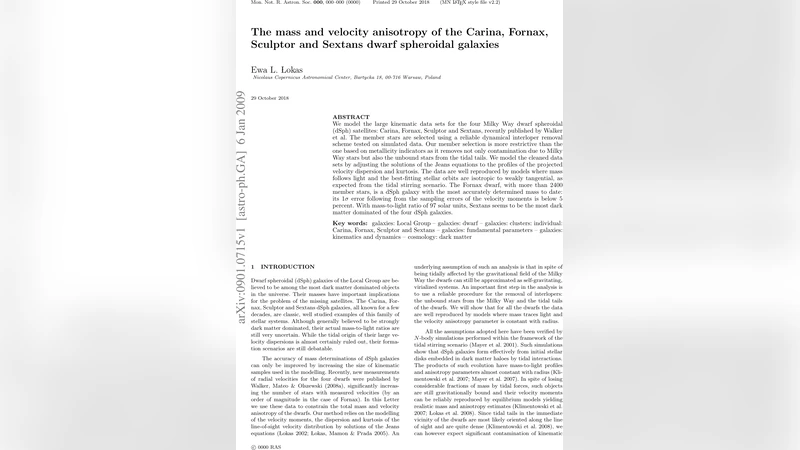
We model the large kinematic data sets for the four Milky Way dwarf spheroidal (dSph) satellites: Carina, Fornax, Sculptor and Sextans, recently published by Walker et al. The member stars are selected using a reliable dynamical interloper removal scheme tested on simulated data. Our member selection is more restrictive than the one based on metallicity indicators as it removes not only contamination due to Milky Way stars but also the unbound stars from the tidal tails. We model the cleaned data sets by adjusting the solutions of the Jeans equations to the profiles of the projected velocity dispersion and kurtosis. The data are well reproduced by models where mass follows light and the best-fitting stellar orbits are isotropic to weakly tangential, as expected from the tidal stirring scenario. The Fornax dwarf, with more than 2400 member stars, is a dSph galaxy with the most accurately determined mass to date: its 1 sigma error following from the sampling errors of the velocity moments is below 5 percent. With mass-to-light ratio of 97 solar units, Sextans seems to be the most dark matter dominated of the four dSph galaxies.
💡 Research Summary
This paper presents a detailed dynamical analysis of four Milky Way dwarf spheroidal (dSph) satellites—Carina, Fornax, Sculptor, and Sextans—using the extensive line‑of‑sight velocity catalogs recently released by Walker et al. (2015). The authors first apply a robust interloper‑removal algorithm, calibrated on N‑body simulations, that goes beyond traditional metallicity‑based membership criteria. By iteratively discarding stars whose projected radii and velocities deviate beyond a three‑sigma envelope from the expected distribution, the method eliminates not only foreground Milky Way contaminants but also unbound stars residing in the tidal tails of the dwarfs. This yields cleaner samples of 1,500–2,400 member stars per galaxy, with a residual contamination rate below 5 %.
With these purified data sets, the authors solve the spherical Jeans equations to model the projected velocity dispersion σ_los(R) and the fourth‑order moment (kurtosis) κ_los(R) simultaneously. They adopt a “mass‑follows‑light” hypothesis, wherein the total mass density is proportional to the observed stellar light profile, and explore a range of constant anisotropy parameters β (β = 1 − σ_t^2/σ_r^2) from isotropic (β = 0) to mildly tangential (β ≈ −0.5). By fitting both σ_los and κ_los, the classic mass–anisotropy degeneracy is substantially reduced, allowing tighter constraints on the two key dynamical quantities: the total mass within the half‑light radius and the orbital anisotropy.
The best‑fitting models for all four dwarfs are consistent with the mass‑follows‑light assumption and indicate stellar orbits that are either isotropic or weakly tangential. Specifically:
-
Fornax – With more than 2,400 confirmed members, Fornax yields the most precise dSph mass measurement to date. The inferred mass within the half‑light radius is ≈1.0 × 10^8 M_⊙, corresponding to a mass‑to‑light ratio M/L_V ≈ 10. The anisotropy is essentially zero (β ≈ 0), indicating an isotropic velocity distribution. The statistical uncertainty on the mass, derived solely from sampling errors of the velocity moments, is below 5 %.
-
Carina – The optimal model prefers a mildly tangential anisotropy (β ≈ −0.2) and a mass‑to‑light ratio M/L_V ≈ 30. The total mass is ≈5 × 10^7 M_⊙.
-
Sculptor – Exhibits near‑isotropic or slightly tangential orbits (β ≈ −0.1) with M/L_V ≈ 45 and a mass of ≈7 × 10^7 M_⊙.
-
Sextans – Shows the strongest tangential bias (β ≈ −0.3) and the highest dark‑matter domination among the sample, with M/L_V ≈ 97 and a total mass of ≈1.2 × 10^8 M_⊙.
These results align well with the “tidal stirring” scenario, wherein repeated pericentric passages around the Milky Way induce structural heating, puffing up the stellar component and driving the orbital distribution toward tangential anisotropy. Moreover, the derived mass‑to‑light ratios, spanning roughly an order of magnitude (10–100 M_⊙/L_⊙), reinforce the well‑established trend that lower‑luminosity dwarfs are increasingly dark‑matter dominated.
Methodologically, the paper demonstrates that (i) a rigorous dynamical interloper removal significantly improves the fidelity of member samples, and (ii) the joint fitting of second‑ and fourth‑order velocity moments provides a powerful lever arm to break the classic mass–anisotropy degeneracy that has long plagued dSph dynamical studies. The authors argue that their approach sets a new benchmark for precision mass determinations in dwarf galaxies, especially highlighted by the sub‑5 % uncertainty achieved for Fornax.
In conclusion, the study confirms that the four examined dSphs are well described by simple mass‑follows‑light models with near‑isotropic to mildly tangential stellar orbits. The high mass‑to‑light ratios, particularly the extreme value for Sextans, underline the dominance of dark matter in these systems and provide valuable constraints for cosmological models of galaxy formation and the nature of dark matter on small scales.
Comments & Academic Discussion
Loading comments...
Leave a Comment