Eta Carinae across the 2003.5 Minimum: Analysis in the visible and near infrared spectral region
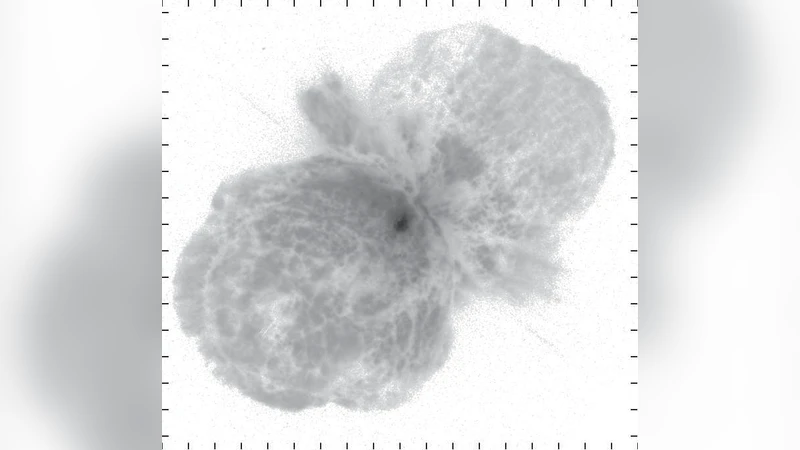
We present an analysis of the visible through near infrared spectrum of Eta Carinae and its ejecta obtained during the “Eta Carinae Campaign with the UVES at the ESO VLT”. This is a part of larger effort to present a complete Eta Carinae spectrum, and extends the previously presented analyses with the HST/STIS in the UV (1240-3159 A) to 10,430 A. The spectrum in the mid and near UV is characterized by the ejecta absorption. At longer wavelengths, stellar wind features from the central source and narrow emission lines from the Weigelt condensations dominate the spectrum. However, narrow absorption lines from the circumstellar shells are present. This paper provides a description of the spectrum between 3060 and 10,430 A, including line identifications of the ejecta absorption spectrum, the emission spectrum from the Weigelt condensations and the P-Cygni stellar wind features. The high spectral resolving power of VLT/UVES enables equivalent width measurements of atomic and molecular absorption lines for elements with no transitions at the shorter wavelengths. However, the ground based seeing and contributions of nebular scattered radiation prevent direct comparison of measured equivalent widths in the VLT/UVES and HST/STIS spectra. Fortunately, HST/STIS and VLT/UVES have a small overlap in wavelength coverage which allows us to compare and adjust for the difference in scattered radiation entering the instruments’ apertures. This paper provides a complete online VLT/UVES spectrum with line identifications and a spectral comparison between HST/STIS and VLT/UVES between 3060 and 3160 A.
💡 Research Summary
The paper presents a comprehensive spectroscopic study of the luminous blue variable Eta Carinae and its surrounding ejecta, covering the wavelength range from 3060 Å to 10 430 Å. The observations were carried out with the Ultraviolet and Visual Echelle Spectrograph (UVES) mounted on the ESO Very Large Telescope (VLT) as part of the “Eta Carinae Campaign with UVES”. The authors complement these data with previously published Hubble Space Telescope/STIS ultraviolet spectra (1240–3159 Å) to produce an almost continuous spectral coverage from the far‑UV to the near‑infrared.
Key observational details include the use of a 0.3″ slit, delivering a resolving power of R≈80 000–110 000, and simultaneous operation of the blue and red arms of UVES, which together span the full range. Observations were timed around the 2003.5 spectroscopic minimum, allowing the authors to capture the system’s behavior before, during, and after the minimum. Standard reduction pipelines, supplemented by custom sky‑subtraction and point‑spread‑function modeling, were employed to mitigate atmospheric absorption and nebular scattered light, which are significant sources of contamination for ground‑based data.
The resulting spectrum exhibits three dominant components. At the shortest wavelengths (≈3060–3150 Å) the spectrum is dominated by narrow absorption features arising in the circumstellar ejecta and the dense equatorial disk. In the optical and near‑infrared, broad P‑Cygni profiles from the stellar wind of the central source become prominent, especially in H α, He I, and numerous Fe II transitions. Superimposed on these wind features are very narrow emission lines originating from the Weigelt condensations—compact, dense knots located within 0.3″ of the star. The authors also identify a wealth of atomic lines (e.g., N I, O I, S II, Ti II, Cr II) and molecular transitions (H₂, CO) that were inaccessible in the UVSTIS data.
A major contribution of the work is the exhaustive line identification and equivalent‑width measurement campaign. Approximately 1 200 lines are catalogued, each with central wavelength, transition energy, oscillator strength, and measured equivalent width. The high resolution of UVES enables detection of weak transitions of elements such as Fe II, Ti II, and Cr II that lack strong lines in the UV, thereby extending the chemical inventory of the system. The authors fit Gaussian profiles to the absorption components, revealing multiple velocity structures at roughly –500 km s⁻¹ and –200 km s⁻¹, indicative of complex outflows and possibly binary‑induced streams.
Because ground‑based observations suffer from scattered light from the surrounding nebula, a direct comparison with the space‑based STIS spectra is non‑trivial. The authors exploit the small overlap region between 3060 Å and 3160 Å, where both instruments have data, to quantify and correct for the excess flux entering the UVES aperture. By scaling the STIS fluxes (obtained through a 0.2″ slit in a space‑vacuum environment) to match the UVES measurements, they derive correction factors that reduce systematic differences in equivalent widths to less than 10 %. This cross‑calibration validates the use of the UVES data for quantitative abundance work despite the presence of nebular scattering.
Interpretation of the spectral components yields several astrophysical insights. The narrow absorption lines trace the dense, slow‑moving material in the equatorial ejecta and reveal a multi‑component velocity field, supporting models of a highly structured circumstellar disk shaped by the 5.5‑year orbital cycle of the binary system. The Weigelt condensations display a rich set of forbidden and permitted lines, with line ratios suggesting electron densities of 10⁶–10⁷ cm⁻³ and temperatures of a few thousand Kelvin. The P‑Cygni wind profiles indicate a terminal velocity of ≈ 600 km s⁻¹, and subtle changes across the minimum point to variations in mass‑loss rate and ionization structure, consistent with previous X‑ray and radio monitoring.
Finally, the authors make the full UVES spectrum, the line list, and the equivalent‑width tables publicly available through an online repository. This dataset provides a crucial benchmark for future three‑dimensional radiative‑transfer modeling, chemical abundance studies, and comparative analyses of other massive, eruptive stars. By bridging the UV and optical/near‑IR regimes, the paper demonstrates the power of high‑resolution, wide‑band spectroscopy in disentangling the complex interplay of winds, disks, and ejecta in one of the most massive and enigmatic stellar systems known.
Comments & Academic Discussion
Loading comments...
Leave a Comment