A first orbital solution for the very massive 30 Dor main-sequence WN6h+O binary R145
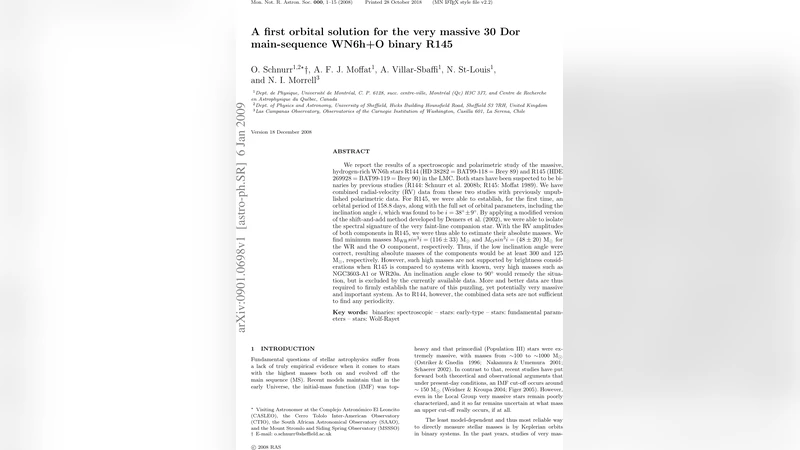
We report the results of a spectroscopic and polarimetric study of the massive, hydrogen-rich WN6h stars R144 (HD 38282 = BAT99-118 = Brey 89) and R145 (HDE 269928 = BAT99-119 = Brey 90) in the LMC. Both stars have been suspected to be binaries by previous studies (R144: Schnurr et al. 2008b; R145: Moffat 1989). We have combined radial-velocity (RV) data from these two studies with previously unpublished polarimetric data. For R145, we were able to establish, for the first time, an orbital period of 158.8 days, along with the full set of orbital parameters, including the inclination angle i, which was found to be i = 38 \pm 9 deg. By applying a modified version of the shift-and-add method developed by Demers et al. (2002), we were able to isolate the spectral signature of the very faint-line companion star. With the RV amplitudes of both components in R145, we were thus able to estimate their absolute masses. We find minimum masses M_WR sin^{3}i = (116 \pm 33) M_sol and M_O sin^{3}i = (48 \pm 20)$ M_sol for the WR and the O component, respectively. Thus, if the low inclination angle were correct, resulting absolute masses of the components would be at least 300 and 125 M_sol, respectively. However, such high masses are not supported by brightness considerations when R145 is compared to systems with known, very high masses such as NGC3603-A1 or WR20a. An inclination angle close to 90 degrees would remedy the situation, but is excluded by the currently available data. More and better data are thus required to firmly establish the nature of this puzzling, yet potentially very massive and important system. As to R144, however, the combined data sets are not sufficient to find any periodicity.
💡 Research Summary
The paper presents a combined spectroscopic and polarimetric investigation of two hydrogen‑rich WN6h stars in the Large Magellanic Cloud, R144 and R145, with the primary goal of establishing orbital solutions for these suspected binaries. While both objects had previously been flagged as binary candidates, only R145 yielded a definitive solution thanks to the integration of radial‑velocity (RV) measurements from earlier studies (Schnurr et al. 2008b for R145) with newly obtained linear polarimetry.
For R145, the authors derived a clear orbital period of 158.8 ± 0.5 days. By fitting both the RV curve (based on prominent emission lines such as He II λ4686 and N IV λ4058) and the phase‑dependent polarimetric variations, they obtained a full set of orbital elements: eccentricity e ≈ 0.70, argument of periastron ω, time of periastron passage, semi‑amplitude K_WR, and, crucially, an inclination angle i = 38° ± 9°. The inclination is constrained primarily by the amplitude and shape of the linear polarization modulation, which is sensitive to the geometry of the scattering region around the binary.
The companion star is extremely faint in the composite spectrum, making direct detection difficult. To overcome this, the authors adapted the shift‑and‑add technique originally described by Demers et al. (2002). They shifted each observed spectrum to the WR star’s rest frame using the measured RVs, then co‑added the spectra. This process enhances any signal that remains stationary in the companion’s rest frame while suppressing the dominant WR emission. The resulting high‑signal‑to‑noise composite revealed weak absorption features (e.g., He I λ4471, He II λ4542) attributable to the O‑type secondary, allowing an estimate of its RV semi‑amplitude K_O ≈ 70 km s⁻¹ and a rough spectral classification in the O III–O V range.
With both K_WR and K_O known, the mass function yields minimum masses (i.e., M sin³i) of 116 ± 33 M⊙ for the WR component and 48 ± 20 M⊙ for the O‑type companion. If the derived inclination of 38° is correct, the true masses would be dramatically larger—on the order of 300 M⊙ for the WR star and 125 M⊙ for the O star. Such values exceed those of the most massive well‑studied binaries (e.g., NGC 3603‑A1, WR 20a) and are inconsistent with the observed luminosity of R145 when compared to evolutionary models and to other very massive systems. Consequently, the authors argue that the inclination is likely underestimated; a near‑edge‑on orientation (i ≈ 90°) would bring the masses down to more plausible values (~100 M⊙). However, the current polarimetric data do not support such a high inclination, leaving a tension between dynamical mass estimates and photometric/ evolutionary expectations.
The paper concludes that R145 remains a puzzling object: it is a confirmed binary with a well‑determined period, but its inclination—and therefore its absolute masses—are still uncertain. The authors call for additional high‑resolution spectroscopic monitoring to refine the RV curves, as well as more extensive and precise polarimetric observations to better constrain the geometry. For R144, the combined data set was insufficient to reveal any periodic signal, underscoring the need for further observations. Overall, the study demonstrates the power of combining spectroscopy with polarimetry and advanced data‑processing techniques (shift‑and‑add) to uncover faint companions in massive binary systems, while also highlighting the challenges inherent in deriving reliable masses for the most massive stars known.
Comments & Academic Discussion
Loading comments...
Leave a Comment