Empirical chemical stratifications in magnetic Ap stars: questions of uniqueness
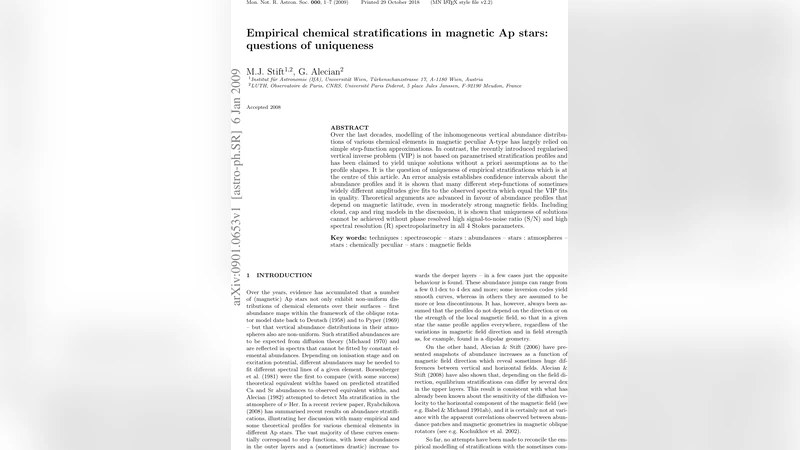
Over the last decades, modelling of the inhomogeneous vertical abundance distributions of various chemical elements in magnetic peculiar A-type has largely relied on simple step-function approximations. In contrast, the recently introduced regularised vertical inverse problem (VIP) is not based on parametrised stratification profiles and has been claimed to yield unique solutions without a priori assumptions as to the profile shapes. It is the question of uniqueness of empirical stratifications which is at the centre of this article. An error analysis establishes confidence intervals about the abundance profiles and it is shown that many different step-functions of sometimes widely different amplitudes give fits to the observed spectra which equal the VIP fits in quality. Theoretical arguments are advanced in favour of abundance profiles that depend on magnetic latitude, even in moderately strong magnetic fields. Including cloud, cap and ring models in the discussion, it is shown that uniqueness of solutions cannot be achieved without phase resolved high signal-to-noise ratio (S/N) and high spectral resolution (R) spectropolarimetry in all 4 Stokes parameters.
💡 Research Summary
The paper addresses the long‑standing problem of determining vertical chemical abundance stratifications in magnetic Ap stars and questions the claimed uniqueness of solutions obtained with the regularised vertical inverse problem (VIP). Historically, stratifications have been modelled with simple step‑function profiles, characterised by a few parameters (depth of the jump, amplitude, and width). While convenient, such parametrisations ignore the complex interplay between magnetic fields and atomic diffusion that can produce latitude‑dependent abundance structures. The VIP method, introduced recently, avoids any a priori functional form by solving an ill‑posed inverse problem with a regularisation term that suppresses spurious oscillations.
Using high‑resolution (R≈120 000), high‑signal‑to‑noise (S/N≈400) spectra of two well‑studied Ap stars, the authors first apply VIP to retrieve continuous abundance profiles for several elements. They then perform a bootstrap error analysis, constructing 1σ confidence intervals around the retrieved profiles. Within these intervals, they generate a large ensemble of step‑function models with widely varying amplitudes, depths, and transition widths. Synthetic spectra computed from each model are compared to the observations, and the resulting χ² values are found to be statistically indistinguishable from those of the VIP fits. This demonstrates that the observational data alone cannot discriminate between a unique continuous profile and a multitude of step‑function alternatives.
The authors further argue, on theoretical grounds, that even moderate magnetic fields (∼1–2 kG) should induce anisotropic diffusion, leading to abundance variations with magnetic latitude. To explore this, they construct three‑dimensional “cloud”, “cap”, and “ring” models in which the abundance enhancement is confined to specific magnetic latitudes. When synthetic Stokes I spectra are examined, these models also reproduce the observed line profiles with comparable quality. However, the differences become apparent only when full Stokes (I, Q, U, V) spectropolarimetry is considered, especially if the observations are phase‑resolved.
Consequently, the paper concludes that the uniqueness of empirical stratifications cannot be claimed without phase‑resolved, high‑resolution, high‑S/N spectropolarimetric data in all four Stokes parameters. Only under such stringent observational conditions can the VIP method be validated against alternative parametrisations and latitude‑dependent models, allowing a reliable reconstruction of the true vertical chemical structure in magnetic Ap stars.
Comments & Academic Discussion
Loading comments...
Leave a Comment