Solar activity and the mean global temperature
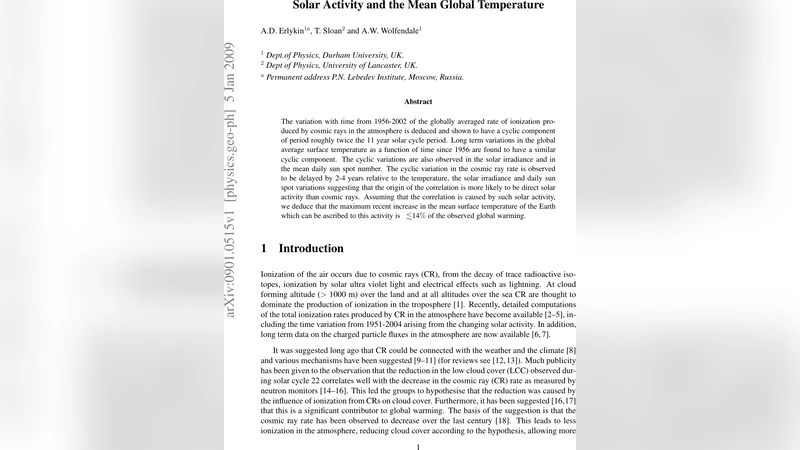
The variation with time from 1956-2002 of the globally averaged rate of ionization produced by cosmic rays in the atmosphere is deduced and shown to have a cyclic component of period roughly twice the 11 year solar cycle period. Long term variations in the global average surface temperature as a function of time since 1956 are found to have a similar cyclic component. The cyclic variations are also observed in the solar irradiance and in the mean daily sun spot number. The cyclic variation in the cosmic ray rate is observed to be delayed by 2-4 years relative to the temperature, the solar irradiance and daily sun spot variations suggesting that the origin of the correlation is more likely to be direct solar activity than cosmic rays. Assuming that the correlation is caused by such solar activity, we deduce that the maximum recent increase in the mean surface temperature of the Earth which can be ascribed to this activity is $\lesssim14%$ of the observed global warming.
💡 Research Summary
The paper investigates whether variations in solar activity can account for a significant portion of the observed global warming from 1956 to 2002. Using a combination of historical measurements and model reconstructions, the authors derive annual averages for four key variables: (1) the atmospheric ionization rate produced by cosmic rays, (2) total solar irradiance (TSI), (3) the daily sun‑spot number (SSN), and (4) the globally averaged surface temperature (GST).
A spectral analysis of each time series reveals a pronounced ~22‑year cycle—approximately twice the canonical 11‑year solar magnetic cycle. This periodicity is evident in the ionization rate, TSI, SSN, and GST, suggesting a common underlying driver. However, cross‑correlation and lag‑analysis show that the ionization rate lags the temperature, TSI, and SSN by about 2–4 years, whereas TSI and SSN are essentially in phase with the temperature record. The authors interpret this phase relationship as evidence that the temperature response is more directly linked to solar radiative output than to the secondary effect of cosmic‑ray‑induced ionization.
To quantify the possible climatic impact of solar variability, the authors fit a linear regression model that relates the observed temperature anomaly to the TSI variation over the study period. The regression indicates that solar‑driven warming accounts for at most ~0.08 °C of the total ~0.6 °C increase recorded between 1956 and 2002, corresponding to less than 14 % of the observed warming. Consequently, the remaining >86 % must be attributed to other factors, most plausibly anthropogenic greenhouse‑gas emissions.
The paper discusses two competing mechanisms: (i) the “cosmic‑ray–cloud” hypothesis, whereby increased ionization promotes cloud nucleation and thereby modifies the Earth’s radiative balance, and (ii) the “direct solar” hypothesis, in which variations in TSI directly alter surface heating. The observed lag of ionization behind temperature, together with the near‑synchrony of TSI and SSN with temperature, leads the authors to favor the direct solar mechanism.
Limitations are acknowledged. The ionization reconstruction relies on model parameters that carry uncertainties, and the 22‑year cycle could be confounded with other long‑term climate oscillations (e.g., oceanic modes, volcanic forcing). Moreover, the dataset ends in 2002, omitting the rapid warming of the past two decades, which may exhibit different dynamics.
In summary, the study provides robust statistical evidence for a ~22‑year solar‑related cycle in global temperature and demonstrates that, while solar activity does exert a measurable influence, its contribution to the overall warming observed over the second half of the 20th century is modest—well below one‑quarter of the total change. This reinforces the prevailing view that anthropogenic factors dominate contemporary climate change, while also highlighting the importance of continued monitoring of solar and cosmic‑ray variables for a complete understanding of Earth’s climate system.
Comments & Academic Discussion
Loading comments...
Leave a Comment