Physical collisions of moonlets and clumps with the Saturns F-ring core
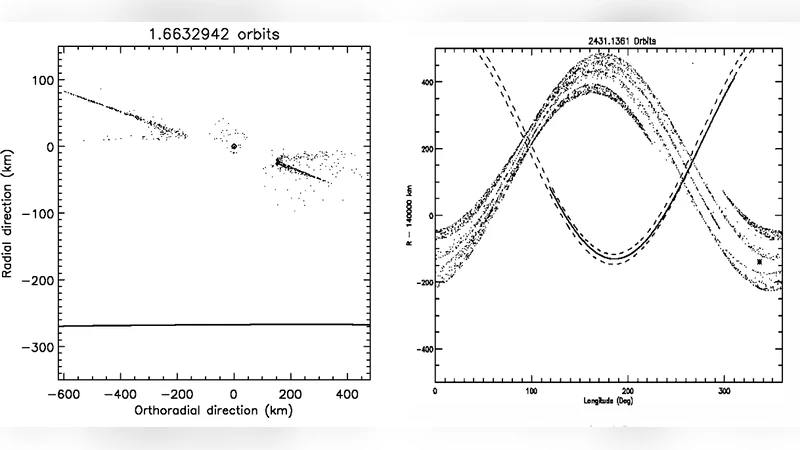
Since 2004, observations of Saturn’s F ring have revealed that the ring’s core is surrounded by structures with radial scales of hundreds of kilometers, called “spirals” and “jets”. Gravitational scattering by nearby moons was suggested as a potential production mechanism; however, it remained doubtful because a population of Prometheus-mass moons is needed and, obviously, such a population does not exist in the F ring region. We investigate here another mechanism: dissipative physical collisions of kilometer-size moonlets (or clumps) with the F-ring core. We show that it is a viable and efficient mechanism for producing spirals and jets, provided that massive moonlets are embedded in the F-ring core and that they are impacted by loose clumps orbiting in the F ring region, which could be consistent with recent data from ISS, VIMS and UVIS. We show also that coefficients of restitution as low as ~0.1 are needed to reproduce the radial extent of spirals and jets, suggesting that collisions are very dissipative in the F ring region. In conclusion, spirals and jets would be the direct manifestation the ongoing collisional activity of the F ring region.
💡 Research Summary
The paper tackles the long‑standing puzzle of the large‑scale radial structures—commonly called “spirals” and “jets”—that have been observed surrounding the core of Saturn’s F ring since the Cassini era. Earlier explanations invoked gravitational scattering by nearby moons, especially Prometheus, but such models required an unrealistically large population of Prometheus‑mass bodies embedded in the ring region, a population that has never been detected. To resolve this discrepancy, the authors propose a fundamentally different mechanism: dissipative physical collisions between kilometer‑scale moonlets (or dense clumps) that are embedded within the F‑ring core and loosely bound clumps that orbit in the surrounding F‑ring environment.
The authors first synthesize recent observational evidence from the Imaging Science Subsystem (ISS), the Visual and Infrared Mapping Spectrometer (VIMS), and the Ultraviolet Imaging Spectrograph (UVIS). These data sets collectively indicate that the F ring contains a population of small, loosely bound aggregates (clumps) that drift on slightly different semi‑major axes and eccentricities than the dense core. Simultaneously, high‑resolution imaging suggests the presence of compact, kilometer‑scale moonlets embedded in the core itself. The paper treats these two populations as the primary actors in a collisional cascade.
Using a combination of N‑body simulations and analytical collision dynamics, the authors explore the outcome of an impact between a moonlet and a passing clump. The key parameter governing the post‑impact morphology is the coefficient of restitution (e). By varying e from near‑elastic (e≈0.9) down to highly inelastic values, they find that only when e is as low as ~0.1 does the resulting debris cloud spread radially to the observed distances of 200–300 km from the core. In such low‑e collisions, the majority of the kinetic energy is dissipated as heat and internal deformation, leaving the fragments to follow low‑energy, nearly ballistic trajectories that form the characteristic spiral‑like arms and jet‑like ejecta.
The simulations further reveal that the frequency of such collisions depends on the spatial density of clumps, their mass distribution (typically 10⁴–10⁵ kg), and the number of embedded moonlets (10⁶–10⁷ kg). For plausible values derived from Cassini observations, the model predicts tens of collisions per year, sufficient to sustain the observed population of spirals and jets over the multi‑year timescales of Cassini’s mission. Moreover, the authors argue that the debris generated by each impact does not simply disperse; a fraction re‑accretes onto the core, while another fraction seeds new clumps, establishing a feedback loop that continuously refreshes the small‑scale structure of the F ring.
A crucial aspect of the study is the physical plausibility of the required low restitution coefficient. Laboratory experiments on icy particle collisions at temperatures comparable to those in Saturn’s rings (≈100 K) routinely report e values in the range 0.05–0.15, reflecting the high porosity and low shear strength of water‑ice aggregates. This agreement lends strong support to the authors’ claim that collisions in the F ring are highly dissipative.
In conclusion, the paper demonstrates that the spirals and jets are not passive signatures of distant gravitational perturbations but are the direct, observable consequences of ongoing collisional activity within the F‑ring system. The proposed mechanism simultaneously accounts for the radial extent, morphology, and temporal variability of the structures, while remaining consistent with independent measurements of particle composition and mechanical properties. The authors suggest that future work should focus on quantifying the size‑distribution evolution of the debris, investigating the role of electrostatic forces, and correlating the collisional model with radio occultation data to further validate the collisional origin of F‑ring fine structure.
Comments & Academic Discussion
Loading comments...
Leave a Comment