Keck spectroscopic survey of strongly lensed galaxies in Abell 1703: further evidence for a relaxed, unimodal cluster
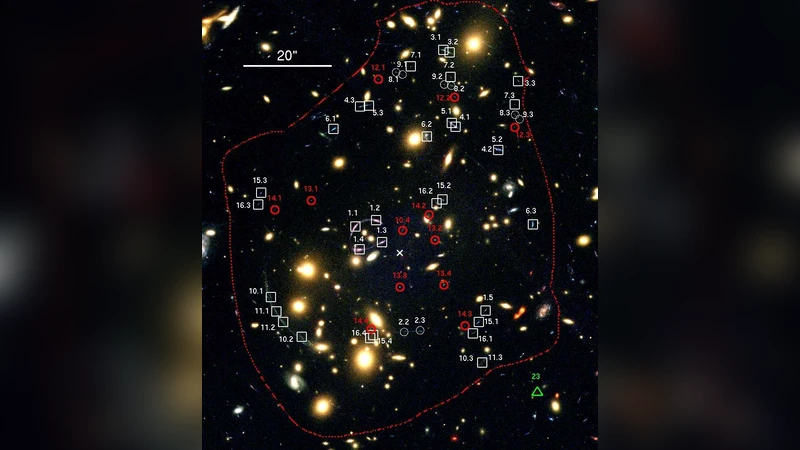
Strong gravitational lensing is a unique tool to model with great accuracy the inner mass distribution of massive galaxy clusters. In particular, clusters with large Einstein radii provide a wealth of multiply imaged systems in the cluster core allowing to determine precisely the shape of the central dark matter profile. This paper presents a spectroscopic survey in the massive cluster Abell 1703, displaying a large Einstein radius (28" at z=2.8) and a high number of strongly-lensed systems including a central ring-like configuration. We used LRIS on Keck to target multiple images and lensed galaxy candidates, and use the measured redshifts to constrain the mass distribution of the cluster using a parametric model. The data enable us to measure accurate redshifts in good agreement with their photometric redshifts, and to update the identification of multiply imaged systems by discovering 3 new systems and a radial counter image. We also report the discovery of a remarkably bright ~3.6 L* i-band dropout at z=5.827 in our mask which is only moderately magnified by the cluster (~3.0+/-0.08). The improved parametric mass model, including 16 multiple systems with 10 spectroscopic redshifts, further constrains the cluster-scale mass distribution with a generalized NFW profile of best-fit logarithmic slope alpha=0.92+/-0.04, concentration c200=4.72+/-0.40 and scale radius rs=476+/-45 kpc. Our strong-lensing model predicts a large scale shear signal consistent with Subaru weak-lensing measurements out to 4 Mpc h^-1. Together with the fact that the strong-lensing modeling requires a single dark matter clump, this suggests that Abell 1703 is a relaxed, unimodal cluster. This unique cluster could be probed further using deep X-ray, SZ and dynamics analysis, for a detailed study of the physics in a relaxed cluster. (abridged)
💡 Research Summary
This paper presents a comprehensive spectroscopic campaign of the massive galaxy cluster Abell 1703, carried out with the Low‑Resolution Imaging Spectrometer (LRIS) on the Keck I telescope. Abell 1703 is notable for its large Einstein radius of 28 arcseconds at a source redshift of z≈2.8, which produces a rich set of strongly‑lensed features, including a central ring‑like configuration. The authors targeted multiple images and candidate lensed galaxies identified from deep optical–near‑infrared imaging, obtaining reliable spectroscopic redshifts for 10 of the 16 multiply‑imaged systems used in the lens model.
In addition to confirming previously known systems, the survey discovers three new multiple‑image families and identifies a radial counter‑image that had been missed in earlier analyses. A particularly striking find is a very bright i‑band dropout galaxy at z = 5.827 ± 0.001, whose intrinsic luminosity is ≈3.6 L*; the cluster magnifies it only modestly (μ ≈ 3.0 ± 0.08), making it an excellent target for studies of early galaxy formation.
Using the spectroscopic redshifts as strong constraints, the authors construct a parametric strong‑lensing model based on a generalized Navarro‑Frenk‑White (gNFW) halo. The best‑fit parameters are a logarithmic inner slope α = 0.92 ± 0.04 (very close to the canonical NFW value of 1), a concentration c200 = 4.72 ± 0.40, and a scale radius rs = 476 ± 45 kpc, corresponding to a total mass M200 ≈ 1.2 × 10¹⁵ M⊙. The model requires only a single, centrally‑located dark‑matter clump; no additional sub‑halos or external shear components are needed to reproduce the observed image positions.
The authors then compare the strong‑lensing prediction for the large‑scale shear field with independent weak‑lensing measurements from Subaru Suprime‑Cam. The predicted shear profile matches the Subaru data out to ∼4 Mpc h⁻¹, demonstrating that the same mass distribution accounts for both the inner strong‑lensing regime and the outer weak‑lensing regime. This consistency, together with the requirement of a single dark‑matter halo, strongly supports the interpretation that Abell 1703 is a dynamically relaxed, unimodal cluster rather than a merging or highly substructured system.
The paper concludes by emphasizing the value of Abell 1703 as a laboratory for precision cluster physics. The authors suggest follow‑up observations in X‑ray (e.g., Chandra, XMM‑Newton), Sunyaev‑Zel’dovich effect (e.g., ALMA, ACT), and spectroscopic dynamics of cluster members to further test the relaxed‑cluster hypothesis, to map the intracluster medium, and to refine constraints on the dark‑matter profile. The combination of a large Einstein radius, a rich set of spectroscopically confirmed multiple images, and agreement between strong and weak lensing makes Abell 1703 an exemplary case for studying the interplay between dark matter, baryons, and galaxy evolution in massive, relaxed clusters.
Comments & Academic Discussion
Loading comments...
Leave a Comment