Direct numerical simulations of the galactic dynamo in the kinematic growing phase
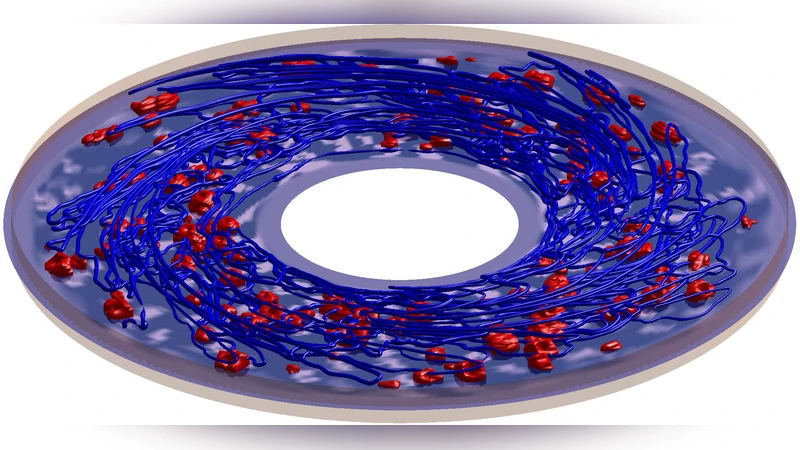
We present kinematic simulations of a galactic dynamo model based on the large scale differential rotation and the small scale helical fluctuations due to supernova explosions. We report for the first time direct numerical simulations of the full galactic dynamo using an unparameterized global approach. We argue that the scale of helicity injection is large enough to be directly resolved rather than parameterized. While the actual superbubble characteristics can only be approached, we show that numerical simulations yield magnetic structures which are close both to the observations and to the previous parameterized mean field models. In particular, the quadrupolar symmetry and the spiraling properties of the field are reproduced. Moreover, our simulations show that the presence of a vertical inflow plays an essential role to increase the magnetic growth rate. This observation could indicate an important role of the downward flow (possibly linked with galactic fountains) in sustaining galactic magnetic fields.
💡 Research Summary
The paper presents the first fully global, direct‑numerical simulations of a galactic dynamo operating in its kinematic growth phase. The authors combine two well‑established ingredients of galactic magnetic field generation: large‑scale differential rotation (the Ω‑effect) and small‑scale helical turbulence produced by supernova‑driven superbubbles (the α‑effect). Unlike traditional mean‑field approaches that parameterise the helicity injection, the simulations resolve the injection scale—hundreds of parsecs—using a 1 pc grid over a cylindrical domain that spans roughly 20 kpc in radius and ±2 kpc in height.
The model injects superbubbles at a prescribed rate, each expanding to ~100 pc and imparting a coherent, helical velocity field around the rotation axis. The magnetic field is evolved with the incompressible MHD induction equation while the Lorentz force is omitted, i.e., the study stays in the linear (kinematic) regime. This set‑up allows a clean measurement of the exponential growth rate of the magnetic energy, which the authors find to be γ ≈ 0.03 Myr⁻¹, comparable to values obtained from earlier mean‑field calculations.
A key result is the emergence of a quadrupolar symmetry: the toroidal field has the same sign above and below the mid‑plane, matching the symmetry observed in many spiral galaxies, including the Milky Way. The field lines also develop a spiral pattern that follows the galactic arms, and the field strength reaches ~10 µG near the centre and ~1 µG in the outer disk, again in line with observations.
The authors explore the impact of a vertical inflow (downward flow) that mimics the return flow of a galactic fountain. Adding a modest v_z < 0 component increases the growth rate by roughly 30 %. The physical interpretation is that the inflow concentrates magnetic flux toward the mid‑plane, reduces vertical diffusion, and reinforces the α‑effect generated by the superbubbles. This finding suggests that galactic fountains may play a more active role in sustaining large‑scale magnetic fields than previously thought.
Limitations are acknowledged. By staying kinematic, the simulations cannot address saturation, back‑reaction of the magnetic field on the flow, or the possible quenching of the α‑effect. The superbubble statistics (rate, energy, spatial distribution) are simplified, and real galaxies exhibit a broader range of star‑formation environments. Future work is proposed to include full MHD coupling, more realistic supernova feedback, and direct comparison with Faraday‑rotation and synchrotron observations.
In summary, the study demonstrates that the combined action of differential rotation and explicitly resolved supernova‑driven helicity can generate realistic galactic magnetic fields without resorting to sub‑grid parameterisation. The additional insight that vertical inflow substantially boosts dynamo efficiency opens a new avenue for linking large‑scale galactic flows, such as fountains, to the long‑standing problem of magnetic field maintenance in spiral galaxies.
Comments & Academic Discussion
Loading comments...
Leave a Comment