The 2008 Luminous Optical Transient in the Nearby Galaxy NGC 300
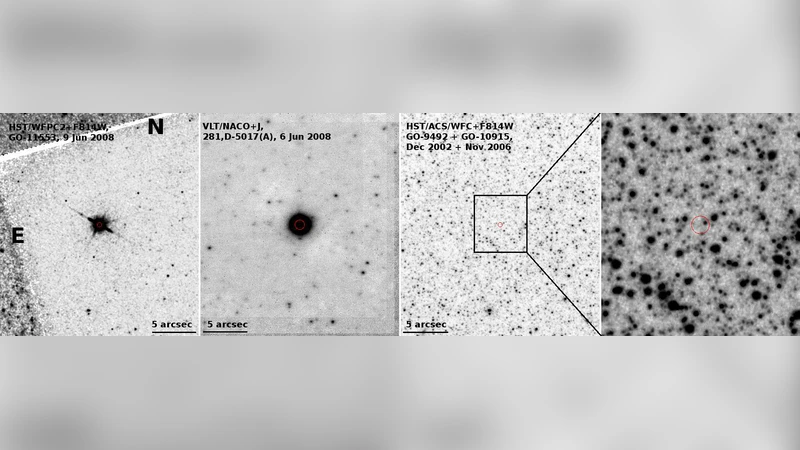
A luminous optical transient (OT) that appeared in NGC 300 in early 2008 had a maximum brightness, M_V ~ -12 to -13, intermediate between classical novae and supernovae. We present ground-based photometric and spectroscopic monitoring and adaptive-optics imaging of the OT, as well as pre- and post-outburst space-based imaging with HST and Spitzer. The optical spectrum at maximum showed an F-type supergiant photosphere with superposed emission lines of hydrogen, Ca II, and [Ca II], similar to the spectra of low-luminosity Type IIn “supernova impostors” like SN 2008S, as well as cool hypergiants like IRC +10420. The emission lines have a complex, double structure, indicating a bipolar outflow with velocities of ~75 km/s. The luminous energy released in the eruption was ~10^47 ergs, most of it emitted in the first 2 months. By registering new HST images with deep archival frames, we have precisely located the OT site, and find no detectable optical progenitor brighter than broad-band V magnitude 28.5. However, archival Spitzer images reveal a bright, non-variable mid-IR pre-outburst source. We conclude that the NGC 300 OT was a heavily dust-enshrouded luminous star, of ~10-15 Msun, which experienced an eruption that cleared the surrounding dust and initiated a bipolar wind. The progenitor was likely an OH/IR source which had begun to evolve on a blue loop toward higher temperatures, but the precise cause of the outburst remains uncertain.
💡 Research Summary
The paper presents a comprehensive multi‑wavelength study of the luminous optical transient (OT) that erupted in the nearby galaxy NGC 300 in early 2008. The transient reached an absolute visual magnitude of roughly –12 to –13, placing it in the luminosity gap between classical novae (M_V ≈ –8 to –10) and typical core‑collapse supernovae (M_V ≈ –17 to –19). The authors combined ground‑based photometric and spectroscopic monitoring, adaptive‑optics imaging, and archival space‑based observations from the Hubble Space Telescope (HST) and the Spitzer Space Telescope to characterize both the outburst and its progenitor.
Spectroscopically, the OT at maximum displayed a continuum consistent with an F‑type supergiant photosphere, overlaid by strong emission lines of hydrogen (Balmer series), Ca II triplet, and the forbidden
Comments & Academic Discussion
Loading comments...
Leave a Comment