Mid-infrared imaging of 25 local AGN with VLT-VISIR
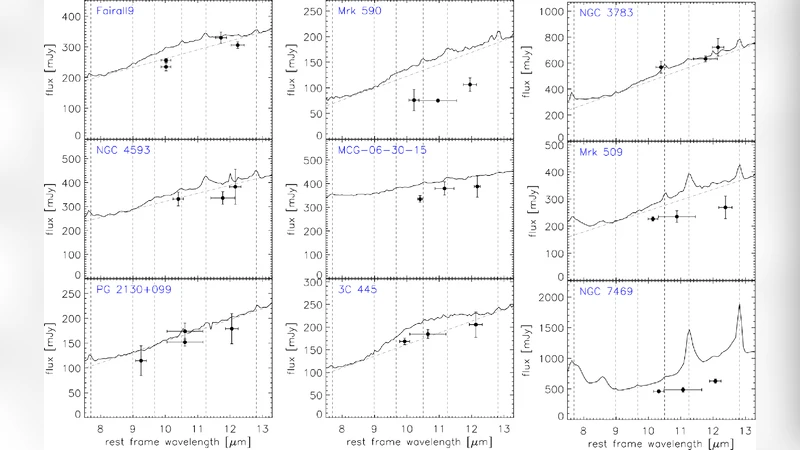
Aims. High angular resolution N-band imaging is used to discern the torus of active galactic nuclei (AGN) from its environment in order to allow a comparison of its mid-infrared properties to the expectations of the unified scenario for AGN. Methods. We present VLT-VISIR images of 25 low-redshift AGN of different Seyfert types, as well as N-band SEDs of 20 of them. In addition, we compare our results for 19 of them to Spitzer IRS spectra. Results. We find that at a resolution of ~ 0.35", all the nuclei of our observed sources are point-like, except for 2 objects whose extension is likely of instrumental origin. For 3 objects, however, we observed additional extended circumnuclear emission, even though our observational strategy was not designed to detect it. Comparison of the VISIR photometry and Spitzer spectrophotometry indicates that the latter is affected by extended emission in at least 7 out of 19 objects and the level of contamination is (0.20 ~ 0.85) * F_IRS. In particular, the 10 um silicate emission feature seen in the Spitzer spectra of 6 type I AGN, possibly 1 type II AGN and 2 LINERs, also probably originates not solely in the torus but also in extended regions. Conclusions. Our results generally agree with the expectations from the unified scenario, while the relative weakness of the silicate feature supports clumpy torus models. Our VISIR data indicate that, for low-redshift AGN, a large fraction of Spitzer IRS spectra are contaminated by extended emission close to the AGN.
💡 Research Summary
The paper presents a high‑resolution mid‑infrared imaging study of 25 nearby active galactic nuclei (AGN) using the VLT‑VISIR instrument in the N‑band (≈8–13 µm). The primary goal is to isolate the emission from the putative dusty torus from surrounding structures and to test the predictions of the AGN unified scheme. The sample spans a range of Seyfert types and includes several LINERs, all at low redshift (z ≲ 0.05). For 20 of the objects, the authors also construct N‑band spectral energy distributions (SEDs) from the VISIR photometry, and for 19 of them they compare the VISIR fluxes with archival Spitzer IRS spectra to assess the impact of extended emission on low‑resolution spectroscopy.
At an angular resolution of ~0.35 arcsec (corresponding to ≲60 pc at the typical distances of the sample), virtually all nuclei appear point‑like. Only two sources show a slight extension that is attributed to instrumental point‑spread‑function (PSF) effects rather than genuine astrophysical structure. However, three galaxies (NGC 7469, Circinus, and NGC 1068) display clear, extended circumnuclear emission that was not part of the original observing strategy but became evident thanks to VISIR’s sensitivity. This extended emission likely originates from star‑forming regions, the narrow‑line region (NLR), or dusty clouds outside the classical torus.
When the high‑resolution VISIR photometry is compared with the much lower‑resolution Spitzer IRS spectra, a substantial discrepancy emerges. In at least 7 of the 19 objects, the IRS fluxes are contaminated by extended emission at a level ranging from 20 % to 85 % of the total IRS flux. This contamination is especially significant for the 10 µm silicate feature. Six type‑I AGN, possibly one type‑II AGN, and two LINERs exhibit silicate emission in the Spitzer spectra, but the VISIR data suggest that a non‑negligible fraction of this emission arises from regions beyond the torus. Consequently, the silicate feature’s strength is diluted relative to expectations from smooth, homogeneous torus models.
These findings have several important implications. First, they demonstrate that sub‑arcsecond mid‑infrared imaging is essential for disentangling the compact torus emission from surrounding dust and star formation, a separation that cannot be achieved with the spatial resolution of Spitzer. Second, they caution that a significant fraction of low‑redshift AGN spectra obtained with Spitzer (and similar facilities) may be biased by host‑galaxy contributions, which can affect measurements of torus properties such as temperature, optical depth, and geometry. Third, the observed weakness and broadness of the silicate emission feature support clumpy (multi‑cloud) torus models, in which the line‑of‑sight encounters a mixture of optically thick and thin clouds, reducing the net feature strength. This is consistent with the unified scheme’s overall framework but refines the physical picture of the obscuring structure.
In summary, the VLT‑VISIR observations confirm that most low‑redshift AGN have compact mid‑infrared cores consistent with a torus, yet a non‑trivial fraction of the mid‑infrared output—particularly the silicate emission—originates in more extended regions. The study underscores the necessity of high‑resolution imaging for accurate interpretation of AGN mid‑infrared spectra and provides strong observational backing for clumpy torus models within the unified AGN paradigm. Future facilities such as JWST, with even higher spatial and spectral resolution, will be able to build on these results to map the detailed geometry and composition of the dusty environments surrounding supermassive black holes.
Comments & Academic Discussion
Loading comments...
Leave a Comment