Observational Evidence for Coronal Twisted Flux Rope
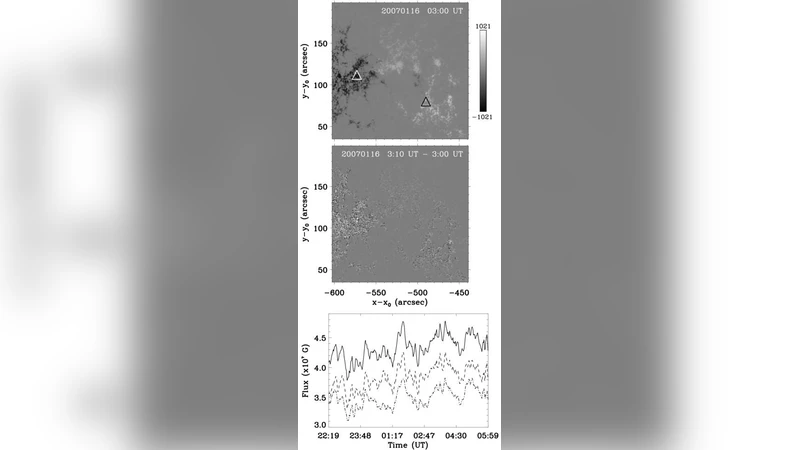
Multi-instrument data sets of NOAA AR10938 on Jan. 16, 2007, (e.g., {\emph{Hinode}}, {\it{STEREO}}, {\it{GOES}}, {\it{MLSO}} and {\it{ISOON}} H$\alpha$) are utilized to study the fine structure and evolution of a magnetic loop system exhibiting multiple crossing threads, whose arrangement and individual shapes are very suggestive of individual field lines in a flux rope. The footpoints of the magnetic threads are closely rooted into pores and plage areas. A C-class flare recorded by {\it{GOES}} at approximately 2:35 UT near one of the footpoints of the multi-thread system (along with a wisp of loop material shown by EUV data) led to the brightening of the magnetic structure revealing its fine structure with several threads that indicate a high degree of linking (suggesting a left-handed helical pattern as shown by the filament structure formed later-on). EUV observations by {\emph{Hinode}}/EIS of hot spectral lines at 2:46 UT show a complex structure of coronal loops. The same features were observed about 20 minutes later in X-ray images from {\emph{Hinode}}/XRT and about 30 minutes further in EUV images of {\it{STEREO}}/SECCHI/EUVI with much better resolution. H$\alpha$ and 304 {\AA} images revealed the presence of several filament fibrils in the same area. They evolved a few hours later into a denser structure seemingly showing helical structure, which persistently lasted for several days forming a segment of a larger scale filament. The present observations provide an important indication for a flux robe as a precursor of a solar filament.
💡 Research Summary
The paper presents a comprehensive multi‑instrument analysis of active region NOAA AR 10938 on 16 January 2007, focusing on a coronal magnetic loop system that exhibits multiple crossing threads suggestive of a twisted flux rope. The authors combine data from Hinode (EIS, XRT), STEREO (SECCHI/EUVI), GOES, MLSO, and ISOON Hα to trace the evolution of the structure from its initial brightening through its cooling and eventual formation of a filament.
At 02:35 UT a C‑class flare recorded by GOES occurs near one footpoint of the multi‑thread system. The flare is accompanied by a “wisp” of EUV loop material that rapidly heats the magnetic structure. Hinode/EIS observations at 02:46 UT in hot spectral lines (e.g., Fe XXIV, Fe XXIII) reveal a complex, highly sheared set of coronal loops. Approximately 20 minutes later the same configuration appears in Hinode/XRT X‑ray images, confirming the presence of very hot plasma (several MK) within the tangled threads. About 30 minutes after that, STEREO/SECCHI/EUVI captures the structure in the 171 Å and 195 Å channels with superior spatial resolution, showing the threads as distinct, interlaced strands.
The temporal sequence—hot spectral lines → X‑ray → EUV—demonstrates a clear cooling progression, indicating that the magnetic bundle first stores energy in a high‑temperature state before radiatively cooling. Hα and 304 Å observations from ISOON and MLSO reveal a set of thin filament fibrils co‑located with the EUV threads. Within a few hours these fibrils merge into a denser, more continuous filament segment that displays a clear left‑handed (negative) helical pattern. The filament persists for several days, becoming part of a larger‑scale filament channel.
The authors interpret the crossing geometry of the threads, the left‑handed helicity, and the sequential cooling as strong evidence for a pre‑existing twisted flux rope that acted as the magnetic backbone of the later filament. The footpoints of the threads are anchored in pores and plage regions, providing stable anchoring points that allow the rope to survive the flare‑induced heating. The flare itself serves as a catalyst that makes the otherwise invisible flux rope visible by populating it with hot plasma that emits in EUV and X‑ray wavelengths.
Key insights include:
-
Multi‑wavelength chronology – The study demonstrates how coordinated observations across temperature regimes can track the thermal evolution of a magnetic structure, from >10 MK (EIS) down to chromospheric temperatures (Hα).
-
Magnetic topology – The observed interleaving of multiple strands, together with the left‑handed twist inferred from the filament’s morphology, matches theoretical predictions of a helical flux rope rather than a simple arcade.
-
Flux‑rope as filament precursor – The transition from a hot, twisted rope to a cool, dense filament provides direct observational support for models that posit flux ropes as the seed structures of solar filaments and prominences.
-
Role of flares – Small‑scale flares can act as diagnostic tools, heating the rope and making its fine structure observable without destroying the underlying magnetic configuration.
Overall, the paper supplies compelling observational evidence that twisted coronal flux ropes exist prior to filament formation and can be revealed through flare‑driven heating. This strengthens the flux‑rope paradigm for filament genesis and offers a valuable template for future studies that aim to predict filament eruptions and associated space‑weather impacts.
Comments & Academic Discussion
Loading comments...
Leave a Comment