Growth of fat slits and dispersionless KP hierarchy
A "fat slit" is a compact domain in the upper half plane bounded by a curve with endpoints on the real axis and a segment of the real axis between them. We consider conformal maps of the upper half plane to the exterior of a fat slit parameterized by…
Authors: A. Zabrodin
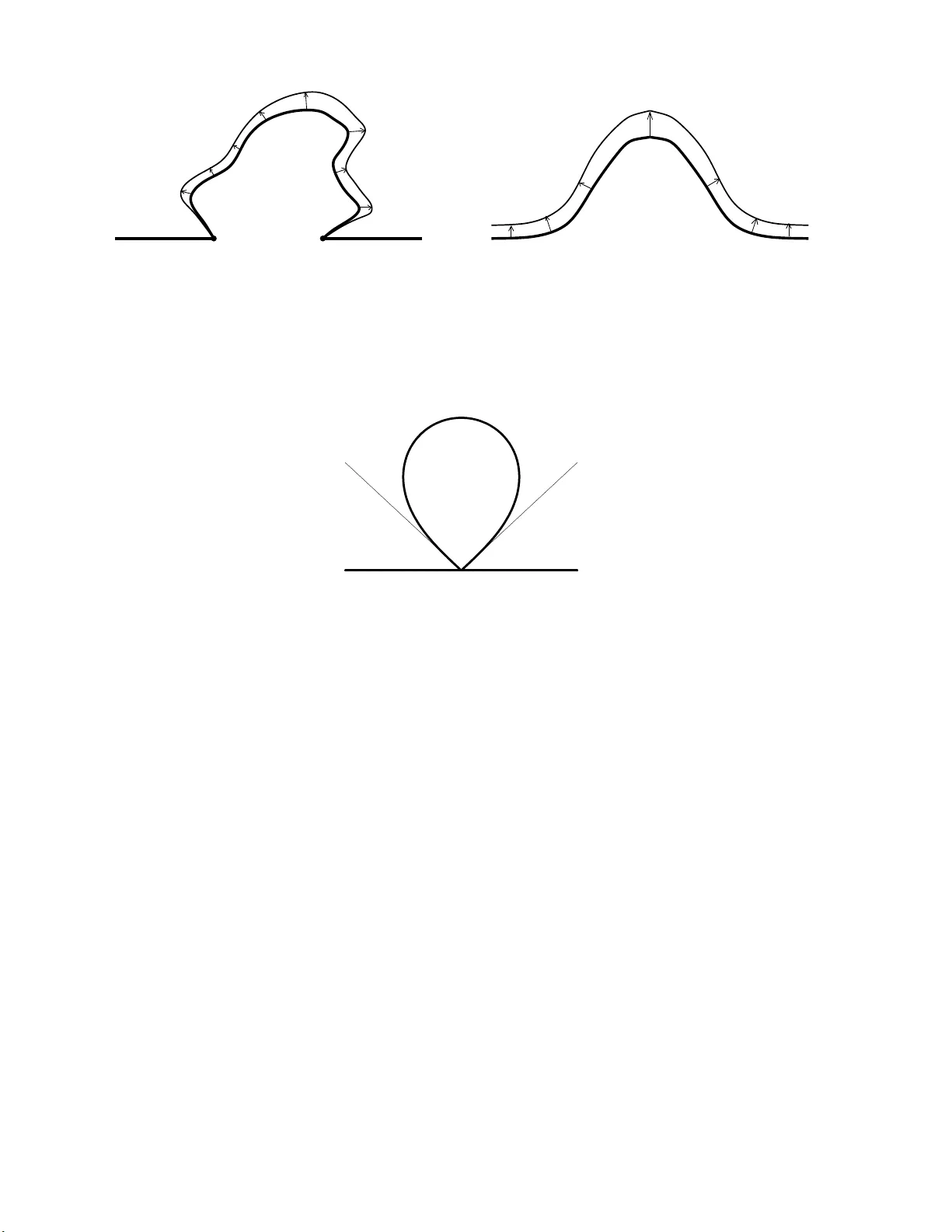
Gro wth of fat sl its and disp ersionless K P hierarc h y A. Zabro din ∗ No vem b er 2008 Abstract A “fat slit” is a co mp act domain in the upp er half plane b ounded b y a curv e with endp oi nts on th e real axis and a segmen t of the real axis b et ween them. W e consider conformal maps of the upp er half plane to the exterior of a fat slit parameterized by harm onic moment s of the latter and sho w that they ob ey an infinite set of Lax equations for the disp ersionless KP hierarc hy . Deformation of a fat slit u nder c hanging a p articular harmonic m omen t can b e treated as a gro wth pro cess similar to the Laplacian gro wth of domains in the whole plane. Th is construction extends the w ell kno wn link b et w een solutions to the disp ersionless KP hierarc hy and conformal m ap s of slit domains in the upp er half plane and pro vides a new, large family of solutions. ∗ Institute of Bio chemical Physics, 4 K osygina st., 1 1933 4, Moscow, Russia and IT E P , 25 B.Cheremushkinsk ay a, 1 17218 , Moscow, Russia 1 1 In tro duction P arametric families of conformal maps in 2 D ar e kno wn to b e c losely related to long w a v e limits o f nonlinear in tegrable PDE’s and their infinite hierarc hies. This observ atio n w as first made in [1] for mappings of slit domains and then extended to mappings of domains b ounded by Jor da n curv es in [2]. In b oth cases confor ma l ma ps from a standar d reference domain (suc h as upp er half plane, or unit disk) to a do ma in of a v arying shap e serv e as Lax functions of an in tegrable hierarch y whose flo ws are iden tified with v ariatio ns of the conformal maps described b y an infinite set o f Lax equations. The in tegrable structures arising in this w ay are disp ersionless Kadomtse v-Pe tviashv ili (dKP) and disp ersionless 2D T o da (dT o da) hierarc hies and, more generally , the unive rsal Whitham hierarch y first in tro duce d [3, 4] in an absolutely differen t con text with the aim t o describ e slo w mo du- lations of exact solutions to soliton equations. The most promising progress a lo ng these lines was ac hiev ed in geometric and ph ysical in terpretation of the dT o da hierarc h y . The key fact, established in [5] and further elab o- rated in [6, 7], is that v a riations of domains under the T o da flo ws go exactly according to the D arcy law specific for gro wth pro cesse s of Laplacian type and viscous hydrodynamics in the Hele-Sha w cell with zero surface t ension (see, e.g., [8, 9]). Although the dKP hierarc h y is simpler than the dT o da hierarch y , its role in the theory of conformal maps and Laplacian growth is not we ll understo o d. The connection with conformal maps observ ed in [1] giv es a geometric interpretation to only rather sp ecial (degenerate) solutions of the dKP hierar ch y whic h are reductions to systems of h ydro dinamic ty p e with a finite n umber of degrees of freedom. As is sho wn in [1] ( see a lso [10, 11]), they a re related to conformal maps of the upp er half plane with slits emanating from the real axis. The a im of t his pap er is to demonstrate that the g eometric inte rpretatio n of the dKP hierarc h y is not limited by domains of suc h sp ecial kind. W e sho w that the same dKP hierarc h y is able to co ve r a m uc h broader class of domains which can b e obtained from the upp er half plane by remov ing not just an infinitely thin slit but a whole compact piece (of a non-zero area and arbitrary shap e) attached to t he real axis, whic h w e call a “f a t slit” to stress t he analogy (Fig. 1). There is an imp ortan t difference, ho w ev er. The dKP-ev olution of usual slits is actually finite dimensional b ecause the slits are to b e regarded as arcs of fixed curv es [1, 10], so o nly their endp oints can mo v e. In con trast, the dKP-evolution of fat slits (giv en by t he Lax equations) take s place in an infinite dimensional v ariet y corresp onding to c ha ng ing their shap e in an arbitrary wa y . Let us recall the Lax fo r m ulation of the dKP hierarc hy . Start ing from a La uren t series z ( p ) = p + ∞ X k =1 a k p − k (1.1) one in tro duces the dep endence o n an infinite n um b er of “times” T 1 , T 2 , T 3 , . . . via Lax equations ∂ z ( p ) ∂ T k = { B k ( p ) , z ( p ) } := ∂ B k ∂ p ∂ z ∂ T 1 − ∂ B k ∂ T 1 ∂ z ∂ p , (1.2) where the generators of the flows B k are p olynomials in p o f t he f o rm B k ( p ) = ( z k ( p )) ≥ 0 (p olynomial par t s of z k ( p )). The dKP hierarc h y is a n infinite system o f nonlinear PDE’s 2 b) a) Figure 1: a) A slit; b) A “fat slit”. for a i ’s resulting fro m comparing co efficien ts in fron t of differen t p ow ers of p in the Lax equations or in an equiv alen t system of equations o f the Zakharov-Shabat t yp e ∂ B j ( p ) ∂ T k − ∂ B k ( p ) ∂ T j + { B j ( p ) , B k ( p ) } = 0 (1.3) for all j, k ≥ 1 (the P oisson brac ke t is defined in (1.2) ). The co efficien ts a i and the times T i are assumed to b e real n umbers. Assuming that z ( p ) is a normalized conformal map from t he upp er half plane onto the exterior o f a fat slit, w e sho w that it o b eys equations (1.2), where T k are prop erly defined harmonic moments of the fat slit (or rather of its exterior). This fact follows from the Hadamard formula fo r v ariations of the G reen function with Dirichle t b oundary conditions. In t his sense the a r g umen ts are para llel to [12, 13]. Ev olutio n in T = T 1 with all other times fixed has an interpretation as a v ersion of the La pla cian gro wth in the upp er half plane with fixed real axis. Applying the approac h dev elop ed in [12 , 13, 14] to the case of fat slits in the upp er half plane, w e construct the disp ersionless “ tau-function” (whic h is actually a limit of prop erly rescaled logarit hm of a disp ersionfull tau- function) of the dKP hierarc hy as a functional on the space of fat slits explicitly giv en b y log τ = − 1 π 2 Z Z fat slit log z − ζ z − ¯ ζ d 2 z d 2 ζ . (1.4) It has a clear electrostatic in terpretation as Coulom b energy of a fa t slit filled with electric c harge of a uniform densit y in the presence of a n infinite grounded conductor placed alo ng the real axis. This functional rega rded as a function o f harmo nic momen ts ob eys a disp ersionless v ersion of the Hirota relation whic h serv es as a master equation generating the whole dKP hierarch y . 2 F at slit domains, their co nformal maps and Green’ s functions Consider a compact simply connected domain B in the upp er half- plane H b ounded b y a non-self-in tersecting analytic curve γ in H with endp oin ts x − , x + on the real axis and a segmen t o f the real axis b etw een them. This segmen t will b e called the b ase of B . Without loss of generality , one can assume that the origin b elongs to the base. F or brevit y , and in 3 − x + x 0 B B α α + − Figure 2: A fat slit B in the upp er half plane an d the c orr esp onding symmetric domain D = B ∪ ¯ B . order to emphasize an analogy with slit domains manifested in the common in tegrable structure of their conformal maps, we call such a domain a fa t slit . Accordingly , the complemen t, H \ B , will b e referred to as a domain with a fat slit, or simply a fat slit domain (in our case, t he fat slit half - plane). It is o f ten con v enien t t o treat fa t slits as upp er halv es of domains symmetric with resp ect to the real axis. Namely , set D = B ∪ ¯ B , where ¯ B is the domain in the low er half plane whic h is obtained from B b y complex conjugation z → ¯ z (Fig. 2). Ob viously , the domain D is symmetric with resp ect to the complex conjugation. In what follow s we call suc h do mains simply symmetric . Vice vers a, an y compact simply connected symmetric domain D is a unio n of a fa t slit and its complex conjugate. The b o undar y of D is assumed to b e analytic ev erywhere except the tw o p oin t s on the real axis whic h are allo we d to b e corner p o ints. 2.1 Conformal maps Let p ( z ) b e a conformal map from H \ B (in the z -plane) onto H (in the p - plane) show n sc hematically in Fig. 3. W e nor ma lize it b y the condition that the expansion of p ( z ) in a Lauren t series at infinit y is of the for m p ( z ) = z + u z + X k ≥ 2 u k z − k , | z | → ∞ (2.1) (a “hydrodynamic” normalizatio n) . Assuming this normalization, the map is unique. The upp er part of the b o undary , γ , is mapp ed to a segmen t o f the real axis [ p − , p + ], while the ra ys of the real axis outside B are mapp ed to the real ra ys [ −∞ , p − ] and [ p + , ∞ ] (Fig. 3). F rom this it fo llows tha t the co efficien ts u k are all real n um b ers. The first co efficien t, u 1 := u , is called a c ap a c ity of B . It is kno wn to b e p o sitive. W e also 4 B x x − − + + p p p z p(z) Figure 3: The c onfo rmal map p ( z ) . need the in v erse map, z ( p ), whic h can b e expanded in to the in v erse Lauren t series z ( p ) = p − u p + ∞ X k =2 a k p − k , | p | → ∞ (2.2) with real co efficien ts a k connected with u k b y p olynomial relations. The series con ve rges for large enough | p | . According to the Sc h w arz symmetry principle, the function z ( p ) admits an analytic con tin uatio n to the lo we r half plane. This a na lytically con tin ued function p erforms a conformal map from the whole complex plane with a finite cut on the real axis from p − to p + on to the exterior of the symmetric domain D = B ∪ ¯ B . 2.2 Green’s func tions Let D = B ∪ ¯ B b e a symmetric domain and let G ( z , z ′ ) be the standard Green’s function of the D ir ichlet b o undary problem in C \ D . The function is harmonic in C \ D with r esp ect to b oth v ariables except at z = z ′ , where it ha s a loga r it hmic singularit y G ( z , z ′ ) = log | z − z ′ | + . . . and equals zero when either z or z ′ lies on the b oundary of D . The Green’s function solv es the Diric hlet b oundary v alue problem: the form ula f ( z ) = − 1 2 π I ∂ D f ( ξ ) ∂ n G ( z , ξ ) | d ξ | (2.3) harmonically extends the function f ( ξ ) from the con tour ∂ D t o its exterior. Here and b elo w, ∂ n is the normal deriv a t ive at the b oundary , with the normal v ector b eing directed to the exterior of D . W e a lso note the Hadamard form ula [15] for v ariation of the G r een’s function under v a riation of the domain: δ G ( a, b ) = 1 2 π I ∂ D ∂ n G ( a, z ) ∂ n G ( b, z ) δ n ( z ) | d z | , (2.4) where δ n ( z ) is the infinitesimal normal displacemen t of the con tour. So me care is needed to define a deformation near the corner p oin ts. How ev er, for our purp oses it is enough to consider deformations with fixed corner p oin ts, then δ n ( z ) is w ell defined at any p oint of the b o undary . Also, in this pap er w e consider only the case when b oth angles α + and α − are a cute, 0 < α ± < π / 2 , then the normal deriv ativ e of the Green’s function v anishes at the corners and the integral con v erges (see more details b elo w). F or symmetric doma ins the Green’s function ob eys the prop ert y G ( z , z ′ ) = G ( ¯ z , ¯ z ′ ). Let us call a function f ( z ) even (resp ectiv ely , o dd ) if f ( z ) = f ( ¯ z ) (resp ectiv ely , f ( z ) = 5 − f ( ¯ z )). It is natural to introduce ev en and o dd Green’s functions suc h that G ± ( z , z ′ ) = ± G ± ( z , ¯ z ′ ): G ± ( z , z ′ ) = G ( z , z ′ ) ± G ( z , ¯ z ′ ) . Note that G − ( x, z ) = 0 for real x . The Pois son fo rm ula (2.3) for ev en a nd o dd b oundary functions can be written in the form f ( z ) = − 1 2 π Z γ f ( ξ ) ∂ n G ± ( z , ξ ) | d ξ | , (2.5) where the integration go es ov er the non-clos e d con tour γ ( F ig. 4). The Hadamard form ula for G ± , δ G ± ( a, b ) = 1 2 π Z γ ∂ n G ± ( a, z ) ∂ n G ± ( b, z ) δ n ( z ) | dz | (2.6) directly follow s from (2.4 ), taking into accoun t that deformations of symmetric do ma ins ob ey the condition δ n ( z ) = δ n ( ¯ z ). 2.3 The o dd Green’s fun ction An imp ortant part in what follow s is pla y ed by the o dd Green’s function G − . It solv es the follo wing Dirich let b oundary v a lue problem in H : T o find a harmonic function in H \ B b ounded at infinit y such that it is equal to a given function on γ and 0 on the rays of the real axis o utside B . Similar to the Green’s function G , G − can b e expresse d through a confo rmal map to a fixed reference domain. The most natura l reference domain in our case is the upp er ha lf plane H . It is easy to see that G − ( z , z ′ ) = log p ( z ) − p ( z ′ ) p ( z ) − p ( ¯ z ′ ) , (2.7) where p ( z ) is the conformal map (2.1) from H \ B onto H . W e also need a useful fo rm ula for the kernel ∂ n G − ( a, z ) in (2.5) through the conformal map, ∂ n G − ( a, z ) = − 2 I m p ( a ) | p ′ ( z ) | | p ( z ) − p ( a ) | 2 , z ∈ γ (2.8) (whic h straigh tforw ardly follow s from (2.7)) and its limiting case as | a | → ∞ : ∂ n I m p ( z ) = | p ′ ( z ) | , z ∈ γ . (2.9) Let us prese nt t he expansion of the o dd Green’s function G − ( a, z ) as | a | → ∞ : G − ( a, z ) = 2 X k ≥ 1 1 k I m ( a − k ) I m ( B k ( p ( z ) ) ) . (2.10) Here B k ( p ) are F ab er p olynomials of p ( z ) defined b y the expansion log z p ( z ) − p = X k ≥ 1 z − k k B k ( p ) , | z | → ∞ , (2.11) and explicitly giv en by B k ( p ) = ( z k ( p )) ≥ 0 , (2.12) 6 where ( . . . ) ≥ 0 means the p olynomial part of the Laurent series. Indeed, fixing a p oint z 1 ∈ H \ B , w e ha ve X k ≥ 1 z − k 1 k B k ( p ) = X k ≥ 1 z k ( p ) ≥ 0 k z k ( p 1 ) = − " log 1 − z ( p ) z ( p 1 ) !# ≥ 0 where p 1 = p ( z 1 ). T o separate non-negativ e part, w e write log 1 − z ( p ) z ( p 1 ) ! = log p 1 − p z ( p 1 ) + log z ( p 1 ) − z ( p ) p 1 − p and notice that the expansion of the first (second) term con tains only non-negativ e (re- sp ectiv ely , negativ e) p o we rs of p . Therefore, X k ≥ 1 z − k 1 k B k ( p ) = − log( p ( z 1 ) − p ) + log z 1 , whic h coincides with ( 2 .11). In par t icular, B 1 ( p ) = p . Clearly , B k ( p ( z ) ) = z k + O ( z − 1 ) , | z | → ∞ , (2.13) and the function B k ( p ( z ) ) − z k is analytic in C \ D . 3 Lo cal co ordinate s in the space of fat slits W e are going to sho w that the harmonic momen ts T k (defined as in (3.1) b elow) lo cally c haracterize a fat slit in the following sense. First, an y small deformation of B that preserv es the momen ts T k , is trivial, i.e., any non- t rivial deformation changes at least one of them. This fact means lo cal uniqueness of a fat slit hav ing give n momen ts. Second, the mo ments T k , under certain conditions discussed b elo w, are indep enden t quan tities meaning that one can explicitly define infinitesimal deformations of B that c hange an y one of them k eeping all other fixed. In this w eak sense they serv e as lo cal co ordinates in the space of fat slits (c.f. the remark in Section 2.1 in [14]). 3.1 Harmonic momen ts Giv en a fat slit B , let us intro duce harmonic momen ts of the fat slit domain H \ B as T k = 2 π k I m Z H \ B z − k d 2 z , k ≥ 2 , T 1 = − 2 π I m Z B z − 1 d 2 z . (3.1) Here we assume that the base of B is a segmen t con taining zero. Since I m ( z − 1 ) < 0 for z ∈ H , T 1 is alw ays p ositiv e. Although the in tegrand in the fo rm ula for T 1 is singular at the o rigin, the in tegral con v erges. The integral for T 2 div erges at infinit y , so one should 7 − x x 0 B + Figure 4: The inte gr ation c ontour γ . in tro duce a cut-off at some large ra dius a nd mak e the angula r integration first; this prescription is equiv alen t to the con tour inte gr a l represen tation giv en b elo w. Note that this set of momen ts do es not include the area of B . Note also that the standa r d har mo nic momen ts dealt with in [1 3] are, for symmetric domains, real parts o f the integrals in (3.1 ) rather than imaginary ones. Some other in t egral represen tations of the momen ts (3.1) a re also useful. Imaginary parts of the integrals can b e tak en by exten ding the integration to the lo w er half plane as T k = 1 iπ k Z C \ D sign( y ) z − k d 2 z , k ≥ 2 , T 1 = − 1 iπ Z D sign( y ) z − 1 d 2 z , (3.2) where y = I m z . Con to ur integral represen tations are easily obtained using the Stok es theorem. They read T k = 2 π k I m Z γ y z − k dz = 1 π ik I ∂ D | y | z − k dz , k ≥ 1 . (3.3) The non-closed in tegratio n con t o ur γ (sho wn in Fig. 4) is the part of the b oundary of B lying in the upp er ha lf plane (with the orien tatio n from righ t to left). It is con venie nt t o in tro duce the generating function of the moments T k : M + ( z ) = 1 π i I ∂ D | y ′ | dz ′ z ′ − z = ∞ X k =1 k T k z k − 1 , | z | → 0 (3.4) (here y ′ = I m z ′ ). T he integral of Cauc h y ty p e in ( 3 .4) defines an analytic f unction ev erywhere inside D . In a small enough neigh b orho o d of the origin this function is represen ted by the (conv ergen t) T ay lor series standing in the r.h.s. of (3 .4 ). F or example, let B b e the half- disk of radius R : | z | ≤ R , I m z ≥ 0 . Then an easy calculation gives T k = 4 R 2 − k π k 2 (2 − k ) for o dd k , T k = 0 for ev en k and M + ( z ) = R π 2 + z 2 − R 2 Rz log R − z R + z ! . 8 3.2 An electrostatic int erpretation Similar to the standard harmo nic momen ts from pap ers [2 , 13], the momen ts T k ha v e a clear 2D electrostatic in terpretation. Let the in terior o f the domain B b e filled b y an electric charge with uniform densit y − 1 and let the low er half plane (or just the real axis) b e a grounded conductor. By the reflection principle, the electric p otential Φ − ( z ) in the upp er half plane is equal to the p oten tial created b y the ch arg e in B and t he fictitious “mirror” charge of opp osite sign in ¯ B : Φ − ( z ) = − 2 π Z B log z − z ′ z − ¯ z ′ d 2 z ′ . (3.5) Let us sho w tha t the T k ’s are co effic ients in the multipole expansion of Φ − ( z ) in the in terior of B near the origin. W e hav e, for z ∈ B : ∂ z Φ − ( z ) = 1 π Z B d 2 z ′ z ′ − z − 1 π Z ¯ B d 2 z ′ z ′ − z = − ¯ z + 1 2 π i I ∂ B ¯ z ′ dz ′ z ′ − z − 1 2 π i I ∂ ¯ B ¯ z ′ dz ′ z ′ − z = z − ¯ z − 1 π I ∂ B y ′ dz ′ z ′ − z + 1 π I ∂ ¯ B y ′ dz ′ z ′ − z , where w e substituted ¯ z ′ = z ′ − 2 iy ′ in the second line and in tegrated the analytic parts b y ta king residues. Since the function under the in tegrals v anishes on the parts of the con tours a lo ng the real axis, w e can eliminate them and com bine the tw o in tegrals in to a single in tegral ov er ∂ ( B ∪ ¯ B ) = ∂ D : ∂ z Φ − ( z ) = z − ¯ z − 1 π I ∂ D | y ′ | dz ′ z ′ − z = z − ¯ z − i X k ≥ 1 k T k z k − 1 , (3.6) where the second equalit y follo ws fro m (3.4). Since Φ − ( x ) = 0 at real x , w e obtain the expansion of the Φ − ( z ) around 0 in t he upp er half plane: Φ − ( z ) = 1 2 ( z − ¯ z ) 2 − i X k ≥ 1 T k ( z k − ¯ z k ) . (3.7) Similarly , expanding Φ − ( z ) around ∞ in the upp er half plane, we get: ∂ z Φ − ( z ) = − i X k ≥ 1 V k z − k − 1 , Φ − ( z ) = i X k ≥ 1 V k k ( z − k − ¯ z − k ) , (3.8) where V k = 2 π I m Z B z k d 2 z (3.9) are momen ts of the in terior. Their generating function, M − ( z ), is giv en by the same Cauc h y-ty p e integral (3.4) fo r z outside D : M − ( z ) = 1 π i I ∂ D | y ′ | dz ′ z ′ − z = ∞ X k =1 V k z − k − 1 , | z | → ∞ . (3.10) 9 Sometimes an equiv alent electrostatic in terpretation app ears to b e more con v enien t. Let us a ssume that there is no conductor but the domain ¯ B in the low er half pla ne is indeed filled with the “mirror” charge. In this case form ulas (3.6) , (3.7) and (3.8) admit con tin uatio n to the low er ha lf plane whic h is a chiev ed by complex conjuga t io n of b oth sides. F or example, complex conjugation of (3.6) yields ∂ ¯ z Φ − ( ¯ z ) = ¯ z − z + i P k ≥ 1 k T k ¯ z k − 1 , z ∈ B , whic h can b e rewritten as ∂ z Φ − ( z ) = z − ¯ z + i P k ≥ 1 k T k z k − 1 , z ∈ ¯ B . 3.3 Lo c al u niqueness of a fat slit with giv en momen ts Here, we pro ve the lo cal uniquene ss of a fat slit with giv en momen ts. The deformations c hanging only one moment will b e constructed in the next subsection. F or the purp ose of this section it is con ve nient to w ork with symmetric domains D = B ∪ ¯ B rather than with fat slits themselv es. L et D ( t ) b e a one-parameter deformation in the class of symmetric domains suc h that D (0) = D and ∂ t T k = 0 for all k = 1 , 2 , . . . . W e shall show that a n y suc h deformation is trivial: D ( t ) = D (0) (at least in a small neigh b orho o d of t = 0). T o see this, consider the t -deriv ativ e of the function M + ( z ). A simple calculation (see App endix A) sho ws that ∂ t M + ( z ) = 1 π i I ∂ D sign( y ′ ) v n ( z ′ ) z − z ′ | dz ′ | , (3.11) where v n ( z ) = δ n ( z ) /δ t is the “v elo city ” of the nor ma l displacemen t of the b oundary at the p o in t z . (If x ( σ , t ), y ( σ, t ) is an y parametrization of the con tour, then v n = dσ dl ( ∂ σ y ∂ t x − ∂ σ x∂ t y ), where dl = | d z | = q ( dx ) 2 + ( dy ) 2 is the line elemen t along the con tour and v n is p o sitive when the con tour mo ve s to the r ig h t of the increasing σ direction). The Cauc h y-t yp e in tegral in the r.h.s. defines analytic functions b o th inside and outside t he con tour. F or z inside the contour, c ho osing a neigh b o r ho o d o f 0 such that | z | < | z ′ | fo r all z ′ ∈ ∂ D , we can expand M + ( z ) as in (3.4) and find that ∂ t M + ( z ) = ∞ X k =1 k ∂ t T k z k − 1 = 0 for all z in this neighborho od. By uniqueness of ana lytic con tin uatio n ∂ t M + ( z ) = 0 ev erywhere in D . According t o the prop erty of in tegrals of Cauch y type this means that the function ∂ t M + ( z ) is analytic in C \ D and is g iven there b y the Cauch y in tegral (3.11). The b oundary v alue of this function is sig n ( y ) v n ( z ) | dz | /dz with r e al v n ( z ) almost ev erywhere on the contour (in our case actually ev erywhere except maybe the tw o corner p oints o n the real a xis). F urthermore, deformations of symmetric doma ins preserving symmetry with respect to the real axis ob ey the condition I ∂ D sign( y ) v n ( z ) | dz | = 0 (b ecause v n ( z ) = v n ( ¯ z )), whic h means, according to the Cauch y integral represen tation, that the function ∂ t M + ( z ) has a zero at infinity of a t least second or der. Inv oking the tec hnique from the t heory of b o undary v alues of analytic functions [16, 17], one can pro v e (see App endix B) that any analytic function with suc h prop erties in C \ D m ust b e identically zero. Therefore, v n ≡ 0, i.e., the deformation is trivial. 10 3.4 Sp ecial deformations of fat slits In or der to define deformations that c hange one of the momen ts T k k eeping all o ther fixed w e need the o dd Green’s function f or symmetric domains in tro duced in Section 2.2. Fix a p oin t a ∈ H \ B and consider small deformations δ − a of a fat slit B defined b y the infinitesimal normal displacemen t of the b oundary as follo ws: δ − a n ( ξ ) = − ǫ 2 ∂ n G − ( a, ξ ) , ξ ∈ γ , a ∈ H \ B . (3.12) (here ξ ∈ ∂ D and ǫ → 0) . These are analo gs of the deformations δ a n ( ξ ) = − ǫ 2 ∂ n G ( a, ξ ) from [14] whic h g enerate dT o da flows in the space of compact domains in the plane. As w e shall so on see, δ − a generate, in the same sense, dKP-flow s in the space o f fat slits. Extending the definition of the δ − a to the low er half plane, w e can define the corresp o nding deformation o f the symmetric domain D = B ∪ ¯ B : δ − a n ( ξ ) = − ǫ 2 sign ( I mξ ) ∂ n G − ( a, ξ ) , ξ ∈ ∂ D . (3.13) Clearly , δ − a n ( ξ ) /ǫ as ǫ → 0 is to b e understo od as normal v elo city of the b oundary under the deformation. An imp orta nt commen t is in order. F or the deformations δ − a to b e w ell defined around the p oin ts x − , x + , w e assume tha t the angles α ± b et we en the curv e γ and the real axis are strictly a cute: 0 < α ± < π / 2 (see F ig. 2). Since p ′ ( z ) ∼ ( z − x ± ) π α ± − 1 around the corner p oin ts (for a rigorous pro of see, e.g., [18, Lemma 2.8 ]), it is seen from (2.8) that the normal ve lo cit y o f the b oundary near the corner p o in ts tends to zero as ξ → x ± and, moreo v er, so do es the angular v elo cit y of t he parts of the b oundary near t he corners (whic h is of o rder | p ′′ ( z ) | ). This means tha t the p oints x ± and the angles α ± remain fixed. F or not strictly acute angles α + , α − the situation is muc h more complicated. F or example, the angles can immediately jump to other v alues and the deformations are not alw ay s w ell defined (cf. [19]). This case deserv es further in v estigation. Expanding the Green’s function as in (2.10) , one can intro duce the deformations δ ( k, − ) n ( ξ ) = ǫ 2 sign ( I mξ ) ∂ n I mB k ( p ( ξ )) , ξ ∈ ∂ D . (3.14) Lik e δ − a , the deformatio ns δ ( k, − ) do not shift the endp oints of γ . It is not difficult to sho w that δ ( k, − ) c hanges the har mo nic momen t T k k eeping all other fixed. Indeed, assuming that a ∈ D , w e write: δ ( k, − ) M + ( a ) = 1 π i I ∂ D sign( y ) δ ( k, − ) n ( z ) a − z | dz | = ǫ 2 π i I ∂ D ∂ n I mB k ( p ( z ) ) a − z | dz | , where the extra sign in the definition of δ ( k, − ) cancels the sign( y ) in the definition of M + ( a ). Because I mB k ( p ( z ) ) = 0 on ∂ D , w e ha v e: δ ( k, − ) M + ( a ) = ǫ 2 π i I ∂ D dB k ( p ( z ) ) z − a = ǫ 2 π i I ∂ D dz k z − a = ǫk a k − 1 , where w e ha v e used the fact that the function B k − z k is analytic in C \ D a nd v a nishes at ∞ , and so do es not con tribute to the integral. W e t h us see that δ ( k, − ) T j = ǫδ k j . 11 3.5 V ector fields in the space of fat slits Deformations whic h dep end on γ in a smo ot h w ay can b e r epresen ted b y v ector fields in the space of fa t slits. Let δ n ( z ) b e an y small deformation of a fat slit. G iv en a f unctional X on the space of f a t slits, its v a riation reads: δ X = Z γ δ X δ n ( ξ ) δ n ( ξ ) | d ξ | . The v ariational deriv a tiv e δ X/δ n ( ξ ) has the follo wing meaning: δ X δ n ( ξ ) = lim ε → 0 δ ( ε ) X ε . Here δ ( ε ) X is the v ariation of the functional under a t tac hing a small bump of area ε → 0 at the p oin t ξ ∈ γ (a symmetric bump is assumed to b e a ttac hed at the p oin t ¯ ξ ). Let δ n ( ξ ) = ǫg ( ξ ), ǫ → 0, then w e define the v ector field (the Lie deriv ativ e) ∇ ( g ) : ∇ ( g ) X = Z γ δ X δ n ( ξ ) g ( ξ ) | dξ | . Applying these general formulas to t he deformat ions δ − a (see (3.12 ) ), w e can write δ − a X = ǫ ∇ − ( a ) X , where the v ector field ∇ − ( a ) acts on functionals as follo ws: ∇ − ( a ) X = − 1 2 Z γ δ X δ n ( ξ ) ∂ n G − ( a, ξ ) | dξ | . (3.15) This equation give s an in v ariant definition of t he v ector field ∇ − ( a ) independen t o f an y c hoice of co ordinates. According to the Diric hlet form ula (2.5), the a ction of ∇ − ( a ) pro vides the harmonic extension of the f unction π δ X/δ n ( ξ ) fr o m γ to H b o unded at infinit y and equal to 0 on the ra ys of the real axis outside B . In the lo cal co ordinates T k , ∇ − ( a ) is represen ted as an infinite linear combination of the v ector fields ∂ /∂ T k whic h can b e though t of as partial deriv ativ es. T o find it explicitly , w e calculate δ − a T k = − 2 π k Z γ I m ( z − k ) δ − a n ( z ) | d z | = ǫ π k Z γ I m ( z − k ) ∂ n G − ( a, z ) | d z | = − 2 ǫ k I m ( a − k ) , where the last equalit y follo ws from t he D iric hlet fo rm ula (2.5) for symme tric domains. No w, giv en a functional X on the space of fat slits, and a ssuming that X is a function of the moments T k only , we write δ − a X = X k ≥ 1 ∂ X ∂ T k δ − a T k = − 2 ǫ X k ≥ 1 1 k I m ( a − k ) ∂ X ∂ T k = ǫ ∇ − ( a ) X , so ∇ − ( a ) is giv en b y ∇ − ( a ) = − 2 X k ≥ 1 1 k I m ( a − k ) ∂ ∂ T k . (3.16) The vec tor fields ∇ − ( a ) a r e “half- plane” analogs of t he vec to r fields ∇ ( a ) in tro duced in [14] via their action on functionals X in the space of all domains: ∇ ( a ) X = − 1 2 Z ∂ D δ X δ n ( ξ ) ∂ n G ( a, ξ ) | dξ | (3.17) (cf. (3.15)). Belo w we will show that the dKP hierarc hy is related to the v ector fields ∇ − ( a ) in the same w ay as the dT o da hierarc h y is related to the ∇ ( a ). 12 4 The disp ersionles s KP hi erarc h y 4.1 Lax equations The dispersionless KP (dKP) hierarch y is enco ded in the Hadamard formula ( 2 .6). T o see this, fix three p oin t s a, b, c ∈ H \ B and find δ − c G − ( a, b ): δ − c G − ( a, b ) = − ǫ 4 π Z γ ∂ n G − ( a, z ) ∂ n G − ( b, z ) ∂ n G − ( c, z ) | dz | . (4.1) This f o rm ula shows that the quan tity ∇ − ( a ) G − ( b, c ) is symmetric with resp ect to all three argumen ts: ∇ − ( a ) G − ( b, c ) = ∇ − ( b ) G − ( a, c ) = ∇ − ( c ) G − ( a, b ) . (4.2) Using the expansions (2.10) and ( 3 .16), w e get ∂ ∂ T k I m ( B l ( p ( z ) ) = ∂ ∂ T l I m ( B k ( p ( z ) ) , k , l ≥ 1 . Since B k ( p ( z ) ) = B k ( p ( ¯ z )), we can easily separate holomorphic and an tiholomorphic parts of this equalit y and rewrite it a s a relatio n b et we en functions of z only: ∂ B l ( p ( z ) ) ∂ T k = ∂ B k ( p ( z ) ) ∂ T l . (4.3) In particular, ∂ B k ( p ( z ) ) ∂ T 1 = ∂ p ( z ) ∂ T k . (4.4) T r eating p rather than z as an indep enden t v a riable a nd passing to the in v erse map, z ( p ), one can bring this equality to the form ∂ z ( p ) ∂ T k = ∂ B k ( p ) ∂ p ∂ z ( p ) ∂ T 1 − ∂ B k ( p ) ∂ T 1 ∂ z ( p ) ∂ p ≡ { B k ( p ) , z ( p ) } . (4.5) Recalling that B k ( p ) = ( z k ( p )) ≥ 0 (see (2.12)), w e r ecognize the standard Lax equations of the dKP hierarc h y . So far we assumed that p do es not b elong to the segmen t [ p − , p + ] (see Fig . 3). This segmen t is a branc h cut of the function z ( p ). On this cut w e can write z ( p ± i 0) = x ( p ) ± i | y ( p ) | , p − < p < p + . (4.6) Here | y ( p ) | = y ( p + i 0) = − y ( p − i 0) ≥ 0 . Outside the cut, the real- v alued function x ( p ) has the same expansion (2.2) as the z ( p ). On the cut, it is giv en b y the principal v alue in tegral x ( p ) = p + 1 π P . V . Z p + p − | y ( p ′ ) | dp ′ p ′ − p . (4.7) Because B k ( p ) is a p o lynomial with real co efficien t s, one sees from (4.5) that x ( p ) and | y ( p ) | ob ey t he same Lax equations: ∂ x ( p ) ∂ T k = { B k ( p ) , x ( p ) } , ∂ | y ( p ) | ∂ T k = { B k ( p ) , | y ( p ) |} , p ∈ [ p − , p + ] . (4.8) In the next subsection w e sho w that 2 | y ( p ) | is the Orlo v-Shulm an function. 13 4.2 The Orlo v-Sh ulman fun ction Consider the functions M + ( z ), M − ( z ) defined b y the inte gra ls of Cauc hy type (3.4), (3.10) for z inside and outside the domain D = B ∪ ¯ B resp ectiv ely . They can b e also represen ted by the T aylor series M + ( z ) = X k ≥ 1 k T k z k − 1 , M − ( z ) = X k ≥ 1 V k z − k − 1 whic h con verge in some neighborho o ds of 0 and ∞ respectiv ely . The function M + ( z ) is analytic ev erywhere in D while M − ( z ) is analytic ev erywhere in C \ D (with zero of second order at ∞ ). Moreo v er, for analytic arcs γ b oth M + ( z ) and M − ( z ) can b e analytically con tin ued across the arcs γ and ¯ γ ev erywhere except their endp oints on the real axis, where b o th functions ha v e a singularit y . Therefore, the function M ( z ) := M + ( z ) − M − ( z ) = X k ≥ 1 k T k z k − 1 − X k ≥ 1 V k z − k − 1 (4.9) is analytic in a neigh b orho o d of the b oundary of D (excludin g the po in ts x ± on the real axis) and, b y the prop erty of the Cauc h y-ty p e integrals, is equal to 2 |I mz | = 2 | y | on γ ∪ ¯ γ . This can b e also seen from f orm ulas (3.6), (3 .8) (together with their extensions to the low er half plane) taking into accoun t that the deriv ative s of the electrostatic p o ten tial are contin uous at the b oundary: ∂ z Φ − ( z ) in = 2 iy ∓ iM + ( z ) = ∓ iM − ( z ) = ∂ z Φ − ( z ) out where the upp er (low er) sign is tak en for z in the upp er (lo w er) half plane. W e see that for z in the upp er half plane M ( z ) is the analytic con tinuation of the function 2 y from the contour γ , while for z in t he low er half plane M ( z ) is the analytic contin ua t io n of the function − 2 y from the complex conjugate con tour ¯ γ , i.e., M ( z ( p ) ) = 2 | y ( p ) | . Let S ( z ) b e the Sc hw arz function of the con tour γ , i.e., an analytic function suc h that S ( z ) = ¯ z for z on γ (see [20] for details). F or analytic contours, it is known to b e w ell defined in some strip-lik e neigh b orho o d o f the curv e. Clearly , the Sc h warz of the complex conjugate contour ¯ γ is then ¯ S ( z ) = S ( ¯ z ). By uniqueness o f analytic con tinuation, we can express M ( z ) in terms of the Sch w ar z function: M ( z ) = i ( S ( z ) − z ) , I m z > 0 − i ( ¯ S ( z ) − z ) , I m z < 0 . (4.10) Let us sho w that ∂ T k M ( z ) = ∂ z B k ( p ( z ) ) . (4.11) Consider the change o f the S ( z ) under the deformation δ − a . If z ∈ γ , then, using the iden tit y v n ( z ) = ∂ T S ( z ) 2 i q S ′ ( z ) for the normal v elo cit y of the b oundary under a deformation with a para meter T , w e can write δ − a S ( z ) = − 2 i q S ′ ( z ) ǫ 2 ∂ n G − ( a, z ) . 14 Since q S ′ ( z ) = | dz | /dz = 1 /τ ( z ), where τ ( z ) is the unit tangen t v ector to the curv e γ (represen ted as a complex num b er) and ∂ n G − ( a, z ) = − 2 iτ ( z ) ∂ z G − ( a, z ), w e ha v e δ − a S ( z ) = − 2 ǫ∂ z G − ( a, z ) and so, ∇ − ( a ) S ( z ) = − 2 ∂ z G − ( a, z ) (4.12) for z ∈ γ and, b y analytic contin uatio n, ev erywhere in the neigh b or ho o d where S ( z ) is a w ell defined analytic function. Expanding b oth sides as in (2.1 0), (3.16), w e finally get ∂ T k S ( z ) = − i ∂ z B k ( p ( z ) ) , (4.13) whic h is equiv a len t to (4 .1 1). An imp or t a n t particular case of (4.11) is ∂ T 1 M ( z ) = ∂ z p ( z ) . (4.14) P assing to partial deriv a t ives at constan t p , one can r ewrite it in the form of the “string equation”: { z ( p ) , 2 | y ( p ) |} = 1 , p ∈ [ p − , p + ] . (4.15) This relation to gether with the Lax equations (4.8) sho w t hat M ( z ( p )) = 2 | y ( p ) | is the Orlo v-Shulman function [21] of the dKP hierarch y whic h describ es deformations o f fat slits. A closely related useful ob ject is the indefinite in tegral of M ( z ). Using the notation of the previous subsection, we intro duce the function Ω( z ) = Z z 0 M + ( z ) d z + Z ∞ z M − ( z ) d z = X k ≥ 1 T k z k + X k ≥ 1 V k k z − k . (4.16) It is analytic in the same strip-lik e neigh b o rho o d of the curv e γ where the Sc hw arz function is w ell defined. Since the electrostatic p oten tial Φ − ( z ) is con tin uous on γ , it follo ws f rom (3 .7), (3.8) that I m Ω( z ) = y 2 , z ∈ γ . (4.17) The real part of Ω( z ) at z ∈ γ has the meaning o f the partial ar ea b eneath the curv e γ . More precisely , let A ( z ) = Z x x − y ′ dx ′ , z = x + iy ∈ γ b e the partial area of B cut fr om the righ t by a line o rthogonal to the real axis and passing thro ugh z , then R e Ω( z 1 ) − R e Ω( z 2 ) = 2 ( A ( z 1 ) − A ( z 2 )) , z 1 , z 2 ∈ γ . (4.18) By construction, partial T k -deriv ativ es of the function Ω at constant z are the generato r s of the flows: B k ( p ( z ) ) = ∂ T k Ω( z ) . (4.19) In this sense t he function Ω = Ω( z ; { T j } ) solv es the whole set of equations (4.3 ) and th us pro vides a solution to t he dKP hierar c h y . 15 4.3 The string equation The string equation can b e also deriv ed in a differen t w ay along the lines of [13 ]. The idea is to use equation (4.2) with one of the three p oin ts lying on the con t o ur γ : ∇ − ( ξ ) G − ( a, b ) = ∇ − ( a ) G − ( b, ξ ) , ξ ∈ γ , and the other t w o p o in ts tending to infinit y . F rom (3.15) w e see that the l.h.s. is equal to 1 2 ∂ n G − ( a, ξ ) ∂ n G − ( b, ξ ) whic h is 2 I m ( a − 1 ) I m ( b − 1 )( ∂ n I m p ( ξ )) 2 as a, b → ∞ . The r.h.s. in the same limit is − 4 I m ( a − 1 ) I m ( b − 1 ) ∂ T 1 I m p ( ξ ). Equating them, w e obtain the imp ortant relation 2 ∂ T 1 I m p ( z ) = −| ∂ z p ( z ) | 2 , z ∈ γ . (4.20) Its extension to the low er half of t he b oundar y of D reads 2 ∂ T 1 I m p ( z ) = | ∂ z p ( z ) | 2 , z ∈ ¯ γ . (4.21) P assing to the v ar ia ble p with the help of the iden tity ∂ T 1 z ( p ) = − ∂ T 1 p ( z ) ∂ z p ( z ) w e rewrite equations (4.2 0), (4.21) in the for m ∂ z ( p − iǫ ) ∂ p ∂ z ( p + iǫ ) ∂ T 1 − ∂ z ( p − iǫ ) ∂ T 1 ∂ z ( p + iǫ ) ∂ p = i sign ǫ , ǫ → 0 . (4.22) Note that the equation a t ǫ < 0 is obta ined from t he one at ǫ > 0 b y complex conjugation. P assing to the functions x ( p ) and y ( p ), w e see that (4.22 ) coincides with (4.15). Eq. (4.22) can b e cast into t he fo rm of an ev olutio n equation for z ( p ). T o deriv e it, w e start from the Hadamard form ula for the defo r ma t io n δ (1 , − ) : δ (1 , − ) G − ( a, z ) = ǫ 4 π Z γ ∂ n G − ( a, ξ ) ∂ n G − ( z , ξ ) ∂ n I m p ( ξ ) | dξ | . Expanding the Green’s function at | a | → ∞ (see (2.10)) and using t he fact that δ (1 , − ) T 1 = ǫ , δ (1 , − ) T k = 0 at k ≥ 2, w e rewrite it as ∂ T 1 I m p ( z ) = 1 4 π Z γ ∂ n G − ( z , ξ ) | p ′ ( ξ ) | 2 | dξ | , whic h, a f ter extracting t he holomorphic part and passing to the in tegration in the p -plane, reads ∂ T 1 p ( z ) = 1 2 π Z p + p − dp ( p ( z ) − p ) | z ′ ( p ) | 2 . In terms of the function z ( p ) w e hav e: ∂ T 1 z ( p ) = z ′ ( p ) 2 π Z p + p − dp ′ ( p ′ − p ) | z ′ ( p ′ ) | 2 , (4.23) whic h is the desired ev olution equation equiv alen t to (4.22). The latter is obtained from (4.23) b y taking the jump of b oth sides across the segmen t [ p − , p + ]. Because the f unction z ( p ) is analytic in the upp er half plane, this is equiv alent to the full equation (4.23). 16 5 The dKP hierarc h y in t h e Hirota for m Here w e refo r m ulate the dKP hierarc hy in the Hiro t a form using the disp ersionle ss “tau- function” (fr ee energy) and clarify the geometric meaning of the latter. 5.1 F unctional F − and its v ariations Giv en a domain D , no t necessarily symmetric, one can intro duce the functional F : F = − 1 π 2 Z D Z D log | z − 1 − ζ − 1 | d 2 z d 2 ζ . (5.1) If the b o undary is a nalytic, F is the “tau-function for analytic curves ” in tro duced in [12] (more precisely , a prop erly rescaled logarithm of the dT o da tau- f unction). In the 2D electrostatic interpretation, it has the meaning of the electrostatic energy of a uniformly c harged domain D with a comp ensating po in t-like c harg e at the origin. It w as found in [12] that the Green’s function G ( a, b ) is given b y G ( a, b ) = log | a − 1 − b − 1 | + 1 2 ∇ ( a ) ∇ ( b ) F , (5.2) where the v ector field ∇ ( z ) in the space o f all domains is defined in (3.17) (see [13, 14] for more details). W e are going to deriv e a n analog of equation (5.2) for fat slits in the upp er half plane. Giv en a fat slit B , consider the follow ing f unctiona l: F − = − 1 π 2 Z B Z B log z − ζ z − ¯ ζ d 2 z d 2 ζ . (5.3) It has the meaning of the 2D electrostatic energy of the uniformly c harged fat slit in t he presence o f a conductor pla ced a long the real axis. T a king a v ariation o f F − , it is easy to find how the vec tor field ∇ − ( a ) acts on F − . W e use the general relatio ns giv en in section 4.2. W e ha v e: π δ F − δ n ( ξ ) = − 2 π Z B log z − ξ z − ¯ ξ d 2 z . The function in the r.h.s. is a lready harmonic and b ounded in H \ B a s it stands, hence ∇ − ( a ) F − = − 2 π Z B log a − z a − ¯ z d 2 z = Φ − ( a ) . (5.4) Expanding b oth sides as a → ∞ and comparing co efficien ts in front of the basis harmonic functions I m ( a − k ), we find: ∂ F − ∂ T k = 2 π I m Z B z k d 2 z = V k , (5.5) where V k are the interior harmonic momen ts. Pro ceeding in a similar w ay , w e find π δ Φ − ( a ) δ n ( ξ ) = − 2 log ξ − a ξ − ¯ a . 17 The r.h.s. is harmonic (in ξ ) eve rywhere in H \ B except t he p oint a . This singularity can b e canceled by adding the Green’s function G − (whic h v anishes o n the b oundary). Therefore, ∇ − ( b )Φ − ( a ) = − 2 lo g a − b a − ¯ b + 2 G − ( a, b ) , and we obtain the formula for G − ( a, b ), G − ( a, b ) = log a − b a − ¯ b + 1 2 ∇ − ( a ) ∇ − ( b ) F − , (5.6) whic h is a “half-plane” analog of (5.2). 5.2 Hirota equations for the dKP hierarc h y Equation (5.2) is known to enco de the dT o da hierarch y in the Hirota f o rm. Equation (5.6) do es the same for the dKP hierarc h y . T o see this, let us apply the a rgumen ts fro m [14]. Com bining (5.6) and (2.7), w e obtain the relation log p ( z ) − p ( z ′ ) p ( z ) − p ( ¯ z ′ ) 2 = log z − z ′ z − ¯ z ′ 2 + ∇ − ( z ) ∇ − ( z ′ ) F − , (5.7) whic h implies an infinite hierarc hy of differential equations for the f unction F − . Recall that the confo rmal map p ( z ) is normalized a s p ( z ) = z + u z + O (1 / z 2 ) , z → ∞ (5.8) (see (2.1)). T ending z ′ → ∞ in (5.7), one gets: I m p ( z ) = I m z + 1 2 ∂ T 1 ∇ − ( z ) F − . (5.9) The limit z → ∞ of this equalit y yields a simple form ula f or the capa city: u = ∂ 2 T 1 F − . (5.10) Let us separate holo morphic parts of these equations, in tro ducing the ho lo morphic part of the o p erator ∇ − ( z ): D ( z ) = X k ≥ 1 z − k k ∂ T k , ∇ − ( z ) = i [ D ( z ) − D ( ¯ z )] . (5.11) Equation (5.7) then implies the relation log p ( z ) − p ( z ′ ) p ( z ) − p ( ¯ z ′ ) = log z − z ′ z − ¯ z ′ + iD ( z ) ∇ − ( z ′ ) F − , (5.12) whic h is holomorphic in z . In the limit z ′ → ∞ it giv es t he form ula for the conformal map p ( z ): p ( z ) = z + ∂ T 1 D ( z ) F − (5.13) 18 (this form ula also follows from (5.9)). In a similar w ay , equation (5.12) implies the relation log p ( z ) − p ( z ′ ) z − z ′ = − D ( z ) D ( z ′ ) F − , (5.14) whic h is holomor phic in b oth z and z ′ . T aking into account (5.1 3), we rewrite it as follo ws: 1 − e − D ( a ) D ( b ) F − = − D ( a ) − D ( b ) a − b ∂ T 1 F − . (5.15) It is the dKP hierarc h y in the Hirota form. W e see that the function F − is the disp er- sionless tau-function for this hierarc hy . The double integral represen tatio n (5.3) clarifies its geometric meaning. 6 A gro wth mo del asso ciated with dKP hierarc hy The sp ecial deformations from section 4.1 suggest to in tro duce a growth mo del whic h is asso ciated with the dKP hierar ch y in the same w a y as the Laplacian growth [8, 9] of compact planar domains at zero surface tension is ass o ciated [5] with the dT o da hierarc h y . In fact the mo del to b e in tro duced is also of t he Laplacian ty p e, i.e., the in terface dynamics is gov erned b y the Da rcy law, but differs fr o m the standard one b y b oundary conditions. The idea should b e already clear fr om section 4.1 : to consider growth of a fat slit under the deformatio n δ (1 , − ) whic h changes only the first harmonic moment T 1 k eeping all other fixed and to iden tif y T 1 with time T . The corresponding gro wth problem can b e formulated as follow s. Consider a fat slit B ( T ) with a mo ving b oundary γ ( T ), where T is time, and supp o se that the motion of the b oundar y follows the Darcy law: v n ( ξ ) = 1 2 ∂ n φ ( ξ ) , ξ ∈ γ . (6.1) Here v n ( ξ ) = δ n ( ξ ) /δ T is the normal v elo city of the b oundary at the p oint ξ and φ ( z ) is a harmonic f unction in H \ B suc h that (i) φ = 0 on γ and on the ra ys of the real axis [ −∞ , x − ], [ x + , + ∞ ]; (ii) φ ( z ) = I m z + o (1) as I m z → + ∞ . Clearly , φ ( z ) = I m p ( z ), where p ( z ) is the confor ma l map (2.1), is harmonic in H \ B and ob eys these conditions. Comparing with (3.14) at k = 1, we see that the dynamics is giv en b y t he deformation δ (1 , − ) at any p oin t in time T = T 1 and a ll the higher momen ts T k are in tegrals of motio n. In other w ords, for our growth pro cess ∂ T M + ( z ) = 1. Equiv alently , the dynamics can b e reformulated in terms of the in v erse conformal map z ( p, T ) as the “string equation” in the form (4.22), I m h ∂ p z ( p − i 0 , T ) ∂ T z ( p + i 0 , T ) i = 1 2 , p ∈ [ p − , p + ] , (6.2) 19 a) b) Figure 5: a): The L ap l a cian gr owth of a fa t s lit asso ciate d with dKP hier ar c h y; b) The standar d L ap lacian gr owth in the upp er half plane. Figure 6: The curve | z 2 + T 2 | = T 2 in the upp er half p l a n e. The tangent lines a t the origin ar e at an angle of 45 0 to the r e al axis. or in the form of the evolution equation (4.23) (a similar equation for the La placian gro wth in the standard setting is w ell kn own [22]). As w as alr eady men tioned, the gro wth pro cess is w ell defined if b oth angles α ± b et we en γ and the real axis are acute. Then these angles and the p oin ts x − , x + sta y fixed all the time. Comparing this setting with the standard Laplacian gro wth in the upp er half plane, w e see that the conditions on φ are v ery similar if not the same: φ = 0 on an infinite con tour from left t o right infinit y , harmonic ab ov e it and tends to I m z as I m z → + ∞ . Ho w ev er, in our case, unlik e in the standard one, only a finite part of the b oundary (namely , the part whic h lies ab o v e the real axis) mo ve s according to the D arcy la w while the remaining part (the ray s of the real axis) is k ept fixed despite the fa ct that the gradient of φ is nonzero t here (Fig . 5). W e do no t kno w a prop er h ydro dynamic realization of this grow th pro cess. So far w e assumed t hat x − w as strictly less than x + , so t hat the base of a fat slit w as a segmen t of nonzero length. The setting of this section allow s us to consider the degenerate case x − = x + = 0 when the base of a fat slit consists of one p oin t. The first harmonic moment T 1 = T a s w ell as the function M + ( z ) are still w ell-defined but M + ( z ) is singular at z = 0 and thus can not b e expanded into the T ay lor series around this p oint (this means that the higher harmonic momen ts (3.1) a re ill-defined). The simplest explicit solution to equation (6.2) known t o us describ es self-similar 20 gro wth of a “fat slit” with degenerate base. The function p ( z , T ) = z 2 + 2 T 2 √ z 2 + T 2 (6.3) p erforms a conformal map from the exterior in H o f the curv e | z 2 + T 2 | = T 2 , o r , in p olar co ordinates, R ( θ ) = T √ − 2 cos 2 θ , π 4 ≤ θ ≤ 3 π 4 , (6.4) to the upp er half plane. This curv e is show n in Fig. 6. In this case x − = x + = 0, α − = α + = π / 4, p ± = ± 2 T . The in v erse map has the form z ( p, T ) = 1 √ 2 ( p 2 − 4 T 2 ) 1 / 4 p + ( p 2 − 4 T 2 ) 1 / 2 1 / 2 . (6.5) One can chec k that it do es solv e equation (6 .2). More results on explicit solutions to Laplacian gr o wth of fat slits will b e published elsewhe re. 7 Conclud ing remarks W e ha v e constructed a parametric family of conforma l maps of the upp er half plane whic h is related to the dK P hierarc hy with real “t imes” T k in the same w ay as conformal maps of the unit disk onto compact domains in the plane with smo oth b oundary are related to the dT o da hierarc h y with complex conjuga te “times” t k , ¯ t k . Lik e in the dT o da case, the deformations o f domains (“fat slits”) in the upp er half pla ne induced by dK P flow s hav e a phy sical in terpretation as Laplacian gr owth with certain t yp e o f sources or sinks at infinit y . A t the same time, o ur construction extends the well kno wn connection b et w een the dKP hierarc hy and conformal maps of slit domains. In all cases, the conformal map pla ys the role o f the Lax function. Ho w ev er, a limiting pro cedure from fat slits to usual slits is singular and is not easy to tra ce o n the lev el of the Lax equations. W e hop e that a b etter understanding of t his limit will further clarify the geometric meaning o f solutions to equations of the dKP hierarc h y . W e also exp ect tha t ye t more general solutions can b e obtained by the same metho d applied to the case o f a bac kground c harg e distributed in the upp er half plane with a non- uniform densit y , in a ccordance with a similar construction giv en in [23]. The solutions discussed in this pap er ha v e a nice geometric meaning but it seems to b e v ery ha rd to express them ana lytically in a closed form. In this resp ect the situatio n is less fa v oura ble than in the dT o da case, where some simple explicit solutions f or conformal maps as functions of a finite n umber of nonzero harmonic moments (corresp onding, f or example, to a para metric family of ellipses) a r e av ailable. It is clear that in our case the situation when only a finite num b er of the moments T k are nonzero can not b e realized b ecause the lo cal b ehavior of their generating function M + ( z ) near the p oin ts x − , x + (whic h can b e found from the in tegral represen tation (3.4)) sho ws that they are branc h p oints of this function. This suggests that the corresp o nding solutions ma y b e similar to the m ulti- cut solutions to Laplacian gro wth discussed recen tly in [2 4]. 21 8 App endices App endix A Here we give some details of the deriv atio n of the form ula (3.11) for the t ime deriv ative of the f unction M + ( z ): ∂ t M + ( a ) = 1 π i I ∂ D sign( y ) v n ( z ) a − z | dz | . (8.1) Here v n ( z ) is the ve lo cit y of the normal displacemen t of the b oundary a t t he p oint z . Let z ( σ, t ) = x ( σ, t ) + iy ( σ , t ) b e an y parametrization of the con tour suc h that σ is a steadily increasing function of the a r c length, then it is a simple kinematical fact that v n = dσ dl ( ∂ σ y ∂ t x − ∂ σ x∂ t y ) , (8.2) where d l = | dz | = q ( dx ) 2 + ( dy ) 2 is the line elemen t a long the con tour. According to o ur con v en tion, v n ( z ) is p ositiv e when the con tour, in a neigh b orho o d of the po in t z , mov es to the rig h t of the increasing σ direction. Without loss o f generalit y , w e assume t ha t σ v a ries from 0 to 2 π , and, f urthermore, for symmetric contours w e choose σ in suc h a w a y that z (2 π − σ, t ) = z ( σ, t ), z ( 0 , t ) = z (2 π , t ) = x + , z ( π , t ) = x − and y ( σ , t ) is p ositiv e for 0 < σ < π . W e hav e: M + ( a ) = I ( a ) + I (¯ a ), where I ( a ) = 1 π i Z π 0 y ( σ ) dz ( σ ) z ( σ ) − a . A straightforw a rd calculation giv es: iπ ∂ t I ( a ) = Z π 0 ∂ t y ∂ σ z + y ∂ t ∂ σ z z − a − y ∂ t z ∂ σ z ( z − a ) 2 ! dσ = Z π 0 ∂ t y ∂ σ z + y ∂ t ∂ σ z z − a dσ + y ∂ t z d 1 z − a ! = Z π 0 ∂ t y ∂ σ z − ∂ t z ∂ σ y z − a dσ + y ( σ ) ∂ t z ( σ ) z ( σ ) − a π 0 . The last term ob viously v anishes and w e obtain, using (8.2): ∂ t I ( a ) = 1 π i Z γ v n ( z ) | dz | a − z . Adding ∂ t I (¯ a ), w e get (8.1). App endix B In this App endix w e outline the pro of of the follo wing prop osition. 22 Prop osition 1. Let D be a compact domain b ounded by a closed piecewise analytic con tour Γ = ∂ D in the plane with a finite n umber of cor ner p o ints. Consider the function h ( z ) defined b y the Cauch y-type in tegral h ( z ) = 1 2 π i I Γ ρ ( ξ ) | dξ | z − ξ , (8.3) where ρ ( ξ ) is a b ounded real-v alued piecewise con tinuous function on Γ suc h that I Γ ρ ( ξ ) | dξ | = 0 (8.4) and assume that h ( z ) = 0 for all z ∈ D . Then ρ ≡ 0. One can try to prov e this statemen t by means of the following elemen tary arg ument. Let τ ( ξ ) = dξ / | d ξ | b e the unit ta ngen tial vec to r to the curv e Γ at the p oint ξ represen ted as a complex n umber. If h ( z ) = 0 f o r all z ∈ D , then the pro p erties of Cauc h y-ty p e in tegrals imply that ρ ( ξ ) /τ ( ξ ) is the b oundary v alue of a holomorphic function h ( z ) in C \ D v anishing at infinity . In fa ct h ( z ) is giv en by the same integral (8.3), where z ∈ C \ D . Condition (8.4) tells us that the zero at infinity is of at least second order. Let w ( z ) b e the conformal map from C \ D onto the unit disk suc h that w ( ∞ ) = 0 and r = lim z →∞ z w ( z ) is real po sitiv e. By the w ell kno wn prop ert y of conformal maps w e hav e dz | dz | e i arg w ′ ( z ) = dw | dw | along the curv e Γ. Therefore, τ ( z ) = i | w ′ ( z ) | w ( z ) w ′ ( z ) , (8.5) and we thus see that ρ ( z ) w ′ ( z ) i | w ′ ( z ) | w ( z ) is the b oundary v alue o f the holomorphic function h ( z ) . Since w ′ ( z ) 6 = 0 in C \ D , the function g ( z ) = h ( z ) w ( z ) w ′ ( z ) is holomorphic there with t he pur el y im aginary b oundar y v alue ρ ( z ) i | w ′ ( z ) | . Then the real part of this function is harmonic and b ounded in C \ D and is equal to 0 on the b oundary . By uniquene ss of a solution to the Dir ichlet b oundary v a lue problem, R e g ( z ) mu st b e equal t o 0 identically . Therefore, g ( z ) tak es purely imagina r y v alues ev erywhere in C \ D and so is a constant. By virtute of conditio n (8 .4 ) this constan t m ust b e 0 whic h means t ha t ρ ≡ 0. Ho w ev er, this arg umen t is directly a pplicable only for purely ana lytic contours for whic h all singularities and zeros of the function w ′ ( z ) lie strictly inside it. F o r con tours 23 with corners, the corner p oints are singular p oin ts of the conformal map w ( z ). Some more w or k is required t o make the ab o ve arg ument rigorous. Belo w we presen t another pro of of Prop osition 1 , which makes use of some non-trivial facts ab out b oundary v alues of analytic functions and actually w orks in a muc h more general setting than just a finite n um b er of corner p oints 1 . It tak es adv antage of translating the prop osition to a statemen t ab out ana lytic functions in the unit disk. Sk etch of pro of of Prop osition 1. If h ( z ) defined by (8 .3) is identic ally 0 in D , then it is analytic in C \ D , is O (1 /z 2 ) near infinit y (b ecause of (8.4)) and has the b oundary v alue ρ ( z ) /τ ( z ) almost ev erywhere o n Γ. (In our situation “almost ev erywhere” means ev erywhere except a finite nu mber of p o ints.) It is kno wn [1 6 , c hapter I I I] tha t h ( z ) b elongs to the Smirno v class E 1 ( C \ D ). Let z = ϕ ( w ) b e the conforma l map from the unit disk on to C \ D suc h that ϕ (0 ) = ∞ and ϕ ( w ) = r / w + O (1) as w → 0 with real r . (The function ϕ ( w ) is in v erse to w ( z ) in tro duce d ab ov e.) Set ˜ h ( w ) = h ( ϕ ( w )). Since τ ( ϕ ( w )) = dz | dz | = dϕ ( w ) | dϕ ( w ) | = ϕ ′ ( w ) dw | ϕ ′ ( w ) || dw | = iw ϕ ′ ( w ) | ϕ ′ ( w ) | it follows from the ab o v e that ˜ h ( w ) is analytic in t he unit disk with the b o undary v a lue ˜ h ( w ) = ρ ( ϕ ( w )) | ϕ ′ ( w ) | iw ϕ ′ ( w ) (8.6) almost ev erywhere on the unit circle a nd has zero of at least second order at w = 0. Clearly , the function ˜ H ( w ) = ˜ h ( w ) ϕ ′ ( w ) is analytic in the unit disk b ecause the second order p ole of ϕ ′ ( w ) a t w = 0 is canceled by the zero of ˜ h ( w ). F urthermore, according to the Keldysh-La vren tiev theorem [17, c hapter 10], ˜ H ( w ) b elongs to the Hardy class H 1 . But then the function H ( w ) = w ˜ H ( w ) b elongs to the same Hardy class and ta k es pur ely imaginary b oundary values − iρ ( ϕ ( w )) | ϕ ′ ( w ) | almost ev erywhere o n the unit circle. The c haracteristic prop erty of functions from the class H 1 is that they can b e represen ted by the Poisson integral of their b oundary v alues with real p o sitiv e P oisson k ernel (see [16, c hapter I I, § 5] or Theorem 3.9 in [17]). Th is means that H ( w ) mus t b e purely imaginary ev erywhere inside the unit disk and hence m ust b e a constan t. Since H (0) = 0, the constan t is 0, so h ( z ) v a nishes iden tically a nd ρ ≡ 0. The pro o f extends w ord for w ord to a more general case when ρ is an integrable function with resp ect to | dz | (not neces sarily b ounded) and the b oundary of D is a rectifiable Jordan curv e. It is crucial that the differen tial ρ ( z ) | dz | is real v alued o n the b oundary . If one dropp ed that a ssumption, the statemen t is false. Moreo v er, functions from the class E 1 can hav e real b oundary v alues in domains with cusps (see a n example in [25]). 1 I thank D.Khavinson who sugges ted this pro of and ex pla ined it to me. 24 Ac kno wled gmen ts The autho r thanks D.Khavinson, I.Kric hev er, M.Mineev-W einstein, T.T ak eb e, D .V a- siliev and P .Wiegmann for discussions and D.Khavinson for reading the man uscript. He is also grateful to or g anizers of the w orkshops “Laplacian g ro wth and related t op- ics” (CRM, Mon treal, August 2008) and “Geometry and integrabilit y in mathematical ph ysics” (CIRM, Lumin y , September 2 0 08), where these results w ere rep o rted. This w ork w as supp orted in part b y RFBR grant 08- 0 2-0028 7 , b y gran t for supp ort of scien tific sc ho ols NSh-3035.200 8.2 and b y the ANR pro ject GIMP No. ANR-05- BLAN-0029- 01. References [1] J. Gibb ons and S. Tsarev, R e ductions of the Benn ey e quations , Phys . Lett. A211 (1996) 19-2 4 ; J. G ibb ons and S. Tsarev, Conformal maps and r e ductions of the Benney e quations , Ph ys. Lett. A258 (1999 ) 263-2 7 1. [2] P . Wiegmann and A. Zabro din, Conformal maps and inte gr able hier ar chie s , Com- m un. Math. Ph ys. 213 (2000) 52 3-538. [3] I. Kriche ve r, Th e τ -function of the universal Whitham hier ar ch y, matrix mo dels and top olo gic al field the ories , Comm. Pure Appl. Math. 47 (1994 ) 437-4 7 5, e-prin t arc hiv e: hep-th/92 05110; I. Kric hev er, F unct. Anal Appl. 22 (1989) 200- 213; I. Kric hev er, The disp ersionless L ax e q uations a nd top olo gic a l minima l m o dels , Com- m un. Math. Ph ys. 143 (1991) 41 5-429. [4] K. T ak asaki and T. T akebe, Inte gr abl e hie r ar chies and disp ersionle s s lim it , Rev. Math. Ph ys. 7 (1995) 743-808; K. T ak asaki and T. T akebe, SDiff(2) T o da e quation – hier ar chy, tau function and symmetries , Lett. Math. Ph ys. 23 ( 1 991) 205 -214. [5] M. Mineev-W einstein, P . Wiegmann and A. Zabro din, Inte gr abl e structur e of interfac e d ynamics , Ph ys. Rev . Lett. 84 (2000 ) 510 6-5109 , e-print a rc hiv e: nlin.SI/0001007. [6] I. Kric hev er, M. Mineev-W einstein, P . Wiegmann and A. Zabro din, L aplacian gr owth and Whitham e quations of soliton the ory , Ph ysica D 198 (200 4) 1-28, e-prin t arc hiv e: nlin.SI/0311005. [7] A. Zabro din, Gr owth pr o c esses r elate d to the dis p ersionl e ss L ax e quations , Phys ica D235 (2007) 101-108, e- prin t arc hiv e: math- ph/0609023. [8] A comprehensiv e list of relev an t pap ers published prior to 1998 can b e f ound in: K. A. Gillow and S. D. How ison, A biblio g r aphy of fr e e and movin g b oundary pr oblems for Hele-Shaw and Stokes flow , h ttp:// www.maths.o x.ac.uk/ ∼ ho wison/Hele-Sha w / [9] B. Gustafsson, A. V asil’ev, Co n formal and Potential Analysis in Hele-Shaw Cel ls , Birkh¨ auser V erlag , 2006. 25 [10] L. Y u and J. Gibb ons, The initial va lue pr oblem for r e ductions of the Benn ey e qua- tions , In v erse Problems, 16 (2000) 605- 618. [11] M . Mana s, L. Martinez Alo nso and E. Medina, R e ductions and ho do gr a ph so l utions of the disp ersionl e ss KP h ier ar chy , J. Phys . A.: Math. Gen., 35 (2002) 40 1-417; M. Manas, S -functions, r e ductions an d ho do gr aph solutions of the r -th disp ersionless mo difie d KP and Dym hier ar chies , J. Ph ys. A.: Math. Gen., 37 (2004) 11191-1 1221. [12] I. Kostov, I. Kric hev er, M. Mineev-W einstein, P . Wiegmann and A. Zabro din, τ - function for analytic curves , in: Ra ndom Matrix Mo dels and Their Applications, Math. Sci. Res. Inst. Publ. v ol. 40, Cam bridge Univ ersit y Press, pp. 285-299 , e-prin t arc hiv e: hep-th/00 05259. [13] A. Marshak ov , P . Wiegmann and A. Z a bro din, In te gr a ble Structur e of the Dirichlet Boundary Pr oblem in Two Dimensions , Commun. Math. Phy s. 227 (2 0 02) 13 1-153. [14] I. Kric hev er, A. Marshako v and A. Z a bro din, Inte gr able Structur e of the D i rich- let Boundary Pr oblem in Multiply-Conne cte d Domai n s , Commun. Math. Phys . 259 (2005) 1-44 . [15] J. Hadamard, M ´ em. pr ´ esent´ es p ar divers savants ` a l’A c ad . sci. , 33 (1 9 08). [16] I. I. Priv alov , R a ndeigenschaften Analytischer F unktionen , Deutsc her V erlag Wis- sensc haften, East Berlin, 1956 (translated from the second Russian edition I. I. Pri- v alov , Gr anichnie svoistva a n aliticheskih funkciy , Gostehizdat, Mosco w, Leningrad, 1950). [17] P . Duren, The ory of H p sp ac es , Academic Press , New Y ork, 1970. [18] J. Ak ero yd, D. Khavins on and H. Shapiro, R ema rks c onc ernin g cyclic ve ctors in Har dy and Ber gman sp ac es , Mic higan Math. J. 38 (1991) 19 1 -205. [19] J. R. King, A. A. Lacey and J. L. V azquez, Pe rs i s tenc e o f c orners in fr e e b oundaries in Hele-Shaw flow , Euro. J. Appl. Math. 6 (1995) 455- 490. [20] P . J. D a vis, The Schwarz function and its appli c ations , The Carus Math. Mono- graphs, No. 1 7, The Math. Assotiation of America, Buffalo, N.Y., 1974. [21] A. Orlov and E. Sh ulman, A dditional symmetries for inte gr able e quations and c on- formal algebr a r epr esentation , Lett. Math. Ph ys. 12 (1986 ) 171-179. [22] B. Shraiman a nd D. Bensimon, Singularities in nonlo c a l interfac e dynamics , Ph ys. Rev. A30 (1 9 84) 2840-2 8 42. [23] A. Zabro din, Disp ersionl e s s limit of Hir ota e quations in some pr oblems of c ompl e x analysis , Theor. a nd Math. Phy s. 129 (2 0 01) 239- 257. [24] Ar. Abanov , M.Mineev-W einstein a nd A.Za bro din, Multi-cut solutions to L aplacian gr owth , submitted to Ph ysica D. [25] D. Khav inson, R emarks c onc e rning b oundary pr op erties of analytic functions of E p - classes , Indiana Univ. Math. J. 31 (1982) 779- 787. 26
Original Paper
Loading high-quality paper...
Comments & Academic Discussion
Loading comments...
Leave a Comment