On alpha stable distribution of wind driven water surface wave slope
We propose a new formulation of the probability distribution function of wind driven water surface slope with an $\alpha$-stable distribution probability. The mathematical formulation of the probability distribution function is given under an integral formulation. Application to represent the probability of time slope data from laboratory experiments is carried out with satisfactory results. We compare also the $\alpha$-stable model of the water surface slopes with the Gram-Charlier development and the non-Gaussian model of Liu et al\cite{Liu}. Discussions and conclusions are conducted on the basis of the data fit results and the model analysis comparison.
💡 Research Summary
This paper introduces a novel statistical description of wind‑driven water‑surface wave slopes using the α‑stable (stable‑law) probability distribution. The authors argue that the probability density function (PDF) of surface slopes, a key input for radar backscatter models, exhibits pronounced non‑Gaussian features such as asymmetry, heavy tails, and peakedness that cannot be captured adequately by traditional Gaussian‑based approaches. Historically, the Gram‑Charlier series expansion and the non‑Gaussian model proposed by Liu et al. have been employed to incorporate skewness and kurtosis, but both suffer from convergence problems when extreme slope events become frequent, and the Liu model assumes symmetry, limiting its ability to represent skewed data.
The α‑stable distribution is defined by four parameters: the stability index α (0 < α ≤ 2), the skewness parameter β (−1 ≤ β ≤ 1), the scale parameter γ > 0, and the location parameter μ ∈ ℝ. When α = 2 the distribution reduces to a Gaussian, α = 1 with β = 0 yields a Cauchy law, and special cases recover Lévy and other heavy‑tailed laws. Crucially, for α < 2 the variance is infinite and the tails follow a power‑law decay, allowing the model to accommodate the high‑probability of large slopes observed in wind‑generated seas.
Because a closed‑form expression for the PDF exists only for a few special cases, the authors adopt the Zolotarev integral representation, which avoids infinite integrals and is well suited for numerical evaluation. Parameter estimation is performed using the sample characteristic function method (Kogon‑Williams regression). By taking logarithms of the real and imaginary parts of the empirical characteristic function, linear relationships in log |t| and t are obtained, enabling straightforward regression for α and γ (log‑scale) and for β and μ (phase). This approach circumvents the difficulties of maximum‑likelihood estimation when the PDF lacks an explicit formula.
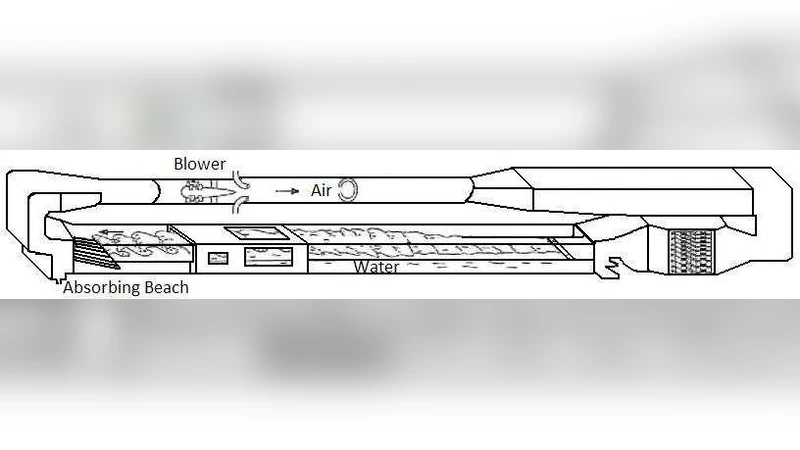
Experimental data were collected in a large wind‑wave facility at the IRPHE‑IO laboratory (Avignon, France). The tank (40 m × 3 m × 1 m) was equipped with an axial fan generating wind speeds from 0 to 15 m s⁻¹. Surface elevation η(t) was measured by two capacitance wave gauges spaced 5 cm apart, sampled at 200 Hz for 36 000 points. Instantaneous slope s(t) was derived as s(t) = −η̇(t)/c, where c is the phase velocity of the dominant wave component. Experiments covered a range of fetches (2 m to 26 m) and wind speeds (U₁₀ at 10 m height). Three representative regimes were selected for detailed analysis: (i) capillary waves at low fetch, (ii) mixed capillary‑gravity waves at moderate fetch and wind, and (iii) fully developed gravity waves at long fetch and high wind.
Parameter estimates for the three regimes are summarized in Table 1. The stability index α ranges from 1.72 to 1.99, indicating near‑Gaussian behavior for mild conditions but a clear departure (α ≈ 1.9) under strong wind and long fetch. The skewness β varies from –0.08 (almost symmetric) to –1.00 (maximally left‑skewed), reflecting the increasing asymmetry of the slope distribution as wind intensifies. Scale γ lies between 0.54 and 0.70, while the location μ is close to zero in all cases. These results demonstrate that the α‑stable model can capture both the heavy‑tail nature (through α) and the asymmetry (through β) of the measured slope data.
The authors compare the α‑stable fit with the Gram‑Charlier expansion and the Liu model. The Gram‑Charlier series, which adds skewness and kurtosis terms to a Gaussian core, fails to converge for the heavy‑tailed data and underestimates the probability of large slopes. The Liu model, being symmetric, cannot reproduce the observed negative skewness; its empirical extensions improve the fit only marginally. In contrast, the α‑stable model provides a statistically superior fit, as quantified by Kolmogorov‑Smirnov tests and log‑likelihood values, and reproduces the full shape of the empirical PDFs across all regimes.
Beyond fitting, the paper discusses implications for radar remote sensing. The backscatter coefficient σ₀(θ) depends on the slope PDF evaluated at the specular point; incorporating an α‑stable PDF directly introduces realistic asymmetry, peakedness, and heavy‑tail effects into σ₀, potentially improving sea‑state retrieval algorithms. Moreover, the four‑parameter α‑stable description offers a compact statistical summary of complex nonlinear wave dynamics (including wave‑wave and wave‑wind interactions) that are otherwise described by multifractal spectra.
The study acknowledges limitations: numerical evaluation of the PDF is computationally intensive, and the characteristic‑function‑based estimator can be sensitive to sample size and measurement noise. Future work is suggested on developing fast approximations of the α‑stable PDF, robust real‑time parameter estimation techniques, and validation with field data from satellite or airborne radar platforms.
In conclusion, the paper demonstrates that α‑stable distributions provide a powerful, flexible framework for modeling wind‑driven water‑surface slope statistics, outperforming traditional Gram‑Charlier and symmetric non‑Gaussian models, and offering promising avenues for enhanced radar backscatter modeling and sea‑state characterization.
Comments & Academic Discussion
Loading comments...
Leave a Comment