Resonant control of stochastic spatio-temporal dynamics in a tunnel diode by multiple time delayed feedback
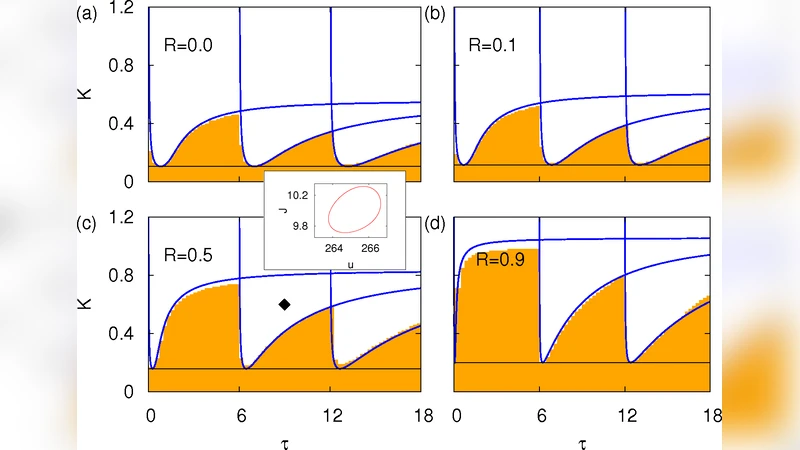
We study the control of noise-induced spatio-temporal current density patterns in a semiconductor nanostructure (double barrier resonant tunnelling diode) by multiple time-delayed feedback. We find much more pronounced resonant features of noise-induced oscillations compared to single time feedback, rendering the system more sensitive to variations in the delay time $\tau$. The coherence of noise-induced oscillations measured by the correlation time exhibits sharp resonances as a function of $\tau$, and can be strongly increased by optimal choices of $\tau$. Similarly, the peaks in the power spectral density are sharpened. We provide analytical insight into the control mechanism by relating the correlation times and mean frequencies of noise-induced breathing oscillations to the stability properties of the deterministic stationary current density filaments under the influence of the control loop. Moreover, we demonstrate that the use of multiple time delays enlarges the regime in which the deterministic dynamical properties of the system are not changed by delay-induced bifurcations.
💡 Research Summary
This paper investigates how to control noise‑induced spatio‑temporal current density patterns in a double‑barrier resonant tunnelling diode (DBRT) by employing multiple time‑delayed feedback (MTDF). The authors first formulate a spatially extended semiconductor model that couples the charge continuity equation with a nonlinear current‑voltage characteristic and includes a stochastic Poisson (shot) noise term. The control loop is introduced as a feedback signal applied to the measured current:
\
Comments & Academic Discussion
Loading comments...
Leave a Comment