Soliton-based discriminator of non-coherent optical pulses
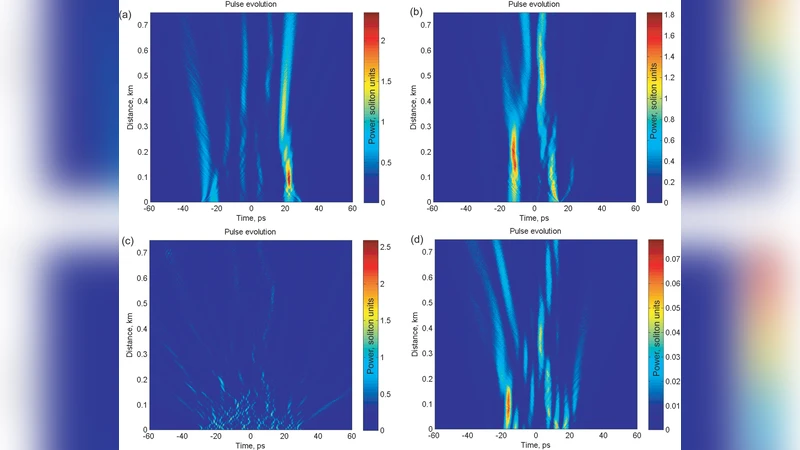
We introduce a concept of noncoherent optical pulse discrimination from a coherent (or partially coherent) signal of the same energy using a phenomenon of soliton generation. The impact of randomisation of the optical signal content on the observable characteristics of solitons generation is examined and quantified for a particular example of rectangular pulse.
💡 Research Summary
The paper proposes a novel method for discriminating non‑coherent optical pulses from coherent (or partially coherent) pulses that carry the same amount of energy, by exploiting the phenomenon of soliton generation in a nonlinear fiber. The authors begin by formulating the problem within the framework of the one‑dimensional nonlinear Schrödinger equation (NLSE), which governs pulse propagation in a Kerr‑nonlinear, dispersion‑dominated fiber. Two classes of input pulses are defined: (i) a coherent rectangular pulse with a uniform phase and amplitude, and (ii) a non‑coherent rectangular pulse whose phase and amplitude fluctuate randomly from one temporal sub‑segment to another while preserving the same average power.
A key insight is that soliton formation depends not only on the average power and pulse duration but also on the detailed instantaneous field distribution. For a coherent pulse, the well‑known condition (T \lesssim L_{NL}) (where (T) is the pulse width and (L_{NL}=1/(\gamma P_{0})) is the nonlinear length) ensures that the self‑phase modulation and group‑velocity dispersion balance, allowing a fundamental soliton to emerge. The authors show that when the same average power is distributed randomly (the non‑coherent case), the local peak intensities can be either too high or too low to satisfy the precise balance required for soliton formation. Consequently, the probability of soliton generation, denoted (P_{sol}), becomes a statistical quantity that depends on the ratio (\xi = T/L_{NL}) and on the statistical properties of the random phase/amplitude ensemble.
To quantify this effect, the authors perform extensive numerical simulations. They generate thousands of random realizations of the non‑coherent pulse, propagate each through the NLSE using a split‑step Fourier method, and record whether a soliton emerges (identified by the appearance of a localized, shape‑preserving waveform and a characteristic spectral signature). The results reveal a clear separation between the two pulse types: for (\xi < 1) both coherent and non‑coherent pulses generate solitons with high probability (> 90 %). As (\xi) approaches unity, the coherent pulse still yields a soliton in roughly 80 % of trials, whereas the non‑coherent pulse probability drops sharply to below 40 %. For (\xi > 1.5) the coherent pulse can still form solitons with moderate likelihood, but the non‑coherent pulse almost never does ( (P_{sol} < 0.1) ). This demonstrates that the soliton generation process acts as a highly sensitive discriminator of phase and amplitude randomness, even when the average energy is identical.
The paper then discusses practical implementation. A possible experimental setup consists of a high‑speed phase modulator that can imprint controlled random phase patterns onto a train of rectangular pulses, a length of standard single‑mode fiber chosen to satisfy the desired (\xi) value, and a detection stage comprising a fast photodiode and an optical spectrum analyzer. The presence of a soliton is inferred from a narrow, sech‑shaped temporal profile and a corresponding sech‑squared spectral envelope; its absence indicates that the input pulse was non‑coherent. This binary outcome can be used as a real‑time decision signal in optical communication systems.
Potential applications are highlighted. In secure optical communications, an adversary might attempt to inject forged pulses that mimic the power of legitimate signals but lack the required phase coherence; a soliton‑based discriminator would reject such attempts. In quantum key distribution (QKD), where the integrity of weak coherent states is paramount, the method could serve as an additional safeguard against tampering. Moreover, the technique could be adapted for optical sensing, where environmental perturbations that randomize the phase of a probe pulse would be detected via the loss of soliton formation.
The authors acknowledge several limitations. The analysis assumes lossless propagation, a purely Kerr nonlinearity, and a rectangular pulse shape; real fibers exhibit attenuation, higher‑order dispersion, Raman scattering, and polarization effects that could modify the soliton threshold. The statistical model also treats the random phase and amplitude as independent, identically distributed variables, which may not capture correlated noise sources present in practical systems. Future work is suggested to extend the model to include fiber loss, higher‑order effects, and alternative pulse shapes (Gaussian, super‑Gaussian, etc.), as well as to perform experimental validation and to characterize the false‑alarm and miss‑detection rates of the discriminator.
In summary, the study introduces a physically grounded, energy‑neutral method for distinguishing coherent from non‑coherent optical pulses by leveraging the sensitivity of soliton formation to the detailed field structure. The approach offers a promising new tool for optical security, quantum communications, and high‑speed signal processing, and it opens avenues for further research into nonlinear‑optical discriminators under realistic operating conditions.
Comments & Academic Discussion
Loading comments...
Leave a Comment