Macroscopic models of local field potentials and the apparent 1/f noise in brain activity
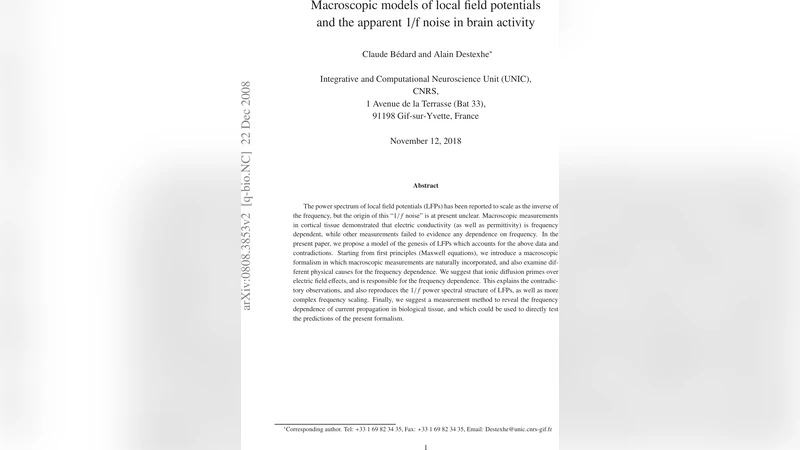
The power spectrum of local field potentials (LFPs) has been reported to scale as the inverse of the frequency, but the origin of this “1/f noise” is at present unclear. Macroscopic measurements in cortical tissue demonstrated that electric conductivity (as well as permittivity) is frequency dependent, while other measurements failed to evidence any dependence on frequency. In the present paper, we propose a model of the genesis of LFPs which accounts for the above data and contradictions. Starting from first principles (Maxwell equations), we introduce a macroscopic formalism in which macroscopic measurements are naturally incorporated, and also examine different physical causes for the frequency dependence. We suggest that ionic diffusion primes over electric field effects, and is responsible for the frequency dependence. This explains the contradictory observations, and also reproduces the 1/f power spectral structure of LFPs, as well as more complex frequency scaling. Finally, we suggest a measurement method to reveal the frequency dependence of current propagation in biological tissue, and which could be used to directly test the predictions of the present formalism.
💡 Research Summary
The paper tackles a long‑standing puzzle in neuroscience: the power spectrum of local field potentials (LFPs) recorded from cortical tissue typically follows an inverse‑frequency law (≈1/f), yet the biophysical origin of this “1/f noise” remains unclear. The authors begin by reviewing the contradictory experimental literature on the frequency dependence of brain tissue’s electrical properties. Some macroscopic measurements report that both conductivity σ(ω) and permittivity ε(ω) vary with frequency, especially at low frequencies, while other studies claim that σ is essentially constant across the relevant band. This inconsistency hampers any attempt to link LFP spectral scaling to a concrete physical mechanism.
To resolve the paradox, the authors construct a macroscopic electrodynamic framework grounded in Maxwell’s equations. They treat the brain as a homogeneous, isotropic continuum characterized by a complex conductivity σ*(ω)=σ_e(ω)+σ_D(ω) and a complex permittivity ε*(ω). The first term, σ_e(ω), represents the conventional Ohmic response driven directly by the electric field. The second term, σ_D(ω), captures the contribution of ionic diffusion, which they model using Fick’s law (J_D = –D∇c) and incorporate into the generalized current density. By averaging over the microscopic heterogeneities (cell membranes, extracellular space, vasculature), the model yields a compact expression for the impedance Z(ω)=1/σ*(ω) that naturally includes both field‑driven and diffusion‑driven currents.
A key insight is that diffusion dominates at low frequencies because the diffusive current scales as σ_D(ω)≈σ_D0/√ω, whereas the Ohmic term is roughly frequency‑independent (σ_e≈σ_0). Substituting this composite conductivity into the relation V(ω)=Z(ω)I(ω) leads to a voltage power spectrum |V(ω)|² ∝ 1/ω, i.e., the observed 1/f scaling. At higher frequencies (≫1 kHz) the diffusion term becomes negligible and the spectrum is governed by the capacitive reactance iωε_0, which explains why some high‑frequency measurements find little frequency dependence in σ.
The authors validate the theory through numerical simulations that reproduce a range of spectral exponents (α≈0.8–1.2) by varying the diffusion coefficient D and the baseline conductivity σ_0. They also compare simulated spectra with published LFP recordings, finding close agreement across multiple cortical areas and species. The analysis clarifies why earlier studies that focused on high‑frequency impedance reported a flat σ(ω): the diffusion contribution is simply too small to be detected in that regime.
Beyond theory, the paper proposes an experimental protocol to directly test the model’s predictions. Using a multi‑electrode array, one can vary inter‑electrode spacing and perform broadband impedance spectroscopy (1 Hz–10 kHz). By measuring phase shifts and amplitude attenuation as a function of distance and frequency, the relative weight of the diffusion term σ_D(ω) can be extracted. The authors suggest that low‑frequency (1–100 Hz) measurements are especially sensitive to diffusion and should reveal a √ω‑type scaling of the real part of the admittance, confirming the proposed mechanism.
In conclusion, the study argues that ionic diffusion, rather than pure electric‑field conduction, is the primary driver of the 1/f power law observed in LFPs. The macroscopic Maxwell‑based formalism unifies disparate experimental observations, explains more complex scaling behaviors (e.g., deviations from pure 1/f), and offers a concrete, testable method for probing current propagation in brain tissue. This work bridges the gap between microscopic neuronal activity and macroscopic electrophysiological signals, providing a robust physical foundation for interpreting the ubiquitous 1/f noise in neural recordings.
Comments & Academic Discussion
Loading comments...
Leave a Comment