Nonlinearity in Bacterial Population Dynamics: Proposal for Experiments for the Observation of Abrupt Transitions in Patches
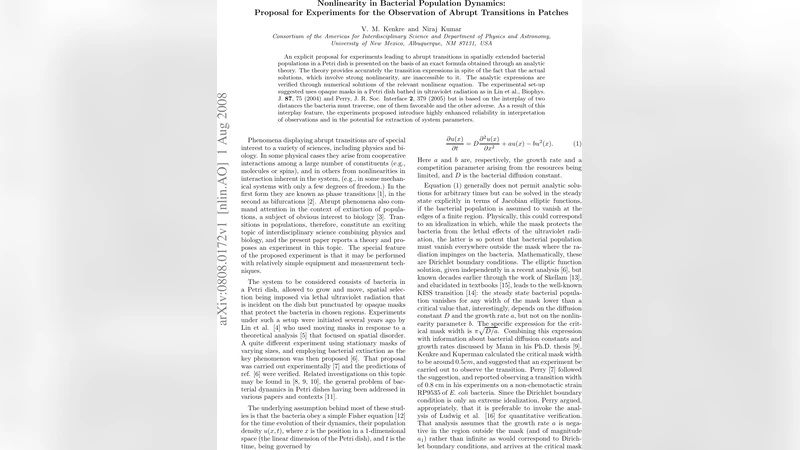
An explicit proposal for experiments leading to abrupt transitions in spatially extended bacterial populations in a Petri dish is presented on the basis of an exact formula obtained through an analytic theory. The theory provides accurately the transition expressions in spite of the fact that the actual solutions, which involve strong nonlinearity, are inaccessible to it. The analytic expressions are verified through numerical solutions of the relevant nonlinear equation. The experimental set-up suggested uses opaque masks in a Petri dish bathed in ultraviolet radiation as in Lin et al., Biophys. J. {\bf 87}, 75 (2004) and Perry, J. R. Soc. Interface {\bf 2}, 379 (2005) but is based on the interplay of two distances the bacteria must traverse, one of them favorable and the other adverse. As a result of this interplay feature, the experiments proposed introduce highly enhanced reliability in interpretation of observations and in the potential for extraction of system parameters.
💡 Research Summary
The paper presents a concrete experimental proposal to observe abrupt, non‑linear transitions in spatially extended bacterial populations grown on a Petri dish under ultraviolet (UV) illumination. Building on earlier mask‑based UV experiments (Lin et al., 2004; Perry et al., 2005), the authors introduce a configuration that involves two characteristic distances: a “favorable” distance L₁ that the bacteria can traverse under a protective opaque mask, and an “adverse” distance L₂ that they must cross in the exposed, lethal region. By treating the bacterial density n(x,t) with a reaction‑diffusion equation of Fisher‑Kolmogorov‑Petrovsky‑Piskunov (FKPP) type, they derive an exact analytical expression for the critical mask width at which the population either persists or collapses.
The governing equation is
\
Comments & Academic Discussion
Loading comments...
Leave a Comment