Influence of firing mechanisms on gain modulation
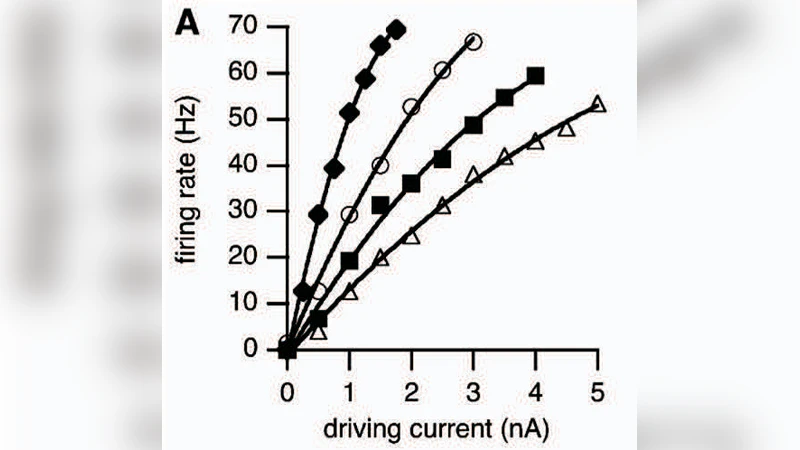
We studied the impact of a dynamical threshold on the f-I curve-the relationship between the input and the firing rate of a neuron-in the presence of background synaptic inputs. First, we found that, while the leaky integrate-and-fire model cannot reproduce the f-I curve of a cortical neuron, the leaky integrate-and-fire model with dynamical threshold can reproduce it very well. Second, we found that the dynamical threshold modulates the onset and the asymptotic behavior of the f-I curve. These results suggest that a cortical neuron has an adaptation mechanism and that the dynamical threshold has some significance for the computational properties of a neuron.
💡 Research Summary
The paper investigates how a dynamical firing threshold influences the input‑output (f‑I) relationship of cortical neurons when they are embedded in a realistic background of synaptic activity. The authors begin by evaluating the classic leaky integrate‑and‑fire (LIF) model, which uses a fixed voltage threshold to trigger spikes. Simulations show that, under noisy synaptic drive, the standard LIF model produces an almost linear increase of firing rate with injected current and fails to capture two hallmark features of real cortical neurons: (1) a steep, nonlinear rise in firing rate as the current approaches the neuronal threshold, and (2) a saturation of firing rate at high currents. This discrepancy is attributed to the lack of any adaptation mechanism in the fixed‑threshold LIF formulation.
To address this limitation, the authors introduce a “dynamical threshold” extension to the LIF model. In this variant, each spike instantaneously raises the threshold by a fixed amount ΔV, after which the threshold decays exponentially back to its baseline with a time constant τθ. This simple rule mimics the biophysical processes of sodium channel inactivation and potassium channel activation that transiently increase the excitability barrier after a spike.
Extensive numerical experiments demonstrate that the dynamical‑threshold LIF model reproduces the full shape of experimentally recorded f‑I curves. At low to moderate currents, the model exhibits a sharp, supralinear increase in firing rate, matching the “onset gain” observed in cortical recordings. As the injected current grows, the accumulated threshold elevation reduces the incremental gain, leading to a gradual flattening and eventual saturation of the firing rate—precisely the behavior seen in vivo. By systematically varying ΔV and τθ, the authors show that the onset point, slope, and asymptotic firing rate can be tuned, indicating that the dynamical threshold acts as a flexible gain‑control knob. Larger ΔV shifts the curve rightward (higher rheobase), while longer τθ lowers the maximal firing rate, reflecting stronger adaptation.
The study also explores how background synaptic noise interacts with the adaptive threshold. Increasing the variance of the noisy drive amplifies the effect of threshold dynamics, causing the neuron to adopt a more conservative firing strategy under high‑fluctuation conditions. This suggests that the dynamical threshold helps maintain a stable signal‑to‑noise ratio and prevents runaway firing in noisy environments, a computational advantage for cortical circuits.
From these results, the authors draw two main conclusions. First, a fixed‑threshold LIF model is insufficient for capturing the nuanced f‑I characteristics of cortical neurons, especially under realistic synaptic bombardment. Second, incorporating a dynamical threshold provides a parsimonious yet powerful mechanism for gain modulation, enabling neurons to adapt their input‑output transformation based on recent spiking history and the statistical properties of their inputs. The paper argues that such an adaptation mechanism is likely present in real cortical cells and has significant implications for neuronal computation, network stability, and energy efficiency.
Finally, the authors propose future directions: integrating the dynamical threshold with other adaptive processes (e.g., synaptic plasticity, voltage‑dependent conductances) to build more comprehensive neuron models, and testing the impact of these mechanisms on larger network dynamics and information processing tasks. The work positions the dynamical‑threshold LIF model as a valuable bridge between simple analytical neuron models and the rich adaptive behavior observed in biological neurons.
Comments & Academic Discussion
Loading comments...
Leave a Comment