Comment to the Paper of Michael J. Saxton: "A Biological Interpretation of Transient Anomalous Subdiffusion. I. Qualitative Model"
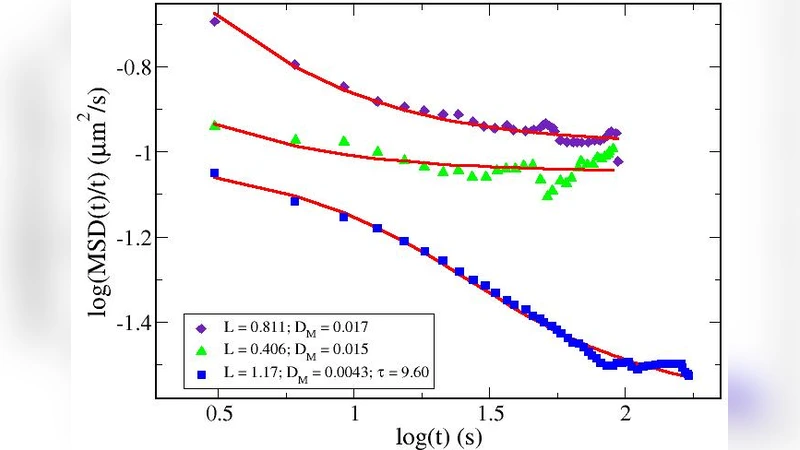
In a recent paper, Michael J. Saxton proposes to interpret as anomalous diffusion the occurrence of apparent transient sub-diffusive regimes in mean-squared displacements (MSD) plots, calculated from experimental trajectories of molecules diffusing in living cells, acquired by Single Particle (or Molecule) Tracking techniques (SPT or SMT). In this Comment, without questioning the existence of sub-diffusive behaviors, which certainly play a key role in numbers of mechanisms in living systems, we point out that the data used by J.M. Saxton can as well be fitted by a simple law, resulting from confined diffusion at short times, with a slower free diffusion superimposed at larger times. When visualizing MSD plots, the transition from short-term diffusion confined in domains of size L, to slower, longer-term free diffusion, can be confused with anomalous diffusion over several orders of magnitude of time.
💡 Research Summary
In this commentary, Destainville, Saulière and Salomé critically examine Michael J. Saxton’s 2007 proposal that transient sub‑diffusive regimes observed in single‑particle tracking (SPT/SMT) experiments within living cells should be interpreted as anomalous diffusion arising from an infinite hierarchy of spatial or energetic scales. Saxton’s model assumes that the mean‑squared displacement (MSD) follows a power law MSD(t)≈Ω t^α with α<1 over several decades, reflecting a scale‑free environment that temporarily hinders normal diffusion before crossing over to ordinary Brownian motion at very short and very long times.
The authors argue that the same experimental data can be explained far more parsimoniously by a confined‑diffusion model with a single characteristic length scale L. They introduce the analytical expression
MSD(t)=L²
Comments & Academic Discussion
Loading comments...
Leave a Comment