Empirical analysis of the worldwide maritime transportation network
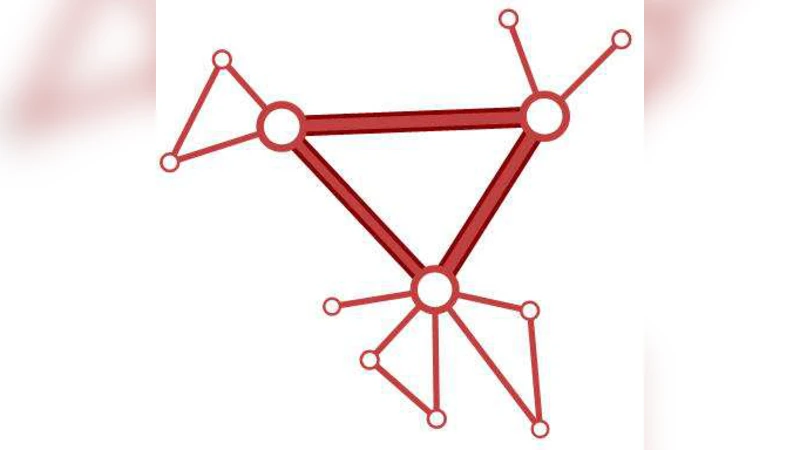
In this paper we present an empirical study of the worldwide maritime transportation network (WMN) in which the nodes are ports and links are container liners connecting the ports. Using the different representation of network topology namely the space $L$ and $P$, we study the statistical properties of WMN including degree distribution, degree correlations, weight distribution, strength distribution, average shortest path length, line length distribution and centrality measures. We find that WMN is a small-world network with power law behavior. Important nodes are identified based on different centrality measures. Through analyzing weighted cluster coefficient and weighted average nearest neighbors degree, we reveal the hierarchy structure and “rich-club” phenomenon in the network.
💡 Research Summary
The paper presents a comprehensive empirical investigation of the worldwide maritime transportation network (WMN), where ports are modeled as nodes and container liner services as links. Using data from the CI‑online database (878 ports, 1802 liner routes from 434 shipping companies), the authors construct two distinct network representations: L‑space, in which consecutive stops on a route are linked, and P‑space, in which all ports belonging to the same route are fully connected. This dual representation allows the study of both actual vessel movement (L‑space) and potential direct cargo exchanges (P‑space).
Basic topological metrics reveal that WMN exhibits small‑world characteristics. In L‑space the average degree is 9.04, clustering coefficient 0.40, and average shortest path length 3.60; in P‑space the corresponding values are 28.44, 0.706, and 2.66, respectively. Degree distributions differ markedly between the spaces. L‑space shows a truncated power‑law: for k ≤ 20 the exponent is ≈ −1.7, while for k > 20 it steepens to ≈ −2.95, reflecting the high cost of adding new connections to already busy hub ports. In contrast, P‑space degrees follow exponential distributions (α ≈ 0.0085), a pattern also observed in rail and bus networks.
Weighted analyses indicate that both link weight w and node strength s obey power‑law tails (P(w) ∼ w⁻⁰·⁹⁵, P(s) ∼ s⁻¹·³). Moreover, strength scales super‑linearly with degree (s ∝ k¹·³), meaning that high‑degree ports attract disproportionately more traffic. The line‑length distribution is exponential (α ≈ 0.13), confirming that short‑haul routes dominate while long‑haul routes, though few, connect major hubs across continents.
Clustering coefficients C(k) decay with degree in both spaces, indicating a hierarchical organization: low‑degree ports belong to tightly knit local communities, whereas high‑degree hubs are less clustered. Weighted clustering Cᵂ(k) exceeds its unweighted counterpart, highlighting the importance of heavily trafficked triads for network robustness. The average nearest‑neighbor degree k_nn(k) rises with k, evidencing a “rich‑club” phenomenon where major hubs preferentially interconnect, further enhancing efficiency.
Overall, the WMN is a small‑world, hierarchically organized, and rich‑club network where economic constraints, logistical efficiency, and hub centrality co‑determine its structure. These insights have practical implications for route planning, port development, and improving the resilience of global maritime logistics.
Comments & Academic Discussion
Loading comments...
Leave a Comment