Localized nonlinear waves in systems with time- and space-modulated nonlinearities
Using similarity transformations we construct explicit nontrivial solutions of nonlinear Schr\"odinger equations with potentials and nonlinearities depending on time and on the spatial coordinates. We present the general theory and use it to calculat…
Authors: Juan Belmonte-Beitia, Victor M. Perez-Garcia, Vadym Vekslerchik
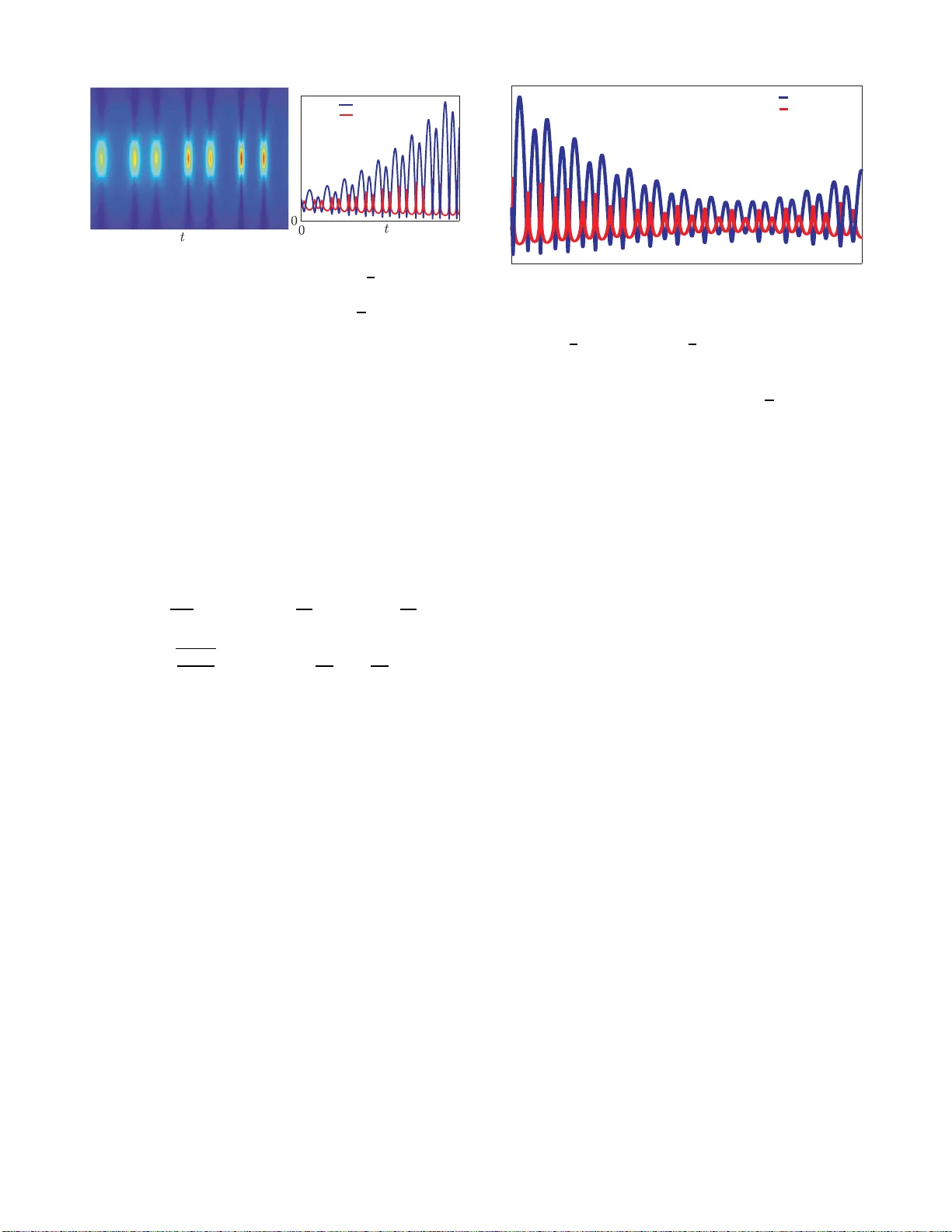
Lo calized nonlinear w a v es in systems with time- and space-mo dulated nonlinearities Juan Belmonte-Beitia 1 , V ´ ıctor M. P ´ erez-Gar c ´ ıa 1 , V a dym V eksler chik 1 , and Vladimir V. Konotop 2 1 Dep artament o de Matem´ at ic as, Escuela T´ ecnic a Sup erior de Ingenier os Industriales, and Instituto de Matem´ atic a Aplic ada a la Ci encia y la Ingenier ´ ıa (IMACI), Universidad de Castil la-L a Mancha, 13071 Ciudad R e al, Sp ain 2 Centr o de F ´ ısic a T e´ oric a e Computacional, Universidade de Lisb o a, Complexo Inter discipl inar, Avenida Pr ofessor Gama Pinto 2, Lisb o a 1649-0 03, Portugal and Dep artamento de F ´ ısic a, F aculdade de Ciˆ encias, Universidade de Lisb o a, Camp o Gr ande, Ed. C8, Piso 6, Lisb o a 1749-016, Portug al. (Dated: October 25, 2018) Using similarit y transformations we construct explicit nontrivial solutions of non linear Schr¨ odinger equations with p oten tials and n onlinearities dep ending on time and on the spatial coordinates. W e present the general theory and use it to calculate explicitly non - trivial solutions such as p erio dic (breathers), resonant or quasiperio dically oscill ating solitons. Some implications to the field of matter-w av es are also d iscussed. P ACS n um b ers: 05.45.Yv, 03.75.Lm, 42.65.Tg Intr o duction .- The co ncept of solitons was intro duce d in the seminal paper by Zabusky and Krusk al [1] to c har- acterize nonlinear so litary wa ves, which emerge fr om the delicate balance b etw een nonlinearity and disp ersion, and preserve their lo calized shap es and v elo cities during prop- agation and after collisions. It was so o n re alized that solitons are remark ably generic ob jects arising in differ- ent contexts and were observed in many e xper imen ts, for example in nonlinear optics starting with the pioneer ing works [2]. Being solutions o f integrable nonlinear wa ve equations, standard solitons app ear usually in transla - tionally inv aria nt sys tems inv olving no nlinearities which depe nd only on the relev ant fields and do not have ex- plicit dep endence on the s pace and time v ariables, b e- cause suc h dep endences t ypica lly break the symmetries of the system. How ever, thos e extra dep endences of the nonlinear interactions op en man y new pra ctical p ossibili- ties for ge ne r ation and control of solitons, what has stim- ulated their study in the las t thirt y years. It was already recognized from the very firs t pap ers [3] that spe c ific de- pendenc ie s of the equation co efficients on the spatial spa- tial co ordina tes a nd on time can pr eserve the in tegr abil- it y . More ov er this g av e an origin to new concepts, like for e x ample, non-a utonomous solitons [4] highly relev ant in nonlinear fib er optics. During the last few years these studies hav e seen an eno rmous reviv al in the context of systems ruled b y nonlinea r Schr¨ odinger (NLS) eq uations bec ause o f their applicatio ns in the mean field theory of Bose-Eins tein condens ates (BECs) [5, 6] a nd in nonlinear optics [4, 7, 8]. In BE C applications, the matter wa ves b eing the nat- ural outcome o f the mean-field des c r iption [5] hav e at- tracted a great deal of in terest in the last years [6]. The p ossibility of using F esch bach resona nces to co n trol the nonlinear ities (see e.g. [9, 10]) has lead to the pro- po sal of man y differe n t no nlinear phenomena induced by the manipulation of the scattering length either in time [11, 12, 13] or in space [14]. In no nlinea r optics, rec e nt de- velopmen ts [1 6] hav e led to the discov ery of a new classes of wav es suc h as the s o-called optica l similariton which arise when the int era ction of nonlinearity , disp ersion and gain in a high-p ow er fibre a mplifier causes the shap e of an ar bitrary input pulse to conv erg e asymptotica lly to a pulse whose shap e is self-simila r. In this letter, w e go b eyond pre vious studies con- sidering s pa ce and time dep endent nonlinearities and constructing differen t types of explicit solutions includ- ing: breathers, reso nan tly oscillating and quas ip erio dic solitary wa ves. W e provide explicit expr e s sions for all those solutions, exploring realistic choices o f no nlineari- ties which are exp erimentally feasible due to the flexible and precise control of the scattering length achiev able in quasi-one-dimensio nal BECs [15] with tunable in ter- actions. Gener al The ory.- W e consider physical s ystems ruled by the NLS equation iψ t = − ψ xx + v ( t, x ) ψ + g ( t, x ) | ψ | 2 ψ , (1) for an unknown complex function ψ ( t, x ) with a po ten tial v ( x, t ) and nonlinear it y g ( x, t ). W e fo cus o n spatia lly lo calized solutions for which lim | x |→∞ ψ ( t, x ) = 0. Our goal is to reduce Eq. (1) to the sta tio nary NLS equa tion µ Φ = − Φ X X + G | Φ | 2 Φ , (2) where Φ ≡ Φ( X ), X ≡ X ( t, x ) is a function to b e de- termined, µ is the eigenv alue of the nonlinear equation, and G is a constant. In this le tter, we ex plo re the case G = − 1, i.e ., fo cusing or attractive nonlinearity . The case G = 1 do es not p ose a n y new challenges and will be studied els e where. T o connect s olutions of E q. (1) with those of Eq. (2) we will use the tra nsformation ψ ( t, x ) = ρ ( t, x ) e iϕ ( t,x ) Φ ( X ( t, x )) . (3) Other simila r it y tr ansformations have been studied fo r NLS equa tions in different contexts [7, 1 7, 18]. 2 8 30 (b) Width Amplitude 0 (a) 12 FIG. 1: [Colo r online] Solution (17), for n = 1, ω 0 = 2, and ε = 0 . 5. Initial d ata for Eq. (11) are ν (0) = √ 2 and ν t (0) = 0. (a) Pseudocolor plot of | ψ ( x , t ) | 2 on the domain x ∈ [ − 3 , 3] (b) Width ν ( t ) (blue line) and amplitude √ γ (red line) vs t . Requiring Φ( X ) to s atisfy Eq. (2) and ψ ( t, x ) to b e a solution of E q. (1) with p otential v ( t, x ) a nd nonlinearity g ( t, x ) we get the set of eq uations ρρ t + ρ 2 ϕ x x = 0 , ρ 2 X x x = 0 , X t + 2 ϕ x X x = 0 . Let us take X ( t, x ) = F ( ξ ) , with ξ ( t, x ) = γ ( t ) x + δ ( t ) , (4) where γ ( t ) is a p ositive definite function representing the inv erse of the width of the lo calized solution, and − δ ( t ) /γ ( t ) is the po sition of the center o f mass. After some alg ebra we o btain v ( t, x ) = ρ xx ρ − ϕ t − ϕ 2 x − µ γ 4 ρ 4 , g ( t, x ) = γ 4 ρ 6 , (5) ρ ( t, x ) = r γ F ′ ( ξ ) , ϕ ( t, x ) = − γ t 4 γ x 2 − δ t 2 γ x + α, (6) where α ( t ) is an arbitra ry function of time. Thu s, ch o osing δ ( t ) , γ ( t ) a nd F ( ξ ) (or equiv alen tly ρ ( x, t )) we can generate pairs g ( x, t ) , v ( x, t ) for which the solutions of Eq. (1) can b e obtained from those of E q. (2) using Eqs. (3). W e will use this fact to construct soliton so lutions with an interesting nontrivial b ehavior. L o c alize d nonline arities.- As a fir s t application o f the metho d, we will study the case of lo calized nonlinearities. While the choice of p ossible mo dels is very rich, b ecause of applications the p ossible applications of our re sults to BECs with optica lly controled interactions [10], w e will fo cus on the gaussian sha ped nonlinearity g ( t, x ) = − γ ( t ) exp − 3 ξ 2 , (7) and the p oten tial including a com bination of harmonic and dip ole traps, which are typical in BE C exp eriments v ( t, x ) = ω 2 ( t ) x 2 + f ( t ) x + h ( t ) − µγ 2 ( t ) exp( − 2 ξ 2 ) , (8) where ω 2 ( t ) = γ 4 + γ tt γ − 2 γ 2 t / 4 γ 2 , (9a) f ( t ) = 4 γ 5 δ + δ tt γ − 2 δ t γ t / 2 γ 2 , (9b) h ( t ) = γ 2 (1 + δ 2 ) − δ 2 t / 4 γ 2 − α t . (9c) 4.5 0 0 40 Width Amplitude t FIG. 2: [Colo r online] Widt h (blue line) and amplitude (red line) versus time of the solution of Eq. (1), given b y Eq. (17) for n = 1, ω 0 = 2, and ε = 0 . 5. Initial data for Eq. (11) given by ν (0) = √ 2 , ν t (0) = − 6 . 125 √ 2. Our choice corre s ponds to ρ ( t, x ) = √ γ exp( ξ 2 / 2) . In the particular ca se wher e δ ( t ) ≡ 0, µ = 0 and α ( t ) = R γ 2 ( t ) dt , we obtain v ( t, x ) = ω 2 ( t ) x 2 , g ( t, x ) = − γ ( t ) e − 3 γ 2 ( t ) x 2 . (10) Thu s, w e hav e a har monic potential and a mo dula ted in time gaussia n nonlinear ity which would cor resp ond in BEC a pplications to a mo dulated laser b eam controlling the interactions optically . In this pap er we focus on non- linearities and p otentials given b y Eq. (10) but many other p ossibilities can b e explor e d using the sa me ideas. Defining ν = 1 / γ we rewr ite Eq. (9a ) in the form ν tt + 4 ω 2 ( t ) ν = 4 /ν 3 , (11) which is the Ermakov-Pinney equation [1 9]. T o discuss explicit s olutions we choose ω 2 ( t ) of the form ω 2 ( t ) = 1 + ε cos( ω 0 t ) , (12) where ε ∈ ( − 1 , 1 ) and 0 6 = ω 0 ∈ R . After so me alg ebra [19], we obtain fr om Eqs. (11) and (12) γ ( t ) = 2 y 2 1 ( t ) + 2( y 2 ( t ) /W ) 2 − 1 / 2 (13) where y 1 , 2 ( t ) are tw o linearly indep e nden t solutio ns of the Mathieu equa tion y tt + 4 ω 2 ( t ) y = 0 (14) and W is their W ronskian. Thu s it is E q. (14) that deter mines the temp o ral dy- namics o f the obtained solutions. Co ns idering different choices of the parameters ω 0 and ε , one can single out three different types of b ehaviors which can b e classified as follows: (i) p erio dic , when ε = 0 or in the frontiers bew tee n the stability and instability r egions o f E q. (14), (ii) r esonant , when ε 6 = 0 and y 1 , 2 ( t ) b elong to a n insta- bilit y region o f E q . (14), and (iii) quasi-p erio dic , when 3 x t x t (a) (b) FIG. 3: [Color online] Plots of | ψ ( x, t ) | 2 for breathing solu- tions of Eq. (1), given by Eqs. (17), for ε = 0 in Eq. ( 12 ), and γ ( t ) giv en by Eq. (19), corresponding to (a) n = 1 (b) n = 2. F or b oth cases, x ∈ [ − 6 , 6], t ∈ [0 , 10] and the initial data for Eq. (11) are ν (0) = √ 2 , ν t (0) = 0. y 1 , 2 ( t ) a r e in the stability regio n. Below we give examples of a ll these cas es. Concerning the so lutio ns of Eq. (2), since µ = 0, Eq. (2) b ecomes Φ ′′ + Φ 3 = 0, and its so lution is given by Φ( X ) = η sn( η X , k ∗ ) / 2 dn( η X , k ∗ ) , (15) with ar bitrary η and k ∗ = 1 / √ 2. W e choose X as X ( t, x ) = Z γ ( t ) x −∞ e − ξ 2 dξ , (16) which takes v alues in (0 , √ π ). This c hoice of X en- sures v anishing of Φ when x → − ∞ . The imp osi- tion o f zero b oundar y condition for x → + ∞ leads to η = 2 nK ( k ∗ ) / √ π where K ( k ) is the elliptic integral. This le a ds to the family of s olutions ψ n = n p γ ( t ) exp 1 2 γ 2 ( t ) x 2 + iϕ ( t, x ))Φ 1 ( nθ ( t, x ) (17) where n = 1 , 2 , ... , ϕ ( t, x ) = − ( γ t / 4 γ ) x 2 + R γ 2 ( t ) dt , Φ 1 ( θ ) = p 2 /π K ( k ∗ ) sn( θ , k ∗ ) / dn( θ , k ∗ ) (18) and θ ( t, x ) = (2 K ( k ∗ ) / √ π ) R γ ( t ) x −∞ dξ e − ξ 2 . It is easy to see that ψ ( x, t ) → 0 when | x | → ∞ in (17), thus they corres p ond to lo calized so lutions. R esonant solitons.- The r espo nse of driven nonlinea r systems to par ametric p erturbations is a field o f interest which has recen tly also be en investigated in the frame- work of the nonlinear dy na mics of BECs [19, 2 0, 21]. Starting with the particula r ca se ω 0 = 2 , in Eq. (12), we observe that for ε 6 = 0 we ar e in the instabilit y r e gion, th us, E q. (17) describ es multisoliton r esonant solutions , since ψ n ( x, t ) p ossesses n − 1 zeros . In Fig. 1 (a ), we plot a reso nan t so lution co r resp onding to n = 1 , with ω 0 = 2. Suc h re sonant soliton ha s an increasing reso nant behaviour. In Fig. 1(b), w e plot its width and ampli- tude versus time. In Fig. 2 , we also plot the width a nd amplitude versus time for the sa me soliton but now with transitory decr easing reso nan t b ehaviour, for n = 1. FIG. 4: [Col or online] Solution of Eq. (1), given by Eq. ( 17), for n = 1, and ω 2 ( t ) = 1 + ε cos( √ 2 t ), with ε = 0 . 5. The initial data for Eq. (11) are ν (0) = 2 3 / 4 and ν t (0) = 0. (a) Pseudocolor plot of | ψ ( x, t ) | 2 (b) W id th ν ( t ). It is rema rk able that we a r e able to construct explicit resonant so litons in a very co mplicated s c enario including a loca lized pulsating nonlinearity and a parametr ically mo dulated trap a long the longitudinal direction. Our so- lutions pr ovide the first explic it res onant solution in a parametrica lly mo dulated one dimensio nal BE C. A sim- ilar r e sonant b ehavior was observed in Ref. [21] when driving a BEC, with p ositive sc a ttering length, along the transverse dir e c tion. W e hav e also studied the stability of these m ultisoliton solutions g iv en by Eq. (17) b y computing numerically their evolution under finite amplitude per turbations. W e hav e found that n = 1, which co rresp onds to the gr ound state, is a s table solution while hig he r solitons are un- stable (sma ll p erturba tions take the solution far from its original pr o file). Br e athing solitons.- When ε = 0 , ω ( t ) = 1, a nd then γ ( t ) = √ 2 1 + 3 cos 2 (2 t ) − 1 / 2 (19) is per io dic. Then, the so lutions giv en by Eq. (17) ar e explicit multisoliton br e athing solutions . In Fig. 3 , we plot so me of them corr e spo nding to n = 1 , 2. Only fo r n = 1 (the gro und state) the breathing soliton is stable. Quasip erio dic solutions.- In o rder to give an exa mple of a quasip erio dic solution o f Eq. (1) we cho ose ω 0 = √ 2 in Eq. (12) ensur ing that the solutions y 1 , 2 ( t ) of the Math- ieu equa tion (14) b elong to the stability region. Then Eq. (12) has t wo incommensurable frequencies. In this wa y , γ ( t ), is a quasip erio dic solution and the solutions (17) show a quasip erio dic b ehaviour. An example o f this behavior is shown in Fig. 4. Using Eqs. (17), w e can also constr uct multisoliton quasip erio dic solutions . Moving s olitons.- As a fina l example of the many p ossi- ble solutions which ca n b e c o nstructed using this method, we will present solutions of Eq. (1) when the cen tre of mass of the soliton mov es with non-z ero velocity . T o do so, w e set f ( t ), in Eq. (9b) equal to zero , with δ 6 = 0 which leads to the following equa tion for δ ( t ), δ tt − 2 ( γ t /γ ) δ t + 4 γ 4 δ = 0 . (20a) 4 FIG. 5: [Color online] Pseudocolor plots of sol utions of Eq. (1), when the centre of mass of t h e soliton mov es with non- zero v elo cit y . (a) Quasip eriodic solution, with x ∈ [ − 3 , 3], t ∈ [0 , 40], fo r ε = 0 . 6 and ν ( 0) = (2 √ 2) 1 / 2 , ν t (0) = 0. (b) Resonant increasing solution, with x ∈ [ − 6 , 6], t ∈ [0 , 40] for ε = 0 . 3 and ν (0) = √ 2 , ν t (0) = 0. In this situation, the p otent ial v and the nonlinearity g are s till given by E q. (10) by just taking α t = γ 2 (1 + δ 2 ) − δ 2 t / 4 γ 2 . (20b) F o rtunatelly , Eqs . (20) can b e solved to ge t δ ( t ) = δ ∗ cos(2 τ ( t )) , α ( t ) = τ ( t ) + 1 4 δ 2 ∗ sin(4 τ ( t )) , (21) where τ ( t ) = R γ 2 ( t ) dt , and δ ∗ is a n arbitrary constant. Hence, we ca n again obtain breathers , resonant solutions and quasip erio dic solutions while, at the same time the center of ma ss of the soliton moves in a co mplex wa y according to Eq. (21). As exa mples, in Fig. 5, we show quasip erio dic [Fig. 5(a)] and resona n t so litons [Fig. 5(b)] while the center of mas s mov es accor ding to E q. (21). Conclusions.- W e have cons tructed explicit solutions of nonlinea r Schr¨ odinger equatio ns in co mplicated yet re- alistic scenar ios w ith s patially inhomogene o us and time depe ndent potentials a nd no nlinearities. Althoug h the range of no nlinearities and p otentials for which this can be do ne is very wide, we hav e fo cused our study in mo d- ulated harmonic p otentials a nd lo caliz e d nonlinearities. W e ha ve explicitly ca lc ula ted brea thers, resonant soli- tons, qua siper io dic solitons and solutions with nontrivial motion of the cen ter o f mass, related to different situ- ations of physical interest in the fie ld of Bose-E instein condensates. The ideas con tained in this pa per can also be applied to study m ulticomp onent systems, nonlinea r optical sys tems, higher - dimensional situations, etc., and may help in the design of p otentials and nonlinear ities to control the dynamics of Bose-E instein co ndensates. This work has b een pa rtially supp orted by gra n ts FIS2006- 0 4190 (Minister io de Educaci´ o n y Ciencia, Spain), P CI08-009 3 (Jun ta de Co m unidades de Ca stilla- La Ma nc ha, Spain), and POCI/FIS/5 6 237/2 004 (Eur o- pea n Pr ogram FEDER a nd FCT, Portugal). [1] N. J. Zabusky and M. D. Krusk al, Phys. Rev. Lett., 15 , 240 (1965). [2] A. Hasega wa and F. T app ert, Appl. Phys. Lett ., 23 , 142 (1973); ibidem 23 , 171 (1973). [3] H.-H . Chen and C.-S. Liu, Phys. Rev. Lett. 37 , 693 (1976); M. Brusc hi, D. Levi, and O. R agnisco, Nuov o Cimen to, 53 , 21 (1979); R. Scharf and A. R . Bishop, Phys. Rev. A 43 , 6535 (1991); V. V. Konotop, O. A. Chub yk alo, and L. V´ azquez, Phys. Rev. E 48 , 563 (1993). [4] V.N. S erk in, A. Hasega wa, and T.L. Belyaev a, Phys. R ev. Lett., 98 , 074102 (2007). [5] L. P . Pitaevskii, and S. Stringari, Bose-Einstein Conden- sation , Oxford Universit y Press, Oxford (2003). [6] Emer gent Nonli ne ar Phenomena in Bose-Einstein Con- densates: The ory and Exp erim ent , P .G. Kevrekidis, D.J. F rantzesk akis, and R. Carretero-Gonz´ alez, Ricardo (Eds.), Springer, V ol. 45 (2008). [7] V.N. Serkin, and A. Hasega w a, Phys. Rev . Lett, 85 (2000) 4502; JETP Lett. 72 , 89 (2000); S el T op. Quant. Electron, 8 , 418 (2002); V.N. Serk in, A. Hasegaw a, and T. L. Belyaev a, Phys. Rev . Lett. 92 , 199401 (2004) [8] Y. Kivshar and G. P . Agraw al, Optic al Soli tons: F r om fib ers to Photonic crystals , A cademic Press (2003). [9] S. Inouye, et al. , N ature 392 , 151 (1998). [10] M. Theis, et al . , Phys. Rev. Lett. 93 , 123001 (2004). [11] B. A. Malomed, Sol iton Management in Perio di c Sys- tems , Springer (New Y ork, 2006). [12] F. Kh. Ab du llaev, et al. , Phys. Rev . Lett. 90 , 230402 (2003); V . M. P´ erez-Garc ´ ıa, V. V. Konotop, and V. A. Brazhnyi, Phys. Rev. Lett. 92 , 220403 (2004). [13] H. Saito and M. Ueda, Phys. Rev. Lett. 90 , 040403 (2003); F. Kh . Ab dullaev, et al . , Phys. Rev. A 67 , 013605 (2003); G. D . Montesinos , V. M. P´ erez-Garc ´ ıa and P . T or- res, Physica D 191 , 193 (2004); V. V. Konotop and P . P acciani, Ph ys. Rev. Lett. 94 , 240405 (2005); V . Zhar- nitsky and D. Pel inovsky , Chaos 15 , 037105, (2005); A. Itin, T. Morishita, and S. W atanab e, Phys. Rev. A, 74 , 033613 (2006). [14] M. I. Ro das-V erd e, H. Michinel and V. M. P ´ erez-Garc ´ ıa, Phys. Rev. Lett . 95 (2005) 153903; H. Sak aguchi and B. Malomed, Phys. Rev. E 72 , 046610 (2005); G. Theocharis, et al. , Phys. Rev. A 72 , 033614 (2005); F. K. A bd ullaev and J. Garnier, i bid. , 72 , 06160 5(R) (2005); J. Garnier and F. K. Abd ullaev, ibid. 74 , 013604 (2006); M. A. Porter, et al . , Physica D , 229 , 104 (2007); J. Belmon te-Beitia, et al. , Phys. Rev . Lett. 98 , 064102 (2007). [15] The relations a s ≪ a ⊥ ≪ λ ≪ a k , where a s is the scat- tering length, a ⊥ , a k , are the transverse and longitudinal trap lengths, and λ is a c haracteristic spatial scale of the w av e pac ket, define the region in whic h the one dimen- sional approac h describ es correctly the p hysics inv olv ed. [16] S. A. Ponomarenk o and G. P . Agraw al, Phys. Rev. Lett., 97 , 013901 (2006 ); J. M. Dudley et al , N ature Physics, 3 , 597 (2007). [17] V. M. P ´ erez-Garc ´ ıa, P . J. T orres, and V. V. K onotop, Physica D 221 , 31 (2006). [18] S. Chen and L. Y i, Phys. Rev. E 71 , 016606 . (2005) [19] V. M. P´ erez-Garc ´ ıa, P . J. T orres and G. D. Montesinos, SIAM J. Appl. Math. 67 , 990 (2007). [20] K. Staliunas, S. Longhi, and G. J. de V alc´ arcel, Ph ys. Rev. Lett. 89 , 210406 (2002); Y u. V. Bludov and V. V. Konotop, Phys. Rev. A 75 , 053614 (2007); [21] P . Engels, C. Atherton, and M. A. Hoefer, Phys. R ev. Lett. 98 , 095301 (2007).
Original Paper
Loading high-quality paper...
Comments & Academic Discussion
Loading comments...
Leave a Comment