Optimal Dynamic Resource Allocation for Multi-Antenna Broadcasting with Heterogeneous Delay-Constrained Traffic
This paper is concerned with dynamic resource allocation in a cellular wireless network with slow fading for support of data traffic having heterogeneous transmission delay requirements. The multiple-input single-output (MISO) fading broadcast channe…
Authors: Rui Zhang
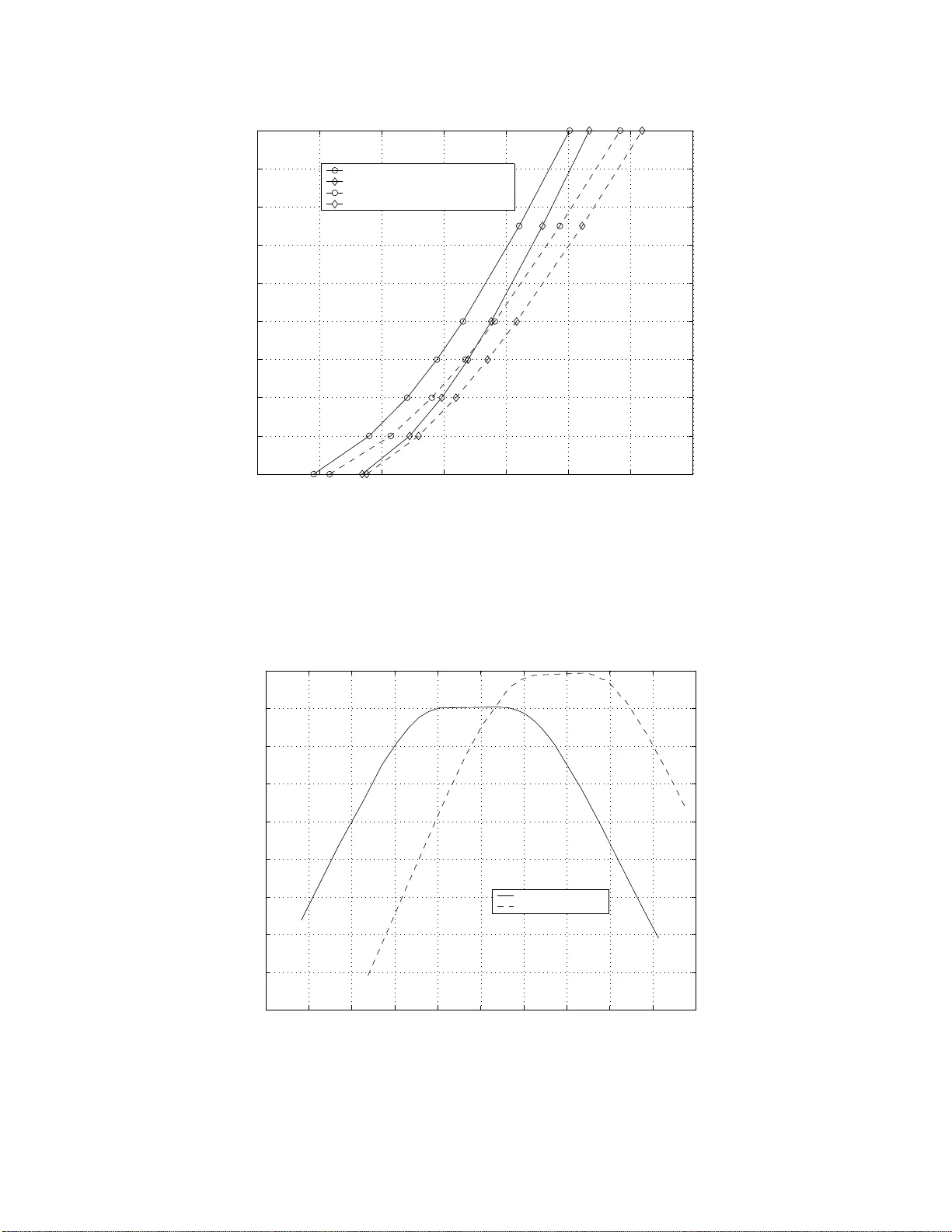
Optimal Dynamic Resource Allocat ion for Multi-Antenna Broadcasting with Heter ogeneous Delay-Constrained T raf fic Rui Zhang Abstract This paper is concerned with dynamic resource allocation in a cellular wireless network with slo w fading for support of data traf fic ha ving heterogeneou s transmission delay requiremen ts. The multiple-input single-output (MISO) fading broadcast channel (BC) is of interest where the base station (BS) employs multiple transmit antennas to re alize s imultaneou s downlink transmission at the same freq uency to multiple mobile user s eac h having a single receiv e antenna. An informatio n-theor etic approach is taken for characterizing capacity limits of the fading MISO- BC u nder various transmission d elay consideration s. First, this paper studies transmit optimization at th e BS when some users hav e delay-toleran t “p acket” data and the oth ers hav e delay -sensitiv e “circu it” data for tran smission at the same time. Based on the con ve x op timization fram ew ork, an on line resour ce allocation algorithm is deri ved that is amenable to efficient cross-layer imp lementation of both physical (PHY) -layer m ulti- antenna tran smission and media-access-co ntrol (MA C) -layer multiuser rate schedulin g. Secondly , this paper in vestigates the fund amental throu ghpu t-delay tradeo ff for transmission over the fading M ISO-BC. By compar ing the network through put un der completely relaxed versu s strictly zero transmission delay constraint, this paper characterizes th e limitin g lo ss in sum c apacity du e to the vanishing delay toleranc e, termed the d elay pen alty , under some prescribed user fairness f or transmit rate a llocation. Index T erms Broadcast chan nel (BC), fading ch annel, multi-an tenna, through put-delay trade off, dyn amic resource alloca- tion, cross-layer optimization, co n vex op timization. I . I N T RO D U C T I O N In mobile wireless networks, co mmunications typ ically take place over time-varying channe ls. When this time- variati on or fading is “ fast” s uch that the c hannel state information (CSI) is hardly obtainab le at the transmitter , a classical a pproach for mitigating impairments of fading to transmission reliability is to apply diversity technique s , Submitted to IEEE Journal on Selected T o pics in Signal Processing (JSTS P), special issue on MIMO-optimized transmission systems for delive ring data and rich content, July 15, 2007, revised February 28, 2008. Rui Zhang is with the Institute for Infocomm Research, Singapore. E- mail: rzhang@i2r .a-star .edu.sg 2 such a s coded diversity , antenna diversity , an d pa th diversity . On the other hand , whe n the fading c hanne l chan ges sufficiently “slowly” such tha t the transmitter is able to acquire the CSI, a ge neral approa ch to compens ate for the fading is dyna mic resour ce a llocation , w hereby transmit res ources su ch as power , bit-rate, antenna-be am and bandwidth are dyna mically a llocated based upo n the fading distribution. E f fecti ve implemen tation o f d ynamic resource allocation usually requires joint optimization of both phys ical (PHY) -layer transmission and me dia- acces s-control (MA C) -layer rate scheduling in the c lassical co mmunication p rotocol stac k, a nd thus demands for a new cross-layer design methodology . One challeng ing issue to be addre ssed for dynamic resource allocation in tomorro w’ s wireless networks is how to me et with u ser’ s heterogeneo us transmission quality-of-service (QoS) requirements. Among o thers, the demand for wireless high-speed connectivity for both delay-tolerant “packet” da ta and delay-sensitive “c ircuit” data is expected to rise significantly in the next de cade. There fore, study on both spe ctral and po we r ef ficient transmission sc hemes for sup port of hetero geneous delay -constrained data traffic becomes an important area for research. On the othe r hand, be cause tolerance for a larger transmission d elay inc urred to d ata traf fic a llo ws for more flexible transmit power a nd rate a daptation over time and thereby leads to a lar ger transmission throughput in the long term, there is in gene ral a fundamental throughput-delay tradeof f ass ociated with dynamic re source allocation over fading ch annels. Cha racterization of suc h fundamental tradeo f f is ano ther important research problem becaus e it reveals the ultimate gain achiev able by dynamic resource allocation under realistic transmission delay requirements. This pape r is aimed to provide concrete answe rs to the aforementione d proble ms by cons idering the fad- ing broadca st cha nnel (BC) that models the do wn link transmission in a typical wireless cellular netw ork. An information-theoretic a pproach is taken in this pape r to address some fund amental l imits o f dy namic res ource allocation for the fading BC unde r vari ous transmission delay conside rations. In particular , the fading multiple- input single-output (MISO) BC is conside red wh ere multi-antennas are equipped at the transmitter of the bas e station (BS), and single ante nna at the rec eiv er of eac h mobile u ser . Be cause o f multi-antennas at the transmitter , spatial multiplexi ng can be used at the BS t o support simultaneous transmission to mobile users at the sa me frequency , named space -di vision-multiple-access (SDMA). A slow-f ading en vironment is as sumed, a nd for sim- plicity , the block-fading (BF) channel model is ado pted. It is further assumed that the BS has perfect use r CSI at its transmitter , a nd is thu s able t o perform a cen tralized dynamic resource allocation based u pon multiuser 3 channe l cond itions. This paper’ s main c ontributi ons are summa rized as follows: • This paper stud ies op timal dy namic resou rce allocation for the fading MISO-BC when both no-delay- constrained (NDC) p acket da ta and delay-co nstrained (DC) circuit data are required for transmission at the s ame time. A cros s-layer optimization a pproach is taken for jointly optimizing c apacity-ach ieving multi- antenna transmiss ion at the PHY -layer and fairness-ens ured mu ltiuser rate sc heduling at the MA C-layer . A con vex o ptimization frame work is formulated for minimi zing the average transmit power at the BS su bject to bo th NDC and DC user rate con straints. A two-laye r Lagrange-duality method is shown to be the key for solving this problem. Based on this method, a novel o nline res ource alloca tion algo rithm that is a menable to efficient cross -layer implementation is deri ved, and its c on vergence beh avior is validated. • This pape r in vestigates the fundamental throughput-delay tradeoff for the fading MISO-BC under optimal dynamic reso urce allocation. By tak ing the dif ference betwee n the ma ximum su m-rate of users und er NDC and DC transmis sion subject to the c onstraint that the rate portion a llocated to eac h user nee ds to be regulated by the same p rescribed rate-pr ofile , the p aper presents a novel ch aracterization for the limiting los s in s um capac ity due to the vanishing d elay tolerance, termed the d elay pen alty , for the fading MISO-BC. T hereby , the delay penalty provides the answ er to the following interesting ques tion: Comparing no delay constraint versus zero-delay cons traint for all use rs in the network, how much is the ma ximum percen tage of throughput gain achiev able for all us ers by optimal dynamic resource allocation? The ca pacity region unde r NDC or DC transmiss ion for a fading single-input sing le-output (SISO) BC has been characterized in [1], [2], an d for a fading SISO multiple-acces s channel (MA C) in [3 ], [4]. A s imilar scena rio like in this pa per with mixed NDC and DC trans mission has a lso been con sidered in [5] for the single -user multiple-input multiple-output (MIMO) fading ch annel, and in [6] for the fading S ISO-BC. The co mparison of a chiev able rates b etween NDC and DC transmission has bee n co nsidered in [7] for the f ading MIMO-BC. Howe ver , none of the above p rior work has conside red transmit optimization with mixed NDC and DC d ata traf fic for the fading MISO-BC, which is addres sed in this paper . O n the other h and, throug hput-delay and power -de lay tradeoffs for communica tions over fading channe ls b y exploiting the combined CSI and data buf fer occupa ncy at the tr ansmitter have been intensi vely studied in the literature f or both single-user and multiuser transmission (e.g., [8] and reference s there in). In contrast to prior work, this pa per studies the throughput-delay tradeoff from a new p erspective by cha racterizing the fundame ntal de lay pe nalty in the network through put owing 4 to stringen t (ze ro) trans mission delay constraint impos ed by all u sers. The concep t of rate-profile, or its equiv alent definitions for specifying some ce rtain fairness in user rate alloca tion have a lso been c onsidered for the SISO multiuser chann el in [9], [10], an d for the MIMO multiuser chan nel in [11], [12]. Howev er , to the author’ s best knowledge, applica tion of rate-profile for characterizing the delay penalty in a multiuser fading channe l is a novelty of this paper . There h as been recently a great dea l o f study on the real-time res ource allocation algorithm, named proportional fair sch eduling (PFS) (e.g., [13]-[16] and refe rences therein), which maximizes the ne twork throughput by exploiting the multiuser ch annel variati on a nd at the sa me time, maintains ce rtain fairness among users in rate allocation. However , PFS is unable to guarantee any prescribed user rate demand. In this paper , a novel online s chedu ling algorithm is propos ed to ensu re that all NDC a nd DC u ser rate d emands are sa tisfied with the minimum transmit power co nsumption at the BS. The remainder of this paper is or gan ized as foll ows. S ection II illustrates the f ading MISO-BC model and provides a summary of kn own information-theoretic results for it. Section III addres ses the optimal cross-layer dynamic resource alloca tion problem for supp ort of simultaneous transmiss ion of heterogen eous delay-constrained traf fic. Se ction IV charac terizes the fund amental through put-delay tradeo f f for the fading MISO-BC. Section V provides the simulation results. Finally , Section VI conc ludes the p aper . Notation : This paper uses uppe r c ase boldface letters to denote matri ces and lo wer case boldf ace letters to indicate vec tors. For a squa re matrix S , | S | and S − 1 are its determinant an d in verse, respec ti vely . For a ny general matrix M , M † denotes its conjugate transpose. I and 0 indica te the ide ntity matrix a nd the vec tor with a ll z ero elements, respe cti vely . k x k denotes the Euc lidean norm of a vector x . E n [ · ] d enotes statistical expectation over the ran dom variable n . R M denotes the M -dimensional real Euclidean sp ace and R M + is its non-negative orthant. C x × y is the space of x × y matrices with complex numb er entries. The distributi on of a circularly-symmetric complex Gaussian (CSCG) vector with the mea n vector x and the covariance matrix Σ is den oted by C N ( x , Σ ) , and ∼ mean s “d istrib uted as”. { x } + denotes the non-nega ti ve part of a real n umber x . I I . S Y S T E M M O D E L A MISO-BC chan nel with K mobile users eac h having a single anten na and a fixed BS having M an tennas is con sidered, as shown in Fig. 1. Becau se o f multi-antennas at the transmitter , the BS is able to e mploy SDMA to trans mit t o multiple us ers s imultaneously at the s ame b andwidth. It is assumed tha t the transmission t o all users is s ynchronou sly divided into cons ecutive blocks, and the fading occ urs from block to bloc k but remains 5 static within a b lock of sy mbols, i.e., a block-fading (BF) model. Fu rthermore, it is ass umed that the fading process is stationary and ergodic. Let n be the rando m variable repres enting the f ading state. At fading state n , the MISO-BC can be con sidered as a discrete-time channe l represe nted b y y 1 ( n ) . . . y K ( n ) = h 1 ( n ) . . . h K ( n ) x ( n ) + z 1 ( n ) . . . z K ( n ) , (1) where y k ( n ) , h k ( n ) and z k ( n ) d enote the rec eiv ed signal, the 1 × M downlink channe l vector , and the rec eiv er noise for use r k , respectively , a nd x ( n ) ∈ C M × 1 denotes the transmitted signa l vector from the BS. It is ass umed that z k ( n ) ∼ C N (0 , 1) , ∀ n, k . The transmitted signal x ( n ) c an be further expressed as x ( n ) = K X k =1 b k ( n ) s k ( n ) , (2) where b k ( n ) ∈ C M × 1 and s k ( n ) represent the p recoding vector an d the t ransmitted codew ord sy mbol for user k , respec ti vely , at f a ding state n . It is assumed tha t each user employs the op timal Gaussian code-book wit h normalized cod ew ord symbols, i.e., s k ( n ) ∼ C N (0 , 1) , ∀ k, n , and the rate of cod e-book for user k at fading state n is de noted as r k ( n ) . The allocated transmit power to user k a t fading state n is deno ted b y p k ( n ) , and it ca n be e asily veri fied that p k ( n ) = k b k ( n ) k 2 . The total transmit power from the BS at fading state n is then expressed as p ( n ) = P K k =1 p k ( n ) . Assuming full knowledge of the fading distribution, the BS is ab le to ad apt the transmiss ion power p k ( n ) a nd rate r k ( n ) (co uld be both zero for s ome fading state n ) allocated to user k in order to exploit multiuser ch annel variations over time. As suming a lon g-term power constraint (L TPC) p ∗ over dif ferent fading s tates, the average transmit power at the BS needs to satisfy E n [ p ( n )] ≤ p ∗ . Supposing that p ( n ) is g i ven, the achiev able rates { r k ( n ) } of users nee d to be con tained in the corresponding capac ity region of the MISO-BC at fading state n , den oted by C BC n ( p ( n ) , { h k ( n ) } ) . Charac terization of C BC n will become us eful later in this paper when the issue on how to dynamically alloca te transmit po wer and us er rates at different fading s tates is a ddresse d. In many ca ses, it is more con venien t to app ly the celebrated duality result between the Ga ussian BC an d MA C [17] to trans form the c apacity region charac terization for the original BC to that for its dual MA C. Ass uming that in the du al S IMO-MA C of the original MISO-BC con sidered in this paper , each user e mploys the optimal Gau ssian code-boo k of ra te R k ( n ) an d has a transmit power q k ( n ) , k = 1 , . . . , K , at fading s tate n , by [18] the ca pacity region of the d ual SIMO-MA C at fading state n ca n be expressed a s C MAC n ( { q k ( n ) } , { h † k ( n ) } ) = ( R ( n ) ∈ R K + : X k ∈ J R k ( n ) ≤ log 2 X k ∈ J h † k ( n ) h k ( n ) q k ( n ) + I , ∀ J ⊆ { 1 , . . . , K } ) , (3) 6 where R ( n ) , [ R 1 ( n ) , . . . , R K ( n )] . The duality result [17] then states that an achie vable rate region for the original MISO-BC at fading state n with total transmit power p ( n ) can be expresse d as R BC n ( p ( n ) , { h k ( n ) } ) = [ { q k ( n ) } : q 1 ( n )+ ... + q K ( n ) ≤ p ( n ) C MAC n ( { q k ( n ) } , { h † k ( n ) } ) . (4) It was later shown in [19] that the above ac hiev able rate region R BC n ( p ( n ) , { h k ( n ) } ) is indee d the capacity region C BC n ( p ( n ) , { h k ( n ) } ) f or the Gaussian BC. By applying the abov e results, it follo ws that any rate-tuple { r k ( n ) } that is ac hiev able i n the fading MISO-BC by the us er power -tuple { p k ( n ) } is also ac hiev a ble as { R k ( n ) } , R k ( n ) = r k ( n ) , ∀ k , n , in the dual fading SIMO-MA C by the correspond ing user power -tuple { q k ( n ) } p rovided that P K k =1 p k ( n ) = P K k =1 q k ( n ) , ∀ n . Note that the p ower alloca tion p k ( n ) for u ser k in the o riginal BC is not neces sarily e qual to q k ( n ) in the dua l MA C. T he transforms between { q k ( n ) } and { p k ( n ) } as well a s the correspond ing precoding vectors { b k ( n ) } for the s ame se t of a chiev able rates { r k ( n ) } and { R k ( n ) } can be found in [17], and are thus omitted in this pap er for bre vity . I I I . D Y N A M I C R E S O U R C E A L L O C A T I O N U N D E R H E T E RO G E N E O U S D E L A Y C O N S T R A I N T S This s ection studies optimal dyna mic resource allocation algorithms for the BF MISO-BC to support si- multaneous trans mission of data traffic with heterogene ous transmit rate and delay constraints. F irst, Se ction III-A provides the problem formulation. Then, Section III-B p resents the s olution base d o n the Lagran ge-duality method of con vex optimization. At last, Section III-C deriv es a n online algorithm that is suitable for real-time implementation of the propos ed s olution. A. Problem F ormulation The follo wing rule for transmission s chedu ling at the BS is c onsidered . As illustrated in F ig. 2, each u ser’ s d ata arising from some higher layer application is first placed into a dedicated buf fer . Periodica lly , the BS removes some of the data from each user’ s buf fer , jointly encode s the m into a b lock of symbols, and then broadc asts the encoded block to a ll users through the MISO-BC. For simplicity , it is assumed that all use r’ s data arriv e to their dedica ted buf fers s ynchrono usly at the beginning o f e ach s cheduling period. The data arri val p rocesse s of use rs are assu med to b e stationary and er godic, mutually indepen dent, and also indep endent of their cha nnel realizations. This paper co nsiders tw o types of da ta traf fic with very d if ferent delay requ irements: One is the 7 delay-tolerant p acket data a nd the other is the d elay-sens iti ve circuit d ata, for which the follo wing as sumptions are made: • For a user with packet data application, the data arri v al process is not neces sarily co ntinuous in time and the amount of arri ved data in each sche duling period may b e variable. All data are s tored in a b u f fer of a su f ficiently lar ge size suc h that data dropping due to buf fer overflo w does not oc cur . In orde r for the schedu ler to op timally exploit the ch annel d ynamics, the allocated transmit rate can be variable du ring each schedu ling pe riod. It is assume d tha t there is always a suf ficient amount of backlogg ed data in the b uffer for transmission. The sch eduler ne eds to ensure that the transmit rate a veraged over sched uling periods in the long run is no smaller than the average data a rri v al rate . Howev er , the exact amount o f delay incurred to transmitted data in the buff er is not gua ranteed. • For a us er with circuit data application, the d ata arri val process is co ntinuous with a constant-rate during each scheduling p eriod. The arr i ved data is stored i n the buf fer for o nly one sc heduling period and then transmitted. Therefore, the amoun t of delay incurred to transmitted data is minimal. Howe ver , the sc heduler needs to ensu re a c onstant-rate transmission independe nt of ch annel condition. Let the users with pa cket data ap plications be rep resented by t he s et U NDC where NDC refe rs to no-delay- constrained, an d the use rs with circuit data a pplications represen ted by U DC where DC refers to delay-constrained . In this paper , we con sider optimal dyna mic resource allocation to minimize the average transmit power at the BS over dif ferent fading states subjec t to the constraint that all NDC a nd DC use r rate demands are satisfied . Re call that r k ( n ) den otes the rate assigned to us er k b y the scheduler at fading s tate n . For a NDC us er , it is required tha t the av erage trans mit rate E n [ r k ( n )] over fading states needs to be no smaller than its average data arriv a l rate R ∗ k . In contrast, for a DC user , the trans mit rate r k ( n ) at any fading state n needs to satisfy its constant data arri v al rate R ∗ k . By considering the dual SIMO-MA C in Sec tion II with R k ( n ) = r k ( n ) , q k ( n ) = p k ( n ) , ∀ k , n , optimal allocation of transmit rates and powers at different n can be obtained by so lving the follo wing optimization 8 problem ( P1 ): Minimize E n " K X k =1 q k ( n ) # (5) Subject to E n [ R k ( n )] ≥ R ∗ k , ∀ k ∈ U NDC (6) R k ( n ) ≥ R ∗ k , ∀ n, ∀ k ∈ U DC (7) R ( n ) ∈ C MAC n { q k ( n ) } , { h † k ( n ) } , ∀ n (8) q k ( n ) ≥ 0 ∀ n , k . (9) For the above problem, the objecti ve func tion and all the c onstraints excep t (8) a re affine. It can also be verified from (3) that C MAC n is a conv ex s et with any giv en po siti ve { q k ( n ) } . Therefore, Proble m P1 is a co n vex optimization problem [20] and thus can be solved using efficient con vex op timization tech niques, a s will be shown next. B. Proposed Solution The Lag range-dua lity method is u sually applied whe n a co n vex optimization problem can be mo re co n veniently solved in its dua l domain than in its original form. In this pap er , we also app ly this method for solving Problem P1. The fi rst step for the Lagrange-du ality me thod is to introduce du al variables associated with some constraints of the original problem. For Problem P1 that has multiple con straints, there are also various ways to introduc e dual variables that might result in diff erent dual problems . For the follo wing p roposed solution, dual variables are chosen with an aim to facilitate implementing it in the real time, a s will be explained later in Section III-C. As a first step , a set of du al variables { µ k } , µ k ≥ 0 , k ∈ U NDC , a re introduc ed for the NDC users with resp ect to (w .r .t.) their average-rate co nstraints in (6). The Lagrangia n of Problem P1 ca n be then expressed a s L ( { q k ( n ) } , { R k ( n ) } , { µ k } ) = E n " K X k =1 q k ( n ) # − X k ∈U NDC µ k ( E n [ R k ( n )] − R ∗ k ) . (10) Denote the set of { q k ( n ) } an d { R k ( n ) } sp ecified by the remaining con straints in (7), (8) and (9) as D , the Lagrange dual function is expresse d as g ( { µ k } ) = min { q k ( n ) ,R k ( n ) }∈D L ( { q k ( n ) } , { R k ( n ) } , { µ k } ) . (11) The dual problem of the original (primal) problem can be then expres sed as max µ k ≥ 0 ,k ∈U NDC g ( { µ k } ) . (12) 9 Becaus e the primal problem is con vex a nd also satisfies the Slater’ s c ondition [20], 1 the duality gap betwee n the optimal value of the primal problem and that of the dual problem becomes zero. Th is su ggests that the problem at hand can b e equiv a lently so lved in its dual domain by first minimizing the Lagrangian L to obtain the d ual function g ( { µ k } ) for some given { µ k } , and then max imizing g ( { µ k } ) over { µ k } . Considering first the minimization problem in (11) to obtain g ( { µ k } ) for s ome gi ven { µ k } . It is interesting to observe that this problem can be solved by considering p arallel s ubproblems each corresp onding to one fading state n . From (10), the sub problem for f ading state n can be written as ( P2 ) Minimize K X k =1 q k ( n ) − X k ∈U NDC µ k R k ( n ) (13) Subject to R k ( n ) ≥ R ∗ k , ∀ k ∈ U DC (14) R ( n ) ∈ C MAC n { q k ( n ) } , { h † k ( n ) } (15) q k ( n ) ≥ 0 ∀ k . (16) Hence, the dual function g ( { µ k } ) can be obtained by solving sub problems all ha ving the identical structure, a technique u sually referred to a s the Lagrange-dual dec omposition . For so lving Problem P2 for each n , a new set of po siti ve dual variables δ k ( n ) , k ∈ U DC , are introduc ed for DC us ers w .r .t. their constan t-rate c onstraints in (14). The Lagrang ian of Prob lem P2 can be then expresse d as L n ( { q k } , { R k } , { δ k ) } ) = K X k =1 q k − X k ∈U NDC µ k R k − X k ∈U DC δ k ( R k − R ∗ k ) . (17) Note that for brevity , the index n is dropp ed in q k ( n ) , R k ( n ) and δ k ( n ) in (17) since it is ap plicable for all n . The correspon ding dual func tion can be then defined as g n ( { δ k } ) = min { q k ,R k }∈D n L n ( { q k } , { R k } , { δ k } ) , (18) where D n denotes the set of { q k } an d { R k } sp ecified by the remaining c onstraints (15) an d (16) at fading state n . The assoc iated du al problem is then defined as max δ k ≥ 0 ,k ∈U DC g n ( { δ k } ) . (19) Similar like P1, Problem P2 can also be so lved by first minimizing L n to obtain the du al function g n ( { δ k } ) for a given set o f { δ k } , a nd then maximizing g n over { δ k } . From (17), the minimization prob lem in (18) can be 1 Slater’ s condition requires that the f easible set of the optimization problem has non-empty i nterior , which is in general the case for Problem P1 because wi th suf ficiently large average transmit power , any fi nite user rates { R ∗ k } are achiev able. 10 expressed a s Minimize K X k =1 q k − X k ∈U NDC µ k R k − X k ∈U DC δ k R k (20) Subject to R ∈ C MAC n { q k } , { h † k } (21) q k ≥ 0 ∀ k . (22) Let β k = µ k , if k ∈ U NDC , a nd β k = δ k , if k ∈ U DC , and π be a permutation over { 1 , . . . , K } s uch that β π (1) ≥ β π (2) ≥ · · · ≥ β π ( K ) , and let β π ( K +1) , 0 . Thanks to the polymatroid structure of C MAC n [3], the above problem can be simplified as ( P3 ) Minimize K X k =1 q k − K X k =1 β π ( k ) − β π ( k +1) log 2 k X i =1 h † π ( i ) h π ( i ) q π ( i ) + I (23) Subject to q k ≥ 0 ∀ k . (24) Problem P3 is con vex b ecaus e all the cons traints are affine and the objec ti ve function is con vex w .r .t. { q k } . Hence, this p roblem ca n be solved, e.g. , by the interior -point method [20 ]. In App endix I, a n alternativ e method based on the block -coordinate d ecent principle [21] by iterativ ely optimizing q k with all the othe r { q k ′ } , k ′ 6 = k as fixed is presen ted. T his me thod can b e c onsidered as a generalization of the algorithm desc ribed in [22], where all β π ( k ) , k = 1 , . . . , K , are equ al. So far , solutions have be en presented for the minimization problem in (11) to obtain g ( { µ k } ) for s ome giv en { µ k } and that in (18) to obtain each g n ( { δ k } ) for s ome gi ven { δ k } . Next, the rema ining issue on how to u pdate { µ k } to maximize g ( { µ k } ) for the dua l p roblem in (12) is add ressed. Similar techniques can also be used for updating { δ k } to maximize g n ( { δ k } ) for ea ch dual problem in (19). From (10) and (11), it is observed that the dual function g ( { µ k } ) , tho ugh affine w .r .t. { µ k } , is n ot directly dif ferentiable w .r .t. { µ k } . Hence, s tandard metho d like Ne wton method canno t be employed to u pdate { µ k } for maximizing g ( { µ k } ) . An appropriate choice h ere may be the sub-gradient-bas ed method [21] tha t is capable of hand ling non-dif ferentiable functions. This method is an iterati ve algorithm and at each iteration, it requires a sub-gradient a t the correspon ding value of { µ k } to update { µ k } for the next it eration. Suppos e tha t after solving Problem P2 for some gi ven { µ k } at all fading states of n , the obtained rates a nd powers are d enoted by { R ′ k ( n ) } and { q ′ k ( n ) } , respec ti vely , k ∈ U NDC . The follo wing lemma then provides a suitable sub-gradient for { µ k } : Lemma 3.1: If L ( { q ′ k ( n ) } , { R ′ k ( n ) } , { µ k } ) = g ( { µ k } ) , the n the vector ν defined as ν k = R ∗ k − E n [ R ′ k ( n )] for k ∈ U NDC is a sub-gradient of g a t { µ k } . 11 Pr o of: Since for any set of θ k ’ s, θ k ≥ 0 , k ∈ U NDC , it follo ws that g ( { θ k } ) ≤ L ( { q ′ k ( n ) } , { R ′ k ( n ) } , { θ k } ) (25) = g ( { µ k } ) + X k ∈U NDC ( θ k − µ k ) R ∗ k − E n [ R ′ k ( n )] . (26) Hence, it is clear that the optimal d ual solution { µ ∗ k } that maximizes g ( { µ k } ) should not lie in the h alf space represented by { θ : P k ∈U NDC ( θ k − µ k ) ν k ≤ 0 } . As a result, any ne w upda te of { µ k } for the next it eration, denoted by { µ new k } , sho uld sa tisfy P k ∈U NDC ( µ new k − µ k ) ν k ≥ 0 . By applying Lemma 3.1, a s imple rule for up dating { µ k } is as follows: 2 µ new k = µ k + ∆ R ∗ k − E n [ R ′ k ( n )] + , k ∈ U NDC , (27) where ∆ is a small pos iti ve step s ize. S imilarly , at each f ading s tate n , { δ k ( n ) } can be also updated towards maximizing g n ( { δ k ( n ) } ) as δ new k ( n ) = δ k ( n ) + ∆ R ∗ k − R ′ k ( n ) + , k ∈ U DC , (28) where { R ′ k ( n ) } , k ∈ U DC , is the solution obtained after solving Prob lem P3 at fading state n . T o su mmarize, the prop osed solution is impleme nted by a two-laye r Lagran ge-duality method. At the fi rst layer , the algorithm searches iterativ ely for { µ ∗ k } with which the average-rate constraints of a ll NDC u sers are s atisfied. At each iteration, an update for { µ k } is generated and then passe d to the sec ond layer where the algorithm starts a parallel search for { δ ∗ k ( n ) } , each for a fading state n , such that the constant-rate constraints of all DC users are satisfied at all fading s tates. The resu ltant { R ′ k ( n ) } of NDC users is then passed ba ck to the first layer for another upda te of { µ k } . The overall a lgorithm is summarized in T able I. Th e complexity of this algorithm ca n be deriv ed as follows. Suppo sing that the ellipsoid method is used to iterati vely update dual variables, the required number of iterations for co n vergence has O ( m 2 ) , w here m is the size of the problem. Let K NDC and K DC denote the size of U NDC and U DC , respectiv ely , whe re K NDC + K DC = K . Therefore, the ellipsoid me thod will n eed O ( K 2 NDC ) iterations for obtaining { µ ∗ k } and O ( N K 2 DC ) iterations for obtaining { δ ∗ k ( n ) } for all f ading states, assuming the nu mber of fading states n is finite an d is e qual to N . The complexity for solving Problem P 3 is O ( K 2 ) by , e.g. , the interior -po int method. Hen ce, the total complexity of the algorithm is O ( K 2 NDC K 2 DC K 2 N ) . 2 Notice that a more ef ficient sub-gradient-bas ed method to it erativ ely find { µ ∗ k } is the ellipsoid method [23], which at each iteration remov es the half space specified by { θ : P k ∈U NDC ( θ k − µ k ) ν k ≤ 0 } for searching { µ ∗ k } . 12 At last, take note that the proposed algorithm jointly optimizes transmit powers and rates together with decoding orders (determined by the ma gnitudes of { µ ∗ k } and { δ ∗ k ( n ) } [3]) of us ers at all fading states for the dua l fading SIMO-MA C. By the BC-MA C duality result [17], the optimal transmit powers, rates , precoding vectors as well as encod ing orders of us ers for the original fading MISO-BC can be obtaine d. C. Online Algorithm One important issu e y et to be a ddresse d for implemen ting the propose d solution for Problem P1 is how to relax its as sumption on perfect knowledge o f the distrib ution of fading state n . No tice that this knowledge is neces sary for computing the achiev able average rates { E n [ R ′ k ( n )] } , k ∈ U NDC , which are neede d for updating the dua l variables { µ k } for NDC users in (27). In prac tice, although it is reas onable to a ssume ea ch user’ s fading chan nel is stationa ry an d ergodic, the s pace of f ading states is us ually con tinuous and infin ite and hence it is infeasible for the BS to initially a cquire the ch annel distribution information for all users at all fading states . Even thou gh this information is av ailable for of f-li ne implementation of the propo sed solution, the computationa l complexity becomes un bounde d as the number of fading states go es to infin ity . Therefore, in this pa per a mo dified “online ” algorithm is de veloped that is able to adaptively up date { µ k } to wards { µ ∗ k } as trans mission p roceeds over time. Let t denote the transmiss ion block index, t = 1 , 2 , · · · . The key for the online algorithm is to approximate the s tatistical average E n [ R ′ k ( n )] , k ∈ U NDC , at time t by a time av erage of transmitted rates up to time t − 1 , denoted by ¯ R k [ t − 1] , where ¯ R k [ t ] is obtained as ¯ R k [ t ] = (1 − ǫ ) ¯ R k [ t − 1] + ǫ R k [ t ] , (29) where R k [ t ] is the trans mitted rate at time t , and ǫ , 0 < ǫ ≪ 1 , is a parameter t hat controls the con ver gence speed of ¯ R k [ t ] → E n [ R ′ k ( n )] as t → ∞ . B y replacing E n [ R ′ k ( n )] by ¯ R k [ t − 1] in (27), { µ k [ t ] } at time t ca n be updated acc ordingly such tha t as t → ∞ it con ver g es to { µ ∗ k } bec ause ¯ R k [ t ] → R ∗ k , ∀ k ∈ U NDC . This modified online algorithm is summarized in T able II. Cross-Layer Implementation: The p roposed online algorithm bas ed on the L agrange -duality me thod is amenable to cross-layer implementation of both PHY - layer transmission and MA C-layer multiuser rate scheduling. One cha llenging issue for cross -layer optimization is on how to select us eful and s uccinct information for different layers to exchange an d share so as to optimize their individual o perations. Th e Lagrange -duality method p rovides a new de sign paradigm for efficient cross-layer information exchan ge. On the one hand, since the MA C-layer has 13 the knowledge of user rate d emands { R ∗ k } as well as their de lay requ irements (NDC or DC), it ca n update dual variables { µ k [ t ] } an d { δ k [ t ] } ac cordingly (see T a ble II), and then pa ss them to the PHY -layer for c omputing the desirable transmission rates of use rs { R k [ t ] } to meet with ea ch user’ s sp ecific rate dema nd. On the othe r han d, the PHY -layer is able to provide the MA C-layer the upda ted { R k [ t ] } that op timize the PHY -layer transmission by solving Problem P 3 given { µ k [ t ] } and { δ k [ t ] } . The refore, by exchanging dual variables a nd transmission rates between PHY - and MA C-laye rs, cross -layer dyna mic resource allocation can be efficiently implemented . Comparison with PFS: It is interes ting to draw a comparison b etween the prop osed online a lgorithm and the well-known PFS algorithm. PFS is des igned for rea l-time multiuse r rate sched uling in a mobile wireles s network to ensure some ce rtain fairness for us er rate allocation while maximizing the ne twork throughpu t. PFS applies to packet data transmission and hence is equ i valent to the transmiss ion sce nario con sidered in this paper wh en only NDC users a re present. At eac h time t , transmit rates { R k [ t ] } assigned to users b y PFS max imize the weighted sum-rate of us ers P k ω k [ t ] R k [ t ] , where the we ights are given by ω k [ t ] = 1 ¯ R k [ t − 1] and ¯ R k [ t − 1] is the es timated av erage rate for us er k up to time t − 1 the sa me as expres sed in (29). Using this rule, it ha s been shown (e.g., [13]-[16] and references therein) tha t a s t → ∞ , ¯ R k [ t ] → R ∗ k where R ∗ k is the average achiev able rate for use r k in the long term. Fu rthermore, PFS ma ximizes P k log( R ∗ k ) over the expected capacity region (please refer to De finition 4.1 i n Section IV) and , hence , { R ∗ k } ca n be considered as the unique intersection of the surface specified by Q k R k = c and the bound ary of the expected capacity region. Becaus e of the log ( · ) function, the rate assignments among users by PFS are regulated in a balanc ed manne r such that no use r can be alloca ted an overwhelmingly larger rate than the othe rs even if it has a supe rior channel cond ition. Howe ver , the achiev able rates { R ∗ k } by PFS are not guaranteed t o satisfy any desired rate demand of users. In contrast, t he proposed online algorithm ensures that e ach NDC us er’ s average-rate d emand is s atisfied by a pplying a dif ferent rule (see T able II) for updating us er weights { µ k [ t ] } for the resource allocation p roblem (see Problem P 3) to b e solved at each t . I V . T H R O U G H P U T - D E L A Y T R A D E O F F For a single-us er BF cha nnel, the expe cted capa city [24], [25] and the delay-limited capa city [4] can be considered as the fading channel ca pacity limits under two extreme ca ses of delay c onstraint. The former is always lar g er than the latter and their dif ference, termed the delay p enalty , then characterizes a funda mental throughput-delay tradeof f for dyna mic reso urce alloca tion ov er a single-user f ading channel. T he delay pe nalty 14 may or may not be significantly l arge for a sing le-user fading channel. F or example, f or a SISO-BF channel, the de lay penalty can be su bstantial beca use the delay-limited capacity is indee d zero if the fading cha nnel is not “in vertible” with a finite average transmit power [26]. However , when multi- antennas are employed at the transmitter a nd/or rec eiv er , the delay-limited ca pacity of the MIMO-BF chan nel can be very close to the c hanne l expected ca pacity [27 ], i.e., a negligible delay penalty . This result can be explained b y the “chan nel-hardening” eff ect [28] f or random MIMO channels, i.e., the mutual information of independ ent MIMO channels becomes less v ariant bec ause of antenn a-induced spac e diversit y , and hence the value of power and rate ada ptation over time vanishes a s the nu mber of an tennas bec omes large. Th is result indica tes that from an information-theoretic viewpoint, MIMO chann els a re h ighly suitable for transmission of real-time and d elay-cons trained data traf fic. Characterization of the dela y penalty in a multiuser fading chan nel is more challenging. The capa city definitions for the single-us er fading c hanne l c an be extended to the multiuser cha nnel as the expected c apacity re gion u nder no delay constraint for all users, and the delay-limited capac ity re gion under zero-de lay co nstraint for all users. Therefore, the delay p enalty ca n be meas ured by directly compa ring the se two capa city regions. Sinc e cap acity region co ntains the achie vable rates of all users, it lies i n a K -dimensional space where K is the number of users in the network. As a result, cha racterization of capa city region be comes incon venien t as K become s large. In order to overcome this dif ficulty , prior research work usua lly adopts the maximum su m-rate of u sers over the capac ity region, termed the su m c apacity , a s a s implified me asure for the n etwork throughp ut. Ap plying the s um capac ity to the corresp onding capacity region, the expected throughput and the delay-limited thr oughput can b e defined accordingly . Howev er , the conv entional sum capa city does not consider the rate alloca tion a mong use rs. As a cons equen ce, each user’ s allocated rate portion in the expe cted through put may be dif ferent compa red to that in the delay-limited throughput. Henc e, a similar mea sure for the de lay pena lty like in the single-user cas e by taking the d if ference between the expected and delay-limited throughpu t looks problematic at a first glance in the multiuser ca se. This sec tion presents a novel characterization of the fundame ntal throu ghput-delay tradeoff for the fading MISO-BC. Instea d of cons idering mixed NDC and DC trans mission like Section III, it is ass umed here that there are only NDC o r DC us ers present, a nd comparison of the ne twork throughpu t und er the se two extreme cas es o f delay constraint is of interes t. Becaus e it is ha rd to comp are directly the expected a nd the delay-limited ca pacity region as the numb er of users be comes large, the sum capacity is also considere d for simplicity . Howe ver , unlike 15 the con ventional sum capac ity that does not gu arantee the amou nt of rate alloca tion among use rs, the expecte d and delay-limited throug hput in this pap er are define d under a n ew constraint tha t regulates each use r’ s alloca ted rate portion base d upo n a prescribed rate-pr ofile . T hen, the delay penalty is charac terized by the dif feren ce between the expected and delay-limited throughput un der the same rate-pr ofi le . The above concep ts are more explicitly defined as follows: Definition 4.1: The expected capa city region for a fading MISO-BC expressed in (1) und er a L TPC p ∗ can be defined as C e ( p ∗ ) = r ∈ R K + : r k = E n [ R k ( n )] , ∀ k , R ( n ) ∈ C BC n ( p ( n ) , { h k ( n ) } ) , ∀ n, E n [ p ( n )] ≤ p ∗ . (30) Similarly , the dela y-limited c apacity region is d efined as C d ( p ∗ ) = r ∈ R K + : r k = R k ( n ) , ∀ k , n, R ( n ) ∈ C BC n ( p ( n ) , { h k ( n ) } ) , ∀ n, E n [ p ( n )] ≤ p ∗ . (31) Definition 4.2: Let R ∗ k denote k -th user’ s rate demand (a verage-rate for a NDC use r or con stant-rate for a DC user) k = 1 , . . . , K , the rate profile is defined as a vector α = { α 1 , . . . , α K } , where α k = R ∗ k P K k =1 R ∗ k , k = 1 , . . . , K . Definition 4.3: The expec ted through put C e ( p ∗ , α ) (de lay-limited throug hput C d ( p ∗ , α ) ) as sociated with a prescribed rate-profile α un der a L TPC p ∗ is de fined as the maximum su m-rate of users over the expec ted (delay-limited) c apacity region und er the constraint that the av erage (constant) transmit rate of ea ch user r ∗ k must satisfy r ∗ i r ∗ j = α i α j , ∀ i, j ∈ { 1 , . . . , K } . Definition 4.4: For some given delay profile α and L TPC p ∗ , the delay pena lty C DP ( p ∗ , α ) is equal to C e ( p ∗ , α ) − C d ( p ∗ , α ) . The proposed de finition for delay penalty is illustrated in Fig. 3 for a 2-user c ase. From Defin ition 4 .4, it is noted that characterization of C DP ( p ∗ , α ) requires that of both e xpected and delay-limit ed throughput. In the next, we prese nt the algorithm for charac terizing C e ( p ∗ , α ) for some g i ven p ∗ and α . Similar a lgorithm can also be developed for characterizing C d ( p ∗ , α ) and is thus o mitted here for brevit y . Acc ording to Definition 4.3 and (30) and using the BC-MA C duality result in Sec tion II , the expected throug hput C e ( p ∗ , α ) can be ob tained by 16 considering the following optimization problem ( P4 ): Maximize C e (32) Subject to E n [ R k ( n )] ≥ C e α k , (33) R ( n ) ∈ C MAC n { q k ( n ) } , { h † k ( n ) } , ∀ n (34) q k ( n ) ≥ 0 ∀ n , k . (35) E n " K X k =1 q k ( n ) # ≤ p ∗ (36) Similar like Prob lem P 1, it can b e verified that the a bove problem is a lso con vex, a nd h ence c an be solved using c on vex optimization tech niques. Here, ins tead of solving Problem P4 from a scratch, the propo sed solution transforms this problem into a specia l form of Problem P1 an d hence the sa me algorithm for Problem P1 can be applied. First, cons idering the following trans mit power minimization problem ( P5 ) for su pport of any a rbitrary set of av erage-rate d emands { R ∗ k } that satisfy a giv en rate-profile co nstraint α , i.e ., R ∗ i R ∗ j = α i α j , ∀ i, j ∈ { 1 , . . . , K } : Minimize E n " K X k =1 q k ( n ) # (37) Subject to E n [ R k ( n )] ≥ R ∗ sum α k , ∀ k , (38) R ( n ) ∈ C MAC n { q k ( n ) } , { h † k ( n ) } , ∀ n (39) q k ( n ) ≥ 0 ∀ n , k . (40) Note tha t R ∗ sum , P K k =1 R ∗ k . It is o bserved that the above problem is a s pecial ca se of Problem P1 if all use rs have NDC transmission , i.e., tho se c onstant-rate cons traints for DC users in (7) are removed. Hence, Prob lem P5 can also be s olved by the proposed algorithm in T able I. Let q ∗ denote the minimal transmit power o btained after solving Problem P5. Noti ce that C e ( p ∗ , α ) is a n on-decrea sing function of p ∗ with some g i ven α becaus e the expected c apacity region C e ( p ∗ ) corresponding to a larger p ∗ always c ontains that with a smaller p ∗ . Hence, if p ∗ > q ∗ , it ca n b e inferred that C e ( p ∗ , α ) mus t be larger than the assu med R ∗ sum . Otherwise, C e ( p ∗ , α ) ≤ R ∗ sum . By using this property , C e ( p ∗ , α ) can be easily obtained by a bisection se arch [20]. Fair ness Penalty: The re is an interes ting relationsh ip betwe en the con ventional sum ca pacity over the expe cted capac ity region, and the expected throughput as a function of delay -profile, a s shown in Fig. 4 for a 2-user case . The sum capac ity is obtained by maximizing the su m-rate of users over the expec ted capac ity region so as to maximally exploit t he multiuser di versity g ain in the achie vable network throughput. Ho we ver , it d oes not 17 guarantee the resu ltant rate a llocation among us ers. Let the res ultant rate p ortion allocated to each u ser in the sum cap acity be s pecified by a rate-profile vector α ∗ . In c ontrast, the expec ted throughput maximizes the su m-rate of users under a ny arbitrary rate-profile vector α e . Due to this h ard fairness c onstraint, the expec ted throughpu t in general is smaller than the s um capacity if α e is dif ferent from α ∗ , and t heir dif ferenc e can be used as a measure of the fairness pe nalty , which is denoted by C FP ( p ∗ , α e ) , C e ( p ∗ , α ∗ ) − C e ( p ∗ , α e ) . Similarly , the fairness p enalty can also be defin ed in the de lay-limited case. Asymptotic Re sults: Consider the MISO-BC with asymptotically large n umber of users K b ut fixed number of transmit antenna s M at the BS. It is as sumed that the ne twork is homog eneous w here all users hav e mutually independ ent but identically d istrib uted ch annels, a nd have ide ntical rate d emands, i.e., α k = 1 K , ∀ k . Under these assumptions , i n [29] it h as bee n shown tha t as K → ∞ the expe cted throughput C e under any finite power constraint p ∗ scales like M log 2 log K + O (1) . In the follo wing theorem, we provide this a symptotic result for the delay-limited throughp ut: Theorem 4.1: Un der the assumption of s ymmetric fading and symmetric u ser rate demand, the delay-limited throughput C d for a fading MISO-BC unde r a L TP C p ∗ is uppe r- bounded by p ∗ ρ log 2 as K → ∞ , where ρ is a constant depend ing so lely o n the chann el distribution. Pr o of: Please refer to Appe ndix II. The above res ults suggest very dif ferent behaviors of the achiev able n etwork throu ghput with NDC versu s DC transmission as K beco mes lar ge. On the one hand, for the expected through put, transmission delay is not an issue and hence the optimal strategy is to s elect only a subset of users with the best joint channel realizations for transmission at o ne time. The expe cted through put thu s scale s line arly with M and in double-logarithm with K , for which the former is due to spatial multiple xing gain and the latter arises fr om the multiuser- div ersity gain. On the other han d, in the delay-limited case, a constan t-rate transmission nee ds to be ensu red for a ll u sers. Consequ ently , as the number of users increases , though more degrees of fr eedom are av a ilable for optimi zing transmit paramete rs su ch a s precoding vectors and enco ding order of users, the d elay-limited throughp ut is ev entually sa turated. Th e above comparison demonstrates tha t for a SDMA-based network with a large user population, transmission delay can be a critical factor that prevents from achieving the ma ximum asymptotic throughput. Howe ver , notice that this may not be the ca se for the network having similar M an d K , as will be verified late r by the simulation results. 18 V . S I M U L A T I O N R E S U LT S In this section, simulation res ults are presen ted for evaluating the p erformances of dyn amic resource alloca tion for the fading MISO-BC under various transmiss ion delay considerations. Since the network throughput is contingent on transmit delay requ irements a s well as many other factors such as numbe r of tr ansmit an tennas at the BS , number of mobile users, use r c hanne l con ditions an d rate requirements, and the trans mit power constraint at the BS, various c ombinations of these factors are co nsidered in the follo wing simulations with an aim to demons trate how transmission d elay interplays with other factors in de termining the ach iev a ble network throughput. The simulation results a re pre sented in the follo wing sub sections. Note tha t in the follo wing simulation, user ch annel vectors { h k ( n ) } are indep endently generated from the p opulation of CSCG vectors, and if not stated otherwise, it is as sumed tha t h k ( n ) ∼ C N ( 0 , I ) , ∀ k . A. T rans mit Optimization for Mixe d NDC and DC T raffic First, consider a MISO-BC with M = K = 4 with tw o u sers ha v ing NDC transmission and the other two having DC transmission. For con ven ience, it is assumed that the t arget a verage trans mit rates for the tw o users with NDC transmission are both eq ual to R ∗ NDC , and the target constant rates for the two users with DC trans mission both equal to R ∗ DC . Let γ den ote the loa ding fac tor representing the ra tio of the total amount of NDC traf fic to that of the sum of NDC a nd DC traffic, i.e., γ , R ∗ NDC R ∗ NDC + R ∗ DC . If the proposed algorithm in T able I that a chieves optimal dynamic resource allocation is used, the required av erage trans mit power at the BS is expe cted to be the minimum for satisfying both NDC and DC u ser rate demands for any given γ . For purpose of c omparison, two suboptimal transmission sch emes are also considered: • T ime-Division-Multiple-Access (TDMA): A simple transmission s cheme is to d i vide e ach trans mission pe riod into K consecutive e qual-duration time-blocks, e ach dedica ted for transmission of o ne use r’ s data traffic. If coherent p recoding is applied a t e ach fading state n , i.e. , the precode r for u ser k , defin ed as ˆ b k ( n ) , b k ( n ) k b k ( n ) k , is equal to h † k ( n ) k h k ( n ) k , ∀ k , it c an be shown tha t the MISO-BC is deco mposab le into K single-user SISO channe ls. Dep ending on eac h user’ s delay requirement, c on ven tional water- filling power control [24] a nd channe l-in version power co ntrol [27] can be applied ov er different fading s tates for use rs with NDC a nd DC transmission, resp ectiv ely , to achieve the mi nimum average trans mit power under the gi ven user rate demand. 19 • Zer o-F or cing (ZF) -Based SDMA: An other p ossible transmission scheme is also base d on the SDMA principle, i.e., supp orting all user’ s transmission simultaneous ly by multi-antenna spa tial multiplexing at the B S. Howe ver , instead of using the dirty-paper-coding (DPC)-based n on-linear p recoding as sumed in this paper , a s imple ZF-ba sed linea r p recoding is e mployed at the BS. The ZF -based p recoder ˆ b k ( n ) for user k at each fading state n maximizes the user’ s o wn equiv alent c hanne l ga in k h k ( n ) ˆ b k ( n ) k 2 subject to the constraint that its a ssociated co -channe l interference must b e c ompletely removed, i.e., h k ′ ( n ) ˆ b k ( n ) = 0 , ∀ k ′ 6 = k . Like TDMA, ZF-ba sed precod ing also dec omposes the MISO-BC into K (assuming K ≤ M ) single -user SISO channe ls, an d thereby o ptimal single-user power con trol schemes can be applied. In Fig. 5 and Fig. 6, thes e three sch emes are compa red for two c ases of network throu ghput, on e c orresponding to the sum-rate of users 2 R ∗ NDC + 2 R ∗ NDC = 6 bits/complex d imension, and one correspon ding to 2 bits/complex dimension. The required average t ransmit p ower o ver 500 randomly gene rated chan nel realizations is plotted versus the load ing factor γ . First, in F ig. 5 it is ob served that in the c ase o f high throug hput (ba ndwidth- limited), ZF-based SDMA outperforms TDMA be cause of its lar ger spectral efficiency by spatial multiple xing. Howe ver , in the cas e of lo w throug hput (power-l imited), in Fig. 6 it is o bserved that TDMA achieves better power efficiency than Z F-based SDMA. T his is be cause c oherent prec oding in TDMA provides more diversit y a nd a rray gains, which become more d ominant over s patial multiplexing ga ins at the power -limi ted regime. Se condly , it is observed that in both cas es of high and low throughpu t, the propose d scheme always outperforms both TDMA and ZF-based SDMA giv en a ny loading factor γ . This is becau se the propose d s cheme optimally balances the achiev able spa tial multiplexing, array , a nd di versity gains for the fading MISO-BC. Thirdly , it is observed that for all schemes, the required trans mit power associated with some γ , γ < 0 . 5 , is al ways lar ger than tha t with 1 − γ (e.g., compa ring γ = 0 . 1 and γ = 0 . 9 ), i.e., giv en the same portion of data tr affic in the total t raf fic, NDC traffic has a b etter power efficiency than DC traffic. This is beca use NDC traffic a llo ws for more flexible dynamic resource allocation than DC traffic and thus leads to a better power e f ficiency . B. Conver genc e of Online Algorithm The con ver gence of the online algorithm in T able II is v alidated by simulations. For simplicity , it is assumed that o nly NDC use rs are present in the network. A MISO-BC with K = 2 and M = 4 is considered . The tar get av erage-rates f or user-1 an d user -2 are 3 and 1 bits/complex dimens ion, respecti vely . The online algorithm is implemented for 300 0 con secutive transmission s with randomly ge nerated chan nel realizations. Initially , the dual 20 variables are s et as µ 1 [0] = µ 2 [0] = 1 , and the estimated av erage t ransmit rates as ¯ R 1 [0] = ¯ R 2 [0] = 0 . The updates for { ¯ R k [ t ] } and { µ k [ t ] } as t proc eeds are shown in Fig. 7 and Fig. 8 , respectiv ely , for ∆ = ǫ = 0 . 01 . It is obse rved that the o nline algo rithm conv erges to the optimal dual vari ables and target average-rates for both users a fter a co uple of hundred s of iterations. S imulations res ults (no t sh own in this pape r) for other values o f ∆ and ǫ ind icate that in g eneral a larger step size leads to a faster algorithm conv ergence but also results in mo re frequent oscillations. C. Throughput-Delay T radeoff Fig. 9 c ompares the network throughput unde r two extreme cases of de lay constraint con sidered in this paper , namely , the expec ted throughput and the delay-limited throug hput. It is assumed that M = 2 , and two type s of networks are considered: One is a 2-user netw ork with user rate profile α = [ 2 3 1 3 ] ; and the other is a 4-use r network with α = [ 2 6 2 6 1 6 1 6 ] . Notice that the ratio of rate demand between any of the first two u sers and any of the las t two users in the se cond ca se is the s ame as that between the two users in the first case, which is e qual to 2 . F irst, it is observed that for both ne tworks, the d elay pe nalties are only moderate for all considered transmit power values. Th e delay pena lty increases as K b ecomes lar ger than M , but only slightly . Small delay penalties in both c ases can be explained by extending the multi-antenna chann el hardening eff ect [28] in the single-user case to the fading MISO-BC, i.e., as the nu mber o f degrees of fading increases with M for some co nstant K , not only the mutual information a ssociated with ea ch use r’ s cha nnel, but also the whole capacity region of the BC become s les s variant over d if ferent fading states. The refore, the sum-rate of users for any gi ven rate profile also chan ges les s dramatically , and as a c onsequ ence, imposing a s et of strict co nstant-rate constraints at eac h fading s tate (equiv alent to a fixed rate-profile) does not incur a large throughput loss for the fading MISO-BC. Second ly , it is obse rved that the expected throug hput for a 4-user network outperforms that for a 2-us er network given that b oth networks have the s imilar a llocated rate portion among users. T his through put ga in can be explained by the we ll-known multiuser diversity effect [13] for NDC transmission. As the number of degrees of fading increa ses with K f or some constan t M , the BS can s elect relati vely fixed number of users (arou nd M ) with the b est joint c hanne l realizations from a larger n umber o f total us ers for trans mission at eac h time. The reby , the network through put is b oosted provided that each user has suf ficient de lay tolerance. On the other hand, it is o bserved that, may be more surprisingly , the de lay-limited through put for the 4-us er ne twork also ou tperforms that for the 2-user network u nder the similar allocated rate portion among users. Notice t hat in this case, all 21 user’ s rate s ne ed to b e co nstant at each fading state, and conse quently , ada pti ve rate allocation for ac hieving the expected throughput does no t ap ply he re. This throughput gain in the DC case c an also be explained by a more generally applied multiuser div ersity effect. Even thou gh a se t of constant-rates of use rs ne ed to be satisfied a t each fading state in the DC case , a lar ger numb er of use rs provides the BS more flexibility in jointly op timizing allocation o f transmit r esources amon g users b ased on t heir cha nnel realizations. T his multiuser di versity gain becomes more s ubstantial as K increase s bec ause a new user can b ring along ad ditional M degrees of fading. Howe ver , it is also important to take note that the mu ltiuser di versity ga in in the d elay-limited case does have certain limitation, e.g., as K become s overwhelmingly lar g er tha n M , the delay-limited throu ghput eventually gets saturated (see Theo rem 4.1). D. Throughput-F airnes s T radeoff At last, the tradeoff b etween the achiev able network throughput and the fairness for user rate allocation is demonstrated. The NDC transmis sion is conside red a nd h ence the expected throughput is of interest. A network with 2 users is cons idered and it is assume d that M = 2 , a nd the av erage L TPC a t the BS is fixed as 10. T wo fading channel models are considered: On e has symmetric f ading where both user channel v ectors h k ( n ) , k = 1 , 2 , are assumed to be distributed as C N ( 0 , I ) ; and the other has asymmetric fading where h 1 ( n ) ∼ C N ( 0 , 2 I ) , and h 2 ( n ) ∼ C N ( 0 , 1 2 I ) . Notice that the a symmetric-fading cas e may correspo nd to a near-f ar situation in the cellular ne twork wh ere use r -1 is closer to the BS and hence has a n average cha nnel gain of ap proximately 20 × log 10 4 = 12 dB compared to user- 2. Let φ denote the ra tio of a verage-rate demand betwee n user-1 and user-2, i.e ., for the corresponding rate profile α , α 1 α 2 = φ . In Fig. 10, the e xpected throughput is sho wn as a function of φ for both s ymmetric- and asymme tric-f ading cases . It is obs erved that in the symmetric-fading case, a strict fairness cons traint for equa l rate allocation amon g users, i.e., φ = 0 . 5 , also correspond s t o the maximum expec ted throu ghput or the sum c apacity . In contras t, for the case of asymmetric fading, the maximum expected throughput is ach iev ed w hen φ = 0 . 7 , i.e. , use r -1 is allocated 70% of the expected throughput b ecaus e of its supe rior ch annel condition. Ho wev er , in the latter case, a strict fairness constraint with φ = 0 . 5 yields a throughput loss of on ly 0.3 bits/complex dimension. This small fairness pe nalty can be explained by observing that the expected throughput for the fading MISO-BC under both symmetric and asymme tric f ading is quite insensitiv e to φ at a very large ra nge of its values, indica ting that by o ptimizing reso urce allocation, transmission with very he terogeneo us rate requiremen ts may incur only a n egligible ne twork throughp ut loss. 22 V I . C O N C L U D I N G R E M A R K S This paper in vestigates t he capacity limit s and the asso ciated o ptimal dynamic resource allocation s chemes for the fading MISO-BC under v arious transmission delay and fairness c onsiderations . First, this paper studies transmit optimization with mixed delay -constrained and delay -tolerant data traffic. The propos ed online resource allocation algorithm is ba sed on a two-layer Lag range-duality method, a nd is amenable to rea l-time cros s-layer implementation. Se condly , this p aper ch aracterizes some key fundamental tradeoffs between n etwork throughput, transmission delay an d us er fairness in rate allocation, and draws some n ovel insights pertinent to mu ltiuser div ersity and channel hardening ef fects for the fading MISO-BC. This pape r shows that whe n there are similar numbers of us ers and transmit antenn as at the BS, the delay penalty and the fairness penalty in the achievable network throu ghput may be only moderate, suggesting tha t employing multi-antenna s at the BS is an effecti ve means for deliveri ng da ta traf fi c with h eterogeneo us delay and rate requirements. The res ults obtained in this paper ca n als o be extended to t he uplink transmission i n a cellular ne twork by considering the fading MA C u nder individual user power constraint instea d of the sum-power constraint in this paper as a cons equen ce of the BC-MA C duality . Henc e, another important factor needs to b e taken into accoun t by dynamic resource allocation for the fading MA C is the fairness in user transmit power co nsumption. The concep t of rate profile in this paper can also b e applied to d efine a similar p ower profile for regulating the power cons umption between users for the MA C [11]. Furthermore, a lthough the developed results in this paper are under the ass umption of capa city-achieving transmiss ion using DPC-base d non-linear precoding at the BS, they are read ily extendible to othe r su boptimal transmission methods such as linear prec oding p rovided that the achie vable rate region by thes e metho ds is still a con vex set a nd, h ence, like in this paper similar con vex optimization technique s can be ap plied. A P P E N D I X I A LT E R NA T I V E A L G O R I T H M F O R P RO B L E M P 3 In Problem P3, the constraints are separable a nd the objectiv e function is c on vex. Henc e, this problem can be solved iterati vely b y the b lock-coordinate decent me thod [21]. A t each iteration, this method minimizes the objectiv e func tion w .r .t. one q k while holding all the othe r q k ’ s cons tant. More specifica lly , the method minimizes (23) w .r .t. q 1 with constant { q 2 , . . . , q K } , and then q 2 with constant { q 1 , q 3 , . . . , q K } , . . . , to q K with constant { q 1 , . . . , q K − 1 } , and after that the above routine is repeated. Be cause after each iteration the objective func tion 23 only dec reases , the con vergence to the g lobal minimum of the objec ti ve fun ction is e nsured. Each iteration of the above a lgorithm is described a s follo ws . W ithout loss of generality , assuming that in (23) , π ( k ) = k , k = 1 , . . . , K . Considering any arbitrary iteration for minimizing (23) w .r .t. q m , m ∈ { 1 , . . . , K } , with a ll the othe r q k ’ s co nstant, Problem P3 can be rewritt en as Minimize q m − K X k = m ( β k − β k +1 ) log 2 h † m h m q m + k X i =1 ,i 6 = m h † i h i q i + I (41) Subject to q m ≥ 0 . (42) By introducing the d ual v ariable λ m , λ m ≥ 0 , ass ociated with the cons traint q m ≥ 0 , the Karus h-Kuhn-T acker (KKT) optimality conditions [20] state that the optimal p ∗ m and dual variable λ ∗ m for this problem must s atisfy K X k = m ( β k − β k +1 ) h m h † m h m q ∗ m + k X i =1 ,i 6 = m h † i h i q i + I − 1 h † m = (1 − λ ∗ m ) log 2 , (43) λ ∗ m q ∗ m = 0 . (44) Let d ( q ∗ m ) de note the function on the left-hand-side of (43). From (44), it is inferred that q ∗ m > 0 only if λ ∗ m = 0 . From (43) and by tak ing note that d ( q ∗ m ) is a non -increasing function of q ∗ m for q ∗ m ≥ 0 , it follows that q ∗ m > 0 occurs only if d (0) > log 2 . Thus, it follows tha t q ∗ m = 0 if d (0) ≤ log 2 q 0 otherwise , (45) where q 0 is the unique root for d ( q ∗ m ) = log 2 . q 0 can be easily found b y a bisection search [20] over [0 , β m log 2 ] , where the above uppe r -bound for q 0 is obtained by the following ineq ualities and equality: log 2 ≤ K X k = m ( β k − β k +1 ) h m h † m h m q ∗ m + I − 1 h † m (46) ≤ 1 q ∗ m K X k = m ( β k − β k +1 ) (47) = β m q ∗ m . (48) A P P E N D I X I I P R O O F O F T H E O R E M 4 . 1 First, we obtain an uppe r -bound for the de lay-limited throughput C d by assuming that there is no co-cha nnel interference between us ers, as oppose d to the s ucces siv e interference p re-subtraction b y DP C. Und er this as sump- tion, the fading MISO-BC is de compos ed into K p arallel single-user fading channe ls. Let ˆ p k denote the average 24 transmit p ower assigned to us er k , k = 1 , . . . , K . The maximum c onstant-rate ac hiev a ble over all fading states (or the so-called delay -limited c apacity [4]) for user k can be expressed as [27] C d ( k ) = log 2 1 + ˆ p k ρ k , (49) where ρ k = E n h 1 k h k ( n ) k 2 i . Becaus e o f the assumed symmetric f ading (hence , ρ k = ρ, ∀ k ) and symmetric rate demand (hence , C d ( k ) = C d K , ∀ k ), it follo ws that ˆ p k = p ∗ K , ∀ k , achieves the maximum average sum-rate of use rs. Hence, the delay -limited throug hput is upper -bounded by C d ≤ K log 2 1 + p ∗ K ρ , (50) which holds for a ny K ≥ 1 . B y tak ing the limit o f the right-hand -side o f (50) as K → ∞ , the proof of The orem 4.1 is completed. R E F E R E N C E S [1] L . Li and A. Goldsmith, “Capacity and optimal r esource allocation for fading broadcast channels - Part I: Ergodic Capacity , ” I EEE T rans. Inf. Theory , vol. 47, no. 3, pp. 1083-1102, Mar . 2001. [2] — —–, “Capacity and optimal resource allocation for fading broadcast channels - Part II: Outage Capacity , ” IEEE Tr ans. Inf. Theory , vol. 47, no. 3, pp. 1103-1 127, Mar . 2001. [3] D . Tse a nd S. Hanly ,“Multi-access fading chan nels-Part I: po lymatroid structure, optimal resource allocation and throug hput capacities, ” IEEE T rans. Inf. Theory , vol. 44, no. 7, pp. 2796-2815, Nov . 1998. [4] S . Hanly and D . Tse,“Multi-access fading channels-Part II: Delay-limited capacities, ” IEEE Tr ans. Inf. T heory , vol. 44, no.7, pp. 2816-283 1, Nov . 1998. [5] Y . C. Li ang, R. Zhang, and J. M. Cioffi, “Trans mit optimization for MIMO-OFDM with delay-constrained and no-delay-constrained traffics, ” IEEE T rans. Signal P r oc. , vol. 54, no. 8, pp. 3190-3199, 2006. [6] N . Ji ndal and A. Goldsmith, “Capacity and optimal po wer al location for fading broadcast channels with minimum rates, ” IEEE T rans. Inf. T heory , vol. 49, no. 1, pp. 2895-2 909, Nov . 2003. [7] H . V iswanathan, S. V enkatesan, and H. C. Huang, “Downlink capacity ev aluation of cellular netw orks with known interference cancelation, ” IEEE J . Sel. Areas Commun. , vol. 21, pp. 802-811, Jun. 2003. [8] R . Berry and E. Y eh, “Cross-layer wireless r esource allocation - fundamental performance limits for wireless fading channels, ” IE EE Signal Pr oc. Magazine , vol. 21, no. 5, pp. 59-68, Sep. 2004. [9] T . Sart enaer , L. V andend orpe, J. Louv eaux, “Balanced capacity of wireline multiuser channels, ” IEEE T ran s. Commun. , vol. 53, no. 12, pp. 2029-2 042, Dec. 2005. [10] Z. Shen, J. G. Andre ws, and B. L. Ev ans, “ Adapti ve resource allocation in mu ltiuser OFDM systems with propo rtional rate constraints”, IEEE T rans. W ir eless Commun. , vol. 4, no. 6, pp. 2726-2 737, Nov . 2005. [11] M. Mohseni, R. Z hang, and J. Ciof fi, “Optimized t ransmission of fading multiple-access and broad cast channels with multiple antennas, ” I EEE J . Sel. A r eas Commun., vol. 24, no. 8, pp. 1627-1639, Aug. 2006. [12] F . Fung, W . Y u and T . J. Lim, “Precoding for the multi-antenna do wnlink: multi -user gap approximation and optimal user ordering”, IEEE T rans. Commun. , vol. 55, no. 1, pp. 188-19 7, Jan. 2007. [13] P . V iswanath, D. Tse, and R. Laroia, “Opportunistic beamforming using dumb antennas, ” IEEE T rans. Inf. Theory , vol. 48, no. 6, pp. 1277-1294, Jun. 2002. [14] S . Shakk ottai and A. L. Stolyar , “Scheduling algorithms for a mixture of real-time and non-real-time data in HDR”, Pr oc. 17th International T eletraffic Congr ess (ITC) , pp. 793-804. S ep. 2001. 25 [15] V . K. Lau, “Proportional fair space-time scheduling for wir eless communications, ” IE EE T rans. Commun. , vol. 53, no. 8, pp. 1353- 1360, Aug. 2005. [16] G. Caire, R. R. M ¨ u ller , and R. Knopp, “Hard fairness versus proportional fairness in wi reless commun ications: the single-cell case”, IEEE T rans. Inf. Theory , vol. 53, no. 4, pp. 1366-1385, Apr . 2007. [17] S . V ishwanath , N. Jindal, and A. Goldsmith, “Duality , achiev able rat es, and sum-rate capacity of Gaussian MIMO broadcast chann els, ” IEEE T rans. Inf. Theory , vol. 49, no. 10, pp. 2658-2668 , Oct. 2003. [18] T . Cover and J. Thomas, Elements of information theory , New Y ork: Wile y , 1991. [19] H. W eingarten, Y . Steinberg, and S. Shamai, “The capacity region of the Gaussian MIMO broadcast channel, ” in Pr oc. IEEE Int. Symp. Inf. Theory (ISIT) , 2004. [20] S . Boyd and L. V andenber ghe, Con ve x optimization, Cambridge Univ ersit y Press, 2004. [21] D. Bertsekas, Non-Linear Pro gramming: 2nd Ed. . Athena Scientific, 1999. [22] W . Y u, “ A dual decomposition approach to the sum power Gaussian vector multiple access channel sum capacity problem, ” Pro c. Conf. Inf. Sciences and Systems ( CISS) , Mar . 2003. [23] R. G. Bl and, D. Goldfarb, and M. J. T odd, “The elli psoid method: A surve y , ” Opera tions Resear ch, vo l. 29, no. 6, pp. 1039-1091, 1981. [24] A. Goldsmith and P . P . V araiya, “Capacity of fadin g channels with channel si de i nformation, ” IEEE Tr ans. Inf. Theory , vol. 43, no. 6, pp. 1986-19 92, Nov . 1997. [25] R. Berry and R. G. Gallager , “Communications ov er fading channels with delay constraints, ” IEEE T ran s. Inf. Theory , vol. 48, no. 5, pp. 1135-11 49, May 2002. [26] G. C aire, G. T aricco, and E. Biglieri, “Optimal power control ov er fading channels, ” IEEE T rans. Inf. Theory , vol. 45, no. 5, pp. 1468-148 9, Jul. 1999. [27] E. Biglieri, G. Caire, and G. T aricco, “Limit ing performance of block-fading channels with multiple antennas, ” IEEE T rans. Inf. Theory , vol. 47, no. 4, pp. 1273-12 89, May 2000. [28] B. Hochwa ld, T . Marzetta, and V . T arokh, “Multi-antenna channel-hardening and its implications for rate feedback and scheduling, ” IEEE T rans. Inf. Theory , vol. 50, no. 9, pp. 1893-1909, Sep. 2004. [29] M. S harif and B. Hassibi, “ A comparison of time-sharing, DPC, and beamforming for MIMO broadcast channels with many users, ” IEEE T rans. Commun., vol. 55, no. 1, Jan. 2007. 26 Initialize { µ k } , k ∈ U NDC and { δ k ( n ) } , k ∈ U DC While not all E n [ R ′ k ( n )] con verges to R ∗ k , k ∈ U NDC , do For n = 1 , 2 , . . . do While not all R ′ k ( n ) con verges to R ∗ k , k ∈ U DC , do Solve Problem P3 for fading state n to obtain { R ′ k ( n ) } Update { δ k ( n ) } according to (28). End W hile End For Update { µ k } according t o (27). End While T ABLE I P RO P O S E D A L G O R I T H M F O R P R O B L E M P 1 . Initialize { µ k [0] } , k ∈ U NDC . Set ¯ R k [0] = 0 , ∀ k ∈ U NDC ; t = 1 . Repeat µ k [ t ] ← ˘ µ k [ t − 1] + ∆ ` R ∗ k − ¯ R k [ t − 1] ´¯ + , k ∈ U NDC . Initialize { δ k [ t ] } , k ∈ U DC . While not all R k [ t ] con verges to R ∗ k , k ∈ U DC , do Solve Problem P3 for giv en { µ k [ t ] } , { δ k [ t ] } and { h † k [ t ] } to obtain { R k [ t ] } . δ k [ t ] ← { δ k [ t ] + ∆ ( R ∗ k − R k [ t ]) } + , k ∈ U DC . End W hile ¯ R k [ t ] = (1 − ǫ ) ¯ R k [ t − 1] + ǫR k [ t ] . t ← t + 1 . T A B L E I I A N O N L I N E A L G O R I T H M F O R P R O B L E M P 1 . M M P S f r a g r e p l a c e m e n t s Base Station User-1 User-2 User-K Fig. 1. MISO-BC for S DMA-based do wnlink t ransmission in a single-cell of wi reless cellular network. 2 7 L L L L L L L L L L L L L L L L P S f r a g r e p l a c e m e n t s Packet Data V ariable Transmit Rate Circuit Data Constant T ransmit Ra te Higher Layer Application Physical-Laye r Tr ansmission Fig. 2. T ransmission scheduling at the MAC-lay er for packe t data and circuit data. P S f r a g r e p l a c e m e n t s R 1 R 2 C e ( p ∗ ) C d ( p ∗ ) α C DP ( p ∗ , α ) R 1 + R 2 = C d ( p ∗ , α ) R 1 + R 2 = C e ( p ∗ , α ) Fig. 3. Illustration of the delay penalty C DP ( p ∗ , α ) . P S f r a g r e p l a c e m e n t s R 1 R 2 α e α ∗ R 1 + R 2 = C e ( p ∗ , α ∗ ) R 1 + R 2 = C e ( p ∗ , α e ) C FP ( p ∗ , α e ) Fig. 4. Illustration of the fairness penalty C FP ( p ∗ , α e ) in the exp ected capacity region C e ( p ∗ ) . 28 0.1 0.2 0.3 0.4 0.5 0.6 0.7 0.8 0.9 0 5 10 15 20 25 30 Loading Factor γ Average Transmit Power (dB) Proposed Algorithm TDMA ZF−Based SDMA Fig. 5. Comparison of the averag e transmit powers for different schemes under mixed NDC and DC tr ansmission. The total amount of NDC and DC traf fic is 6 bits/complex dimension. 0.1 0.2 0.3 0.4 0.5 0.6 0.7 0.8 0.9 −4 −2 0 2 4 6 8 10 12 14 Loading Factor γ Average Transmit Power (dB) Proposed algorithm TDMA ZF−Based SDMA Fig. 6. Comparison of the averag e transmit powers for different schemes under mixed NDC and DC tr ansmission. The total amount of NDC and DC traf fic is 2 bits/complex dimension. 29 0 500 1000 1500 2000 2500 3000 0 0.5 1 1.5 2 2.5 3 3.5 Iteration t Average Transmit Rate (bits/complex dimension) User−1 User−2 Fig. 7. The estimated average transmit rate ¯ R k [ t ] at different time t obtained by the online algorithm. The target averag e-rate for user-1 and user-2 are 3 and 1 bits/complex dimension, respectiv ely . 0 500 1000 1500 2000 2500 3000 1 1.5 2 2.5 3 3.5 4 4.5 5 5.5 6 Iteration t Dual Variable User−1 User−2 Fig. 8. The dual variable µ k [ t ] at diffe rent time t obtained by the online algorithm. 30 −10 −5 0 5 10 15 20 25 1 2 3 4 5 6 7 8 9 10 Average Transmit Power (dB) Achievable Throughput (bits/complex dimension) Expected Throughput, M=2, K=4 Delay−Limited Throughput, M=2, K=4 Expected Throughput, M=2, K=2 Delay−Limited Throughput, M=2, K=2 Fig. 9. Comparison of the expected throughput and the delay-limited throughput. 0 0.1 0.2 0.3 0.4 0.5 0.6 0.7 0.8 0.9 1 4 4.2 4.4 4.6 4.8 5 5.2 5.4 5.6 5.8 Rate Ratio between User−1 and User−2 Expected Throughput (bits/complex dimension) Symmetric Fading Asymmetric Fading Fig. 10. Comparison of the expected throughpu t under dif ferent fairness constraints.
Original Paper
Loading high-quality paper...
Comments & Academic Discussion
Loading comments...
Leave a Comment