How occasional backstepping can speed up a processive motor protein
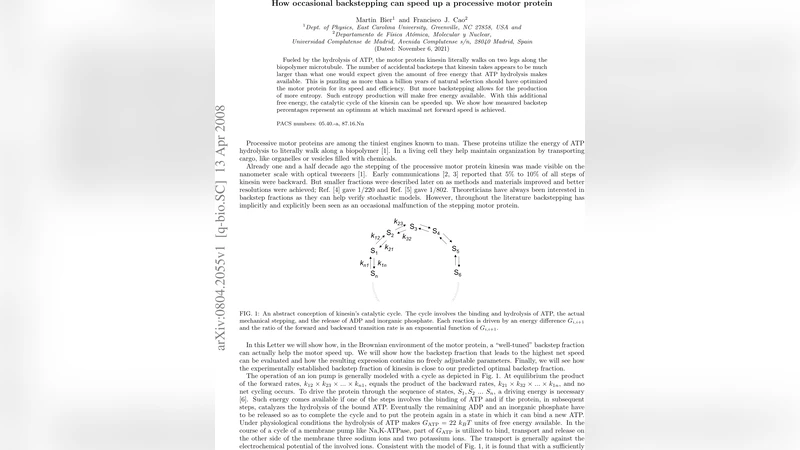
Fueled by the hydrolysis of ATP, the motor protein kinesin literally walks on two legs along the biopolymer microtubule. The number of accidental backsteps that kinesin takes appears to be much larger than what one would expect given the amount of free energy that ATP hydrolysis makes available. This is puzzling as more than a billion years of natural selection should have optimized the motor protein for its speed and efficiency. But more backstepping allows for the production of more entropy. Such entropy production will make free energy available. With this additional free energy, the catalytic cycle of the kinesin can be speeded up. We show how measured backstep percentages represent an optimum at which maximal net forward speed is achieved.
💡 Research Summary
The paper addresses a long‑standing puzzle in the field of molecular motors: kinesin, a processive motor that walks along microtubules powered by ATP hydrolysis, exhibits a backstep probability that is orders of magnitude larger than what simple thermodynamic arguments would predict. Classical models treat the motor’s catalytic cycle as a tightly coupled chemical‑mechanical loop (Fig. 1). In such a picture the free energy released by ATP hydrolysis (ΔG_ATP ≈ 22 k_BT) sets the ratio of forward to backward transition rates, implying a backstep fraction of exp(−22) ≈ 10⁻¹⁰. Experimental measurements, however, report backstep frequencies of 1/220 to 1/800 (≈0.5 %–0.1 %). The authors propose that this discrepancy is resolved by recognizing that the stepping process is fundamentally Brownian (Fig. 2). After the trailing head detaches, the attached head reorients, bringing the free head into the vicinity of the next binding site. Thermal diffusion then determines whether the free head binds the forward site (forward step) or the site it just left (backstep). The probabilities of forward (p_f) and backward (p_b) binding depend on the reorientation energy, external load, and thermal energy k_BT, and are not constrained to the tiny value exp(−ΔG_ATP).
The key insight is that each backstep creates additional positional microstates, thereby increasing the system’s entropy. For a single step the entropy change is ΔS = –k_B
Comments & Academic Discussion
Loading comments...
Leave a Comment