Supersolitons: Solitonic excitations in atomic soliton chains
We show that, by appropriately tuning physically relevant interactions in two-component nonlinear Schrodinger equations, it is possible to achieve a regime with particle-like solitonic collisions. This allows us to construct an analogue of the Newton…
Authors: David Novoa, Boris A. Malomed, Humberto Michinel
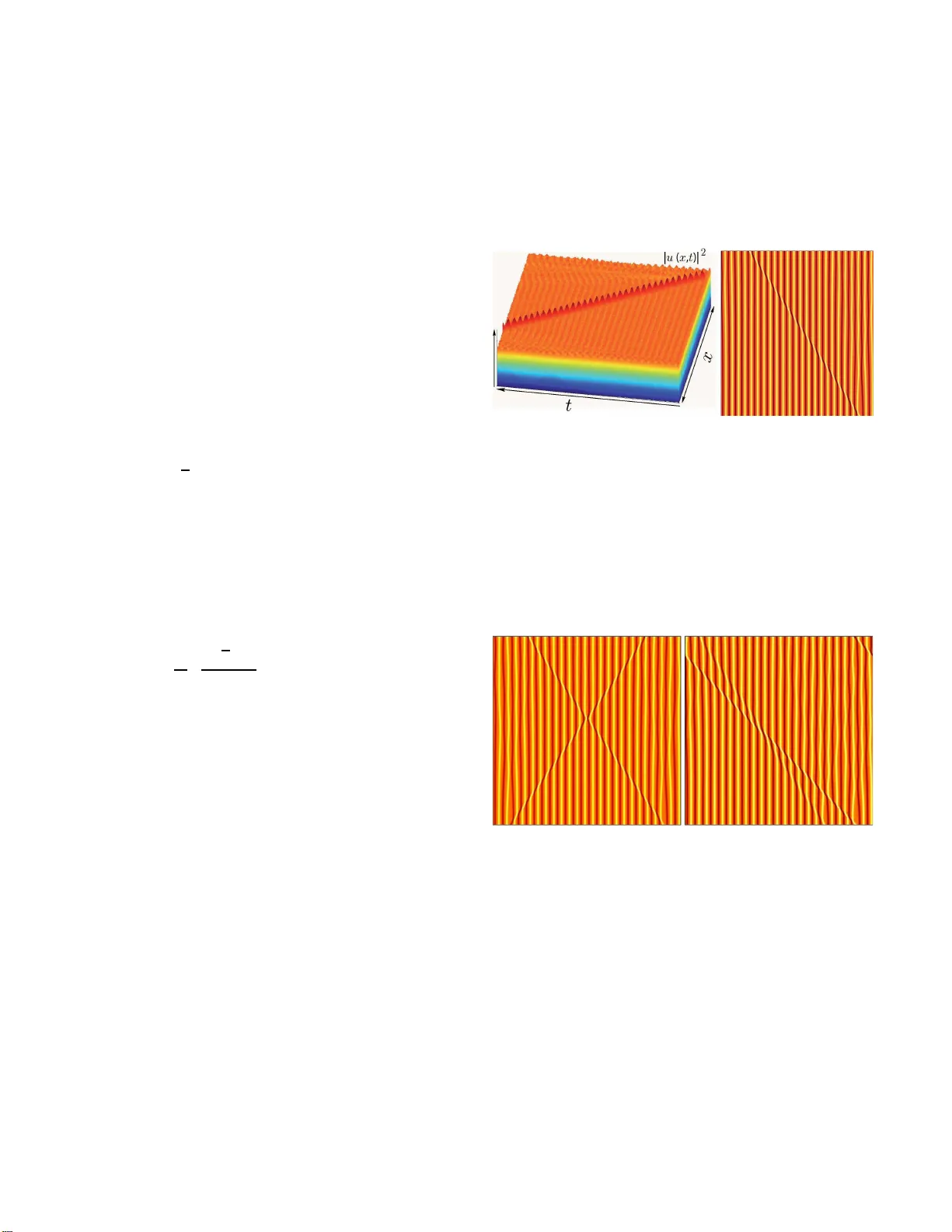
Sup ersolitons : S olitonic excitations in atomic soliton c hains David Nov o a 1 , Boris A. Malomed 2 , H um ber to Michinel 1 , and V ´ ıctor M. P´ erez-Gar c ´ ıa 3 . 1 ´ Ar e a de ´ Optic a, F acultade de Ciencias, Universidade de Vigo, As L ago as s/n, Our ense, E-32004 Sp ain. 2 Dep artment of Physic al Ele ctr onics, Scho ol of Ele ctric al Engine ering, F aculty of Engine ering, T el Aviv University, T el Aviv 69978, I sr ael 3 Dep artamento de Matem´ atic as, E. T. S. I. Industriales, and Instituto de Matem´ atic a Apli c ada a la C i encia y la Ingenier ´ ıa, Av . Camilo Jos´ e Cela, 3, Uni versidad de Castil la-L a Mancha, 13071 Ciudad R e al, Sp ain. W e sho w that, by appropriately tuning physically relev ant in teractions in tw o-component nonlin- ear Sc hr¨ odinger eq uations, it is p ossible to achiev e a regime with particle-lik e solitonic collisions. This a llo ws us to construct an analogue of the Newton’s cradle and also to create localized collectiv e excitations in solitary-wa ve chains whic h are q uasi-integ rable solitons, i.e. sup ersolitons. W e giv e a physical explanation of the ph enomenon, supp ort it with a p erturbative analysis, and confirm our predictions by direct sim ulations. P A CS n um bers: 05.45.Yv, 03.75.Lm Intr o duction and mo del. - One of the most successful concepts of nonlinear science with applications to a great v ariety of physical co nt exts is tha t of solito ns, i.e., self- lo calized nonlinear wav es , sus ta ined by the balance b e- t ween disp e rsion and no nlinearity . Many types of s olitons hav e bee n studied, from the classical examples fo und in int egrable mo dels, such as the Ko rteweg - de V ries, sine- Gordon, T oda -lattice (TL), no nlinea r Schr¨ odinger, and other celebr ated equations, a nd extending into the realm of realistic non-integrable no nlinear-wa ve mo dels. Solitons ar e usua lly ex pected to be robust aga inst col- lisions, whic h is a tradema rk feature of in tegrable equa- tions. A lot of a ctivity ha s b een directed at the study o f soliton co llisions a nd interactions in non-integrable sys- tems. Recent adv ances include the ana lysis o f chaotic scattering [1], the forma tio n of s o liton bo und states and soliton cluster s [2], and the studies of s o liton collisions in vector s ystems [1 , 3, 4], to name just a few. While it is customary to speak o f solitons as ela stically colliding quasi-particles, most solitons, spe c ifically in in- tegrable systems, pa ss through ea ch other, thus clearly featuring their wa v e nature. On the other hand, elastic collisions b e t w een cla ssical pa rticles lea d to momentum exchange b etw een them, and reb ound, due to the no n- pene tr ability of classical par ticles. In this paper we discuss a particular soliton colli- sion sce na rio of physical r elev ance, where truly elas tic particle-like soliton co llisions ca n b e achiev ed. W e will show how this can b e used to build a vector-so liton ver- sion of the Newton ’s cr ad le , and to build sup ersolitons , i.e. collective s oliton-like excitations in a rrays of solitary wa ves, le a ding to a r emark a ble co njunction of emerg ent phenomena: the fo rmer one r e presenting the forma tio n of robus t soliton tra ins , and the la tter effect implying the emergence of an effectively qua s i-discrete s oliton at a hig her level o f o rganizatio n. The basic model which allows to implemen t the ab ov e- men tioned e ffects is base d on the tw o- comp onent (v ecto- rial) nonlinear Schr¨ odinge r equation (NLSE), that a rises in sundry co ntexts [5]. Its normalized form is i ∂ u j ∂ t = − 1 2 ∂ u j ∂ x 2 + V ( x ) u j + X k =1 , 2 g j k | u k | 2 u j . (1) An impo rtant ph ysical rea lization of this mo del is a m ul- ticomp onent Bose-E instein co ndens ate (BE C), w he r e u j are wa v e functions of tw o ato mic states under the actio n of a strong tr ansverse trap with frequency ν ⊥ [6]. The v aria bles x and t are measured, res pec tiv ely , in units of a 0 = p ~ /mν ⊥ and 1 /ν ⊥ , and g ij ≡ 2 a ij /a 0 , with a ij the resp ective s − wav e sca ttering lengths. The nor malization int egral for u j gives the n um ber of atoms in the resp ective sp ecies, R + ∞ −∞ | u j | 2 d 3 x = N j . Solitons in BECs hav e been created exper iment ally [7] and their interactions studied theoretically in many pap ers (see e.g. [8, 9, 10]). Particle-like elastic c ol lisions and the solitonic New- ton ’s cr ad le.- W e will consider Eqs. (1) with intra- comp onent attraction ( g 11 , g 22 < 0) and in ter-comp onent repulsion ( g 12 , g 21 > 0). T o fix ideas we will choose g 11 = g 22 = − g 12 = − g 21 (= 1 without loss of generality) for which case the co upled NLSE are not integrable [11]. In this situation the solitons, that may b e formed in b oth comp onents indep endently , interact incoherently w ith a repulsive force. The basic ph ysical feature underlying our analysis is that the dynamics of those solitons may be similar to that of elas tic b eads. W e will explore the cas es of harmonic long itudinal co nfinement V ( x ) = Ω 2 x 2 / 2, and r ing-shap ed configurations [12]. Let us consider soliton trains built a s follows: u 1 ( x, 0) = X n =1 ,...,N ( − 1) n sech ( x − ξ n ) exp ( ixv n ) , (2a) u 2 ( x, 0) = X n =1 ,...,N ( − 1) n sech ( x − ζ n ) exp ( ixw n ) , (2b) with alternation of the soliton species in the tr ain, i.e., ...ξ n − 1 < ζ n − 1 < ξ n < ζ n < ξ n +1 < ζ n +1 < ..., (3) 2 v n and w n being initial velocities of the solitons . In Fig. 1, where the tr ap is absent, panel (a) displays a sing le collision even t ( N = 1). It is noteworth y that, be c ause of the repulsive in ter-comp onent in teraction, the incident soliton (in field u 1 ) transfers all of its momentum to the initially static soliton (in u 2 ), in full compliance with the behavior of elastic pa r ticles and contrary to the typical behavior of nontopo logical solitons in integrable systems. The dyna mics o f a train of eight a lternating so litons in a ring configura tion demo nstrates the p erio dic tra nsfer o f the momen tum thro ugh the train, see Fig 1(b). (a) (b) FIG. 1: [Colo r online] Pseudo color plots of | u 1 ( x, t ) | 2 (blue) and | u 2 ( x, t ) | 2 (red) sho w the time evolution of initially well separated solito n trains built as p er Eq. (2). The horizontal (vertical ) axis of eac h plot is spatial adimensional v ariable x (adimensional time t ). (a) Collis ion of tw o solitons ( N = 1) for ξ 1 = − 20 , ζ 1 = 0 , v 1 = 0 . 4 , w 1 = 0, x ∈ [ − 30 , 30] and t ∈ [0 , 100]. (b) Multisoliton collisions in a ring for N = 4, ζ j = − 35 + 20 j, ξ j = − 25 + 20 j , x ∈ [ − 40 , 40] and t ∈ [0 , 250]. Initial velocities are all zero except for w 3 = 0 . 5. (a) (b) (c) FIG. 2: (Color online) S ame as Fig. 1 for a Newton ’s cr ad le built u p of five solitons with an external p otential with Ω 2 = 6 · 10 − 5 . In all subplots t max = 1000, x ∈ [ − 40 , 40], and th e initial separation b etw een solitons is ξ n − ζ n = 6. Different oscillatio n mo des are excited by applyin g an initial velocity , of size 0 . 2, t o: (a) the top-left soliton, (b) tw o ultimate solitons on b oth sides, with opp osite velocities, and (c) all solitons. By adding the para bo lic trapping p o tential we urge the solitons to os cillate a round the equilibr ium p osition. In the q uantu m int erpretation o f our mo del this s e tup would provide a way to construct a quantum Newton ’s cr ad le with a tomic solitons, as illustrated in Fig. 2. Un- like o ther settings explore d in BEC [13], the cradle con- figuration doe s not require a lattice po tent ial to create effective particles , which are her e created by purely no n- linear in teractions. The T o da-lattic e limit: sup ersolitons - W e now co n- sider t w o a lter nating c hains o f solitons set along a ring. Within the effectiv e-particle approach, we assume that all solitons, which have iden tical amplitudes in each compo - nent , η (for u 1 ) and θ (for u 2 ), b ehav e like rigid particles and thus do not s uffer conspicuo us deformation, i.e ., ea ch soliton ma y b e approximated by u ( n ) 1 ( x, t ) = η sech [ η ( x − ξ n )] e i ˙ ξ n x + 1 2 R ( η 2 − ˙ ξ 2 n ) dt , (4a) u ( n ) 2 ( x, t ) = θ sech [ θ ( x − ζ n )] e i ˙ ζ n x + 1 2 R ( θ 2 − ˙ ζ 2 n ) dt , (4b) with the initial p ositions arra nged a s p er Eq . (3). A straightforward a nalysis based on the p er tur bation theory for s o litons [14] yields the fo llowing system of equations of motion for the so liton co o r dinates: ¨ ξ n = − Ω 2 ξ n + 8 θ h η 2 e − 2 η ( ξ n − ζ n − 1 ) − e − 2 η ( ζ n − ξ n ) + θ 2 e − 2 θ ( ξ n − ζ n − 1 ) − e − 2 θ ( ζ n − ξ n ) i , (5a) ¨ ζ n = − Ω 2 ζ n + 8 η h η 2 e − 2 η ( ζ n − ξ n ) − e 2 η ( ξ n +1 − ζ n ) + θ 2 e − 2 θ ( ζ n − ξ n ) − e − 2 θ ( ξ n +1 − ζ n ) i . ( 5b) These equations are derived under the assump- tion that adjacent solitons are well sepa rated, i.e., ( η , θ ) ( ξ n − ζ n − 1 ) , ( η , θ ) ( ζ n − ξ n ) ≫ 1, although a strong inequality is not really nec e ssary here. Similar idea s hav e b een used to derive equa tions for the int eraction o f other elementary nonlinear s tr uctures, which gives ris e to different equations at a hig her level of organiza tion [3, 10, 15]. Equations (5 ) with Ω = 0 reduce to the so-called diatomic TL, which is not integrable, althoug h some solutions a re known. With η = θ and Ω = 0 in Eqs. (5 ) and defining q 2 n ( t ) = 2 η ξ n ( t ) , q 2 n +1 ( t ) = 2 η ζ n ( t ) and α = 32 η 4 , we arrive at the in tegrable TL mo del [16], ¨ q n = α h e − ( q n − q n − 1 ) − e − ( q n +1 − q n ) i . (6) This mo del des crib es a dynamical la ttice with the ex- po nent ial p otential of the nea rest-neighbor interaction. How ever, potentials o f the interaction betw een adjacent atoms in r e a l co ndensed-matter systems are nev er ex p o - nent ial, b eing clo ser to those o f nonlinea r anha rmonic oscillator s. This is why the o nly exp e rimental rea lization of the integrable TL was realized in electr ic transmissio n lines [18], tha t may b e r e adily designed in exact co rre- sp ondence to Eqs. (6). Our analys is sug gests a p o s sibil- it y to crea te T oda solitons, of b oth mono- and diato mic t yp e s, as excitations in interwo v en ar rays of multicom- po nent NLSE s o litary wav es . W e name these excitatio ns s up ersolitons since they o c- cur on top of an arr ay of “ elementary” solito ns , and a re 3 exp ected to b e a s robus t as solitons in integrable mo d- els. The sa me name was previously applied to solitons in sup e rsymmetric mo dels [1 7], a nd, in a completely dif- ferent context, to lo calized top o lo gical collective exci- tations in chains of fluxons trapp ed in per io dically in- homogeneous Jo sephson junctions and in layered super - conducting structures [15]. The a ppea rance of TL su- per solitons repre s ent s a rema r k able phenomenon at a higher-or ganization lev el, using, as building blocks, soli- tary w av es of the multicomponent NLSE , i.e. a strongly noninte gr able mo del. In the mono a tomic lattice, Eq . (6) ha s an obvious equi- librium s olution with q n = L/ (2 N ), wher e N is the num- ber of solitons in each sub chain, and L the total leng th of the system. F or s mall p erturbations with frequency ω and w av en um ber k ar ound this configuration, the dis- per sion r elation is ω 2 = 128 η 4 e − ηL / N sin 2 ( k / 2). With resp ect to the quantization imp os e d by the b oundary conditions for the ring-s hap ed soliton c hain, k = π m/ N , m = 0 , ± 1 , ± 2 , ... , this yields | ω m | = 8 √ 2 η 2 exp ( − η L/ 2 N ) | sin( π m/ (2 N )) | . (7) If a wa v e in the lattice is excited by kic king one soliton and lending it velo city v , the wav e will hit solitons with per io d T = L / (2 N v ), which c orresp onds to an effectiv e excitation frequency ω exc ≡ 2 π /T = 4 π N v /L . Thus, res- onant e x citations may be exp ected under the conditio n P ω exc = Q | ω m | , or, in other w ords, at v alues of the kick velocity b elonging to the following r esonant sp e ctrum , v ( P, Q ) m = Q P · 2 √ 2 Lη 2 π N e − ηL / 2 N | sin ( π m/ (2 N )) | , (8) where integers Q and P s tand for the orde r of the reso- nance and subresona nce ( P = Q = 1 corres po nd to the fundamen tal r esonance). Another interpretation of this resonance condition (cf. Ref. [19]) is that the kick veloc- it y coincides with the phase v elo city of linear wa ves. Numeric al stu dies of sup ersolitons - T o v erify o ur pre- dictions based on E q. (6), we hav e p erfor med numerical simulations o f Eq. (1). First, in Fig. 3 we hav e gen- erated a sing le sup ersolito n by kicking one o f the mo st external so lito ns in one of the comp onents. Since this excitation do es not corresp ond exactly to a sup ersoliton we also obtain a small ammount of ra dia tion which is seen as small r emnant o scillations of the individual soli- tary wa v es. Apart from this efect due to the excitation pro cedure, the propaga tion o f the supers oliton is p erfect as seen b oth in the amplitude [Fig 3(a)] a nd pseudo co lor [Fig. 3(b)] plots. Another effect seen in Fig. 3(a) and not co nsidered in our mo del is the sma ll compressio n of the individual solitary wav es when they a re hit by the sup e rsoliton (the mo del assumes equal a mplitude indi- vidual solitary w av es). How ever this small effect do es not affect our conc lus ions and ca n b e minimized by con- sidering smaller energ y co llisions (i.e. incident sp eeds). Fig. 4 shows the co llisional b ehavior for head o n colli- sions of equal s pee d solito ns [Fig. 4(a)] a nd the ov ertak- ing of a slow sup ersoliton by a fas ter o ne [Fig. 4(b)]. In bo th cases the sup e rsolitonic excitatio ns b ehav e as tr ue solitons, what it is justified by the in tegrability o f our simple mo del given b y Eqs. (6). W e wan t to emphasize again that these b ehaviors, typical of integrable systems, arise o n top of a strongly nonintegrable mo del. FIG. 3: ( Color online) Excitation of a supersoliton on a soli- ton c hain given by Eq. (2-3) with N = 24 lo calized solitons in eac h component, by k ic king the j = 22soliton with veloc- it y w 22 = − 0 . 5. Individual solitons hav e initial amp litud es η = θ = 1 and the in tersoliton d istance is five un its lead- ing to a total ring length of 240. Left: Amplitud e plot of | u ( x, t ) | 2 = | u 1 ( x, t ) | 2 + | u 2 ( x, t ) | 2 . Right: Pseudo color plot sho wing | u 1 ( x, t ) | 2 (yello w) and | u 2 ( x, t ) | 2 (red). The range of adimensional times spanned in b oth plots is t ∈ [0 , 250]. FIG. 4: (Color online) Examples of sup ersoliton collisions. The initial configuration is as in Fig. 3 but now tw o supersoli- tons are ex cited. Left: Head-on collision induced with excita- tion parameters v 3 = 0 . 5 and w 22 = − 0 . 5. The range of adi- mensional times spann ed is t ∈ [0 , 250]. R igh t: S oliton o ver- taking excited with initial velocities v 23 = − 0 . 6, w 19 = − 0 . 3. The range of adimensional times spanned is t ∈ [0 , 350]. Can sc alar mo dels supp ort sup ersoli tons?- Soliton col- lisions in the fra mework of scala r NLSEs ha ve b e e n stud- ied in v ario us contexts , a nd equations simila r to E qs. (5) hav e b een derived using different approaches [3, 1 0], leading to the so-called complex TL. Despite the formal similarities, the ensuing dynamics is not ro bus t, and soli- tonic solutions turn out to be unst able b ecause o f the 4 phase dep endence of the int eractions. An example is dis- play e d in Fig. 5(a), which shows tha t the phase shifts induced by the initial kick velocity lead to an unstable dynamics of the single-co mpo nent chain, whereas in its alternating tw o-comp onent counterpart the system do es not display any insta bilit y , as shown in Fig. 5(b); in par- ticular, the configur a tion shown in Fig. 5(b) p er io dically recov ers its s hap e. Th us, the vectorial s ystem with in- coherent interactions is fre e of the instability o f soliton chains in single-comp onent mo dels with cohere nt (phase - depe ndent) in teractions [2 0]. FIG. 5: (Color online) Time evol ution for 0 < t < 500 of matter-w a ve soliton trains with a small collective ex citation in the case of one (a) and tw o (b) sp ecies, whic h are de- scribed, respectively , b y the scalar and coupled NLSEs (black and white colors). Adjacent solitons are giv en opp osed input velocities, χ = ± 0 . 1 in (a), and v j = 0 . 1, w j = − 0 . 1 in (b). Other parameters are as in Fig. 3. Exp erimental r e alization.- The crea tion of TL sup er- solitons in B E Cs would dep end on the us e F esh bac h res- onance techniques to get an atomic mixture with attrac- tive intra-sp ecies and repulsive inter-sp e cies int eractions. A tomic mixtures with co ntrollable interspe c ies interac- tions hav e alrea dy bee n rep orted in Ref. [2 1]. Our ini- tial state o f alternating so litons may b e created by the mo dulational instability and segreg ation from an initially stable tw o-comp onent mixtur e [22]. Conclusions.- W e hav e explored a ph ysical mo del based on the vectorial NLSE, in which hard-pa rticle-like (bo uncing) elastic c ollisions b etw een s o litons b elonging to different spec ie s are p oss ible . These int eractions allow building an analo g ue of the Newto n’s cr adle using soli- tary wa v es, and to s up er s olitons in a chain of alternating solitons. The ex is tence o f these robust lo calized collec- tive e x citations on top of ar rays of nonintegrable solitons represents a r emark a ble emergent phenomenon. A cknow le dgements.- This work has b een partially suppo rted by gr ants FIS2 006-0 4190, FIS2004-0 2466, FIS2007- 2 9090 - E (Ministerio de Educaci´ on y Ciencia, Spain), P GIDIT04TIC383 0 01PR (Xun ta de Galicia) and PCI-08- 0093 (Junta de Comunidades de Ca s tilla-La Mancha, Spain). D.N. ackno wledges a grant from Con- seller ´ ıa de Educaci´ o n (Xunta de Galicia). [1] J. K . Y ang and Y. T an, Phys. Rev. Lett. 85 , 3624 (2000); V. Dmitriev et al ., Phys. Rev . E 68, 056603 (2003); R. H. Go od man and R . Hab erman, Phys. R ev. Lett. 98 , 104103 (2007). [2] J. K. Y ang et al ., Phys. R ev. Lett. 94 , 11390 2 (2005); M. Stratmann, T. Pagel, and F. Mitsc hke, i bi d . 95 , 143902 (2005); Y. Leitner and B. A. Malomed, Phys. Rev . E 71 , 057601 (2005); C. Rotschil d et al ., Nature Physics 2 , 769 (2006); D. Buccoliero et al ., Phys. Rev. Lett. 98 , 053901 (2007); J. Belmonte-Beitia et al ., ibid . 98 , 064102 ( 2007). [3] V . S. Gerdjiko v, and I. M. Uzun o v, Physic a D 152 (2001) 355. [4] T. Kanna et al ., Phys. Rev . E 73 , 026604 (2006); T.-S. Ku et al ., Phys. R ev. Lett. 94 , 063904 (2005). [5] Y . Kivshar, G. P . Agraw al, Optic al Solitons: F r om fib ers to Photonic crystals , Academic Press (2003); L. P . Pitaevskii and S . Stringari, Bose-Einstein Conden- sation , Oxford Universit y Press, Oxford (2003). [6] V . M. P ´ erez-Garc ´ ıa, H. Michinel, and H. Herrero, Ph ys. Rev. A 57 , 3837 (1998). [7] S . Burger et al. , Phys. Rev. Lett. 83 , 5198 (1999); G. B. Partridge, A .G. T ruscott, and R. G. Hu let, Nature 417 , 150 (2002); L. Khayko v ic h et al. , Science 296 , 1290 (2002); B. Eiermann et al. , Phys. Rev. Lett. 92 , 230401 (2004); S. L. Cornish, S. T. Thompson, and C. E. Wie- man, Phys. Rev. Lett. 96 , 170401 (2006). [8] L. D . Carr and J. Brand, Phys. Rev. Lett. 92 , 040401 (2004); V. M. P ´ erez-Garc ´ ıa and J. Belmonte-Beitia, Phys. Rev. A 72 , 033620 (2005); J. Babarro, et al. , ibid. , A 71 , 04360 8 (2005); L. Kha yko v ich and B. A. Malomed, ibid . 74 , 023607 (2006); T. Lin et al. , Nonlinearity 19 , 2755 (2006). [9] V . S. Gerdjiko v , B. B. Baizako v, and M. Salerno, Theor. Math. Phys., 144 , 1138 (2005). [10] A. D. Martin, C. S. Adams, and S. A. Gardiner, Phys. Rev. Lett. 98 , 020402 (2007). [11] V. E. Zakharov and E. I. Sch ulman, Physica D 4 , 270 (1982). [12] S. Gu p ta et al. , Phys. Rev. Lett. 95 , 143201 (2005); C. Ryu et al. , Phys. Rev. Lett. 99 , 260401 (2007). [13] T. Kinoshita, T. W enger and D. S . W eiss, Nature 440 , 900 (2006). [14] Y u. S. Kivshar an d B. A. Malomed, Rev. Mo d. Ph ys. 61 , 763 (1989). [15] A. V. Ustinov, Ph ys. Lett A 136 , 155 (1989); B. A. Mal- omed, Phys. Rev. B 41 , 2616 (1990); Y. S . Kivshar, T. K. Sob olev a, Phys. Rev. B, 42 , 2655(R) (1990). [16] M. T o da, The ory of Nonline ar L attic es , (Springer-V erlag, New Y ork 1989). [17] Y u. I. Manin, A. Radul, Commun. Math. Phys. 98 , 65 (1985); A. S. Carstea , Nonlinearit y , 13 , 1645 (2000); Y. Y a-Xuan, Comm un. Theor. Phys. 49 , 685 (2008). [18] See e.g. P . Marquie, J. M. Bilbault, and M. Remoissenet, Phys. Rev. E 51 , 6127 (1995) and references therein. [19] A. V. Ustinov, M. Cirillo, and B. A. Malomed, Phys. Rev. B 47 , 8357 (1993). [20] T. Galla y and M. Haragus, J. Dyn. Diff. Equ at. 19 , 825 (2007), and references therein. [21] G. Thalhammer, et al. , arxiv:0803.2 763v1 [22] K. Kasamatsu and M. Tsub ota, Phys. Rev. Lett. 93 , 100402 (2004); Phys. Rev . A 74 , 013617 ( 2006).
Original Paper
Loading high-quality paper...
Comments & Academic Discussion
Loading comments...
Leave a Comment