Quantum circuits for strongly correlated quantum systems
In recent years, we have witnessed an explosion of experimental tools by which quantum systems can be manipulated in a controlled and coherent way. One of the most important goals now is to build quantum simulators, which would open up the possibilit…
Authors: Frank Verstraete, J. Ignacio Cirac, Jose I. Latorre
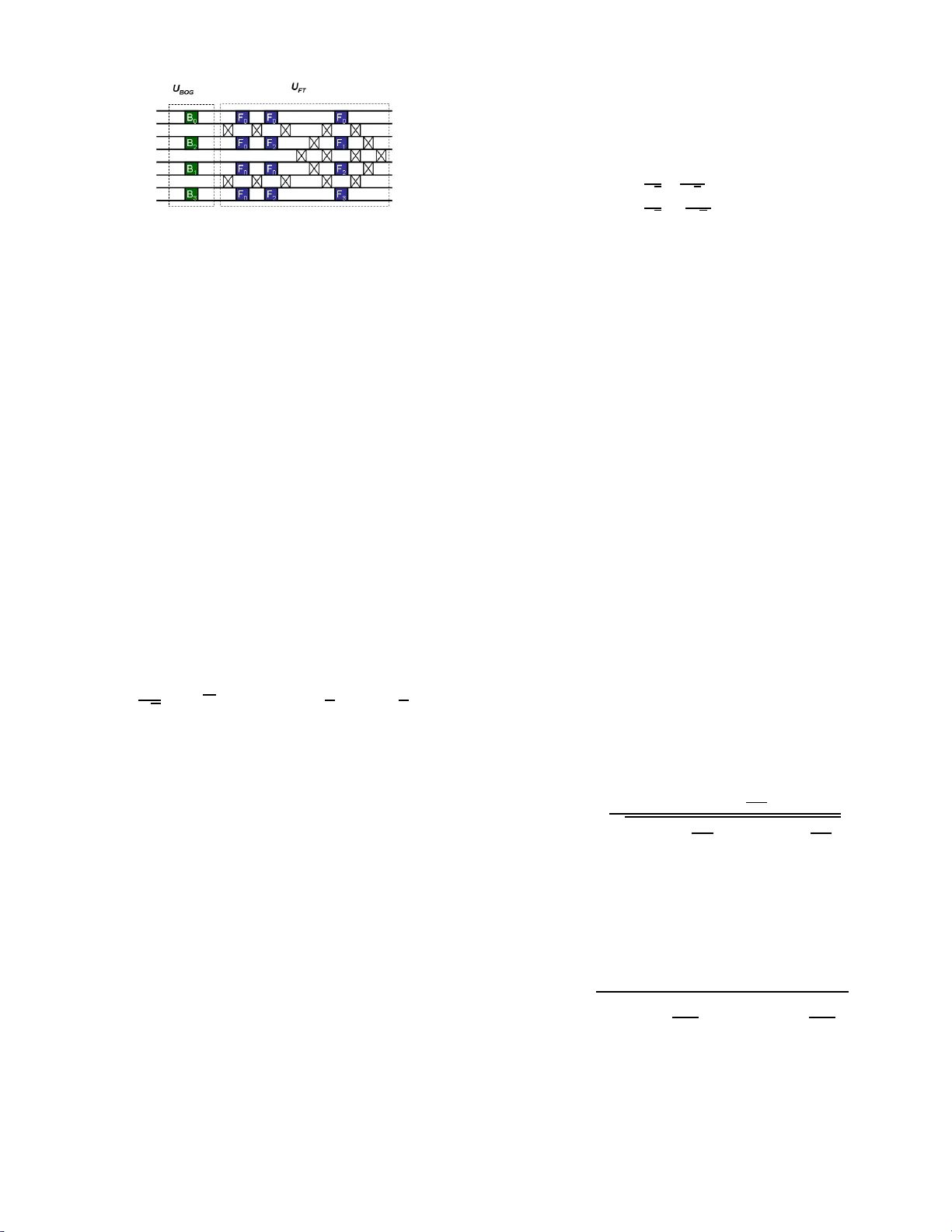
Quan tum circuits for strongly correlated quan tum systems F rank V ers traete, 1 J. Igna cio Cirac, 2 and Jo s´ e I. Latorr e 3 1 F akult¨ at f¨ ur Physik, Univers i t¨ at Wien, Boltzmanngasse 5, A-1090 Wi en, Au stria. 2 Max-Planck-Institut f¨ ur Quante noptik, Hans-Kopfermann-Str. 1, D-85748 Gar ching, Germany. 3 Dept. ECM, Universitat de Bar c elona, M art ´ ı i F r anqu` es 1, 08028 Bar c elona, Sp ain. (Dated: May 21, 2018) In recent y ears, we ha ve witnessed an explosion of exp erimental to ols by which qu antum systems can b e manipulated in a contro lled and coherent w ay . One of th e most imp ortant goa ls now is to build quantum si mulators, which w ould op en up the p ossibility of exciting exp eriments probing v ar- ious theories in regimes that are not achiev able un der normal lab circumstances. H ere we present a nov el approach to gain detailed con trol on the quantum simulation of strongly correlated quantum many-bo dy systems by constructing the explicit qu antum circuits that diagonalize th eir dyn am- ics. W e show that th e exact q uantum circuits underlying some of t he most relev ant many-bo dy Hamiltonians only need a finite amount of lo cal gates. As a particularly simple instance, the full dynamics of a one-dimensional Quan tum Ising mo del in a transverse field with fo ur spins is shown to b e reprod uced using a quantum circuit of only six lo cal gates. This op ens up the p ossibilit y of exp erimentall y pro d ucing strongly correlated states, their time evolution at zero time and even thermal sup erp ositions at zero temperature. Our method also allo ws t o un co ver the exact circuits correspondin g to mo dels that exhibit topological order and to stabilizer states. P ACS nu mbers : 03 . 67.-a , 05.10.Cc Recent adv ances in Quantum Infor mation ha s le d to nov el wa ys of lo oking at strongly cor r elated quant um many-bo dy systems. On the o ne hand, a great dea l of theoretical work has b een made in identifying the basic structure o f entanglemen t in low-energy states of many- bo dy Hamiltonians. This ha s led, for example, to new int er pretations of reno rmalization g roup ideas in terms of v ar iational methods in classes of quan tum states with some very sp ecial lo cal str ucture of entanglement [1, 2, 3], as well as to new methods to study the low energy pr o p- erties of interesting la ttice Hamiltonians. On the o ther hand, new exp er imental to ols hav e b een develop ed which should allow us to simulate certain quantum many–b o dy systems, a nd thus to gain a b etter understanding of their int r iguing properties and potentialities. In particular, the low temp erature states corres p o nding to the Bose - Hubbard model have b een pr epared us ing atoms in op- tical lattices [4, 5], s omething which has trigg ered a lo t of attention b oth in the atomic physics a nd condensed matter ph ysic s communities. In this pap er we pro p o se to use a qua ntu m com- puter (or s imulator) in a differe nt wa y , such that we not only have acc e s s to the low energy states but to the whole sp ectrum for certain qua nt um many–b o dy pro b- lems. Moreov er , this allows one to prepar e a ny excited state or thermal sta te a t an y temperature, as well as the dynamical e volution of a ny sta te for a r bitrary times with an effor t which do es no t dep end on the time, the tem- per ature, or the degree of excitation. The main idea is to unravel a qua nt um circuit that transfor ms the whole Hamiltonian into one co rresp onding to non–interacting particles. As we will show, this will allow us to achiev e the desired goals. Moreov er, the new circuit will be ef- ficient in the sense that the num b er of g ates o nly gr ows po lynomially with the num b er of particles . W e will give some exa mples where with current systems of 4 or 8 trapp ed ions it would b e p o ssible to per form a complete simulation of a stro ngly in teracting Hamiltonian. W e should also mention that what we a re doing ca n b e int er preted in terms of an extensio n o f the renormaliza - tion gr oup ideas [6]. There , o ne is interested in o btaining a simple effectiv e Hamiltonian which describ es the low energy ph ysics of a given problem. This is done by a se- ries o f tr ansformatio ns which inv olve getting rid of hig h energy mo des. In our case, we find a unitary transfor- mation which takes the whole Hamitonian into a simple (non-interacting) one, and thus: (i) we do not lo ose the ph y s ics of the high ener gy mo des in the wa y; (ii) it ca n be implemented exp erimentally . Of course, o ur metho d only w o rks ex actly for the small set o f integrable pr ob- lems, but very similar approximate tra nsformations can in princ iple be found for an y system whose effectiv e lo w- energy ph ysics is well described by quasi-particles. Let us start by co nsidering the consequences of iden ti- fying the quantum cir cuit U dis that disentangles a given Hamiltonian H a cting on n qubits in the fo llowing sense: H = U dis ˜ H U † dis (1) where ˜ H is a non– interacting Hamitonian which, without loss of generality , can b e taken as ˜ H = X i ω i σ z i , (2) with σ z i Pauli o p erators . W e are int er ested in the cir - cuits who se size only grows mo derately with the num b er 2 of qubits. In that ca se we could: (i) pr epare excited eigenstates of H , just preparing a pro duct s tate and then applying U dis ; (ii) simulate the time e volution of a state, just b y using e − it H = U dis e − it ˜ H U † dis . (3) Since e − it ˜ H can be sim ula ted using n single–qubit gates, then the whole evolution would r equire a fixed num b er o f gates, independent o f the time t ; (iii) similar ly , the same circuit will allow to crea te the thermal state exp( − β H ) = U dis exp( − β ˜ H ) U † dis explicitly , just by pr eparing a pro d- uct mixed s ta te to star t with. This is re ma rk able, as, in general, ther e is no known scheme to create thermal states using a (zero-temp eratur e) qua nt um computer. The g oal is th us, to identify the q ua ntum cir cuits that disentangle certain kind of Hamiltonians. Here we will consider three kind o f Hamliltonians: (i) the XY mo del; (ii) Kitaev’s on the honey–comb lattice; (iii) the ones corres p o nding to s ta bilizer states. W e will concentrate in detail in the firs t one, since it gives rise to quantum phase transitions and critical phases, and thus it is p e r haps the most int er esting among them. T o wards the end of the pap er we will briefly explain how one can ca rry out the pro cedure with the other t wo. The c ir cuit U dis we shall co nstruct is surpris ingly small. F or a system of n spins, the total num b er of g ates in the circuit scales a s n 2 and the de pth of the cir cuit g rows as n log n . Then, it seems reas onable to e nvisage exp er i- men ta l realizations of the quan tum cir c uit U dis that will allow to create e.g. the g round sta te of the Quantum Ising mode l fo r any tr ansverse field sta rting from a triv- ial pro duct state and acting only with a small num b er of lo cal g ates. The very same cir cuit would pro duce excited state, sup erp ositions, time evolution a nd even thermal states. This is, thus, a quantum a lgorithm tha t co uld be run in a quantum co mputer to exactly simulate a differ- ent qua nt um system. The strateg y to disentangle the XY Hamiltonian is based in tracing the well-known transforma tion which solves the mo del a nalytically [7, 8]. The path to fol- low is divided in three steps : we fir st need to imple- men t the Jordan-Wig ner map of spins ( σ ) into fermions ( c ), then use the F ourier transform to get fermio ns in momentum space ( b ) and, finally , p erform a B ogoliub ov transformatio n to co mpletely diago nalize the system in terms of free fermions ( a ). As we shall discuss in more detail shor tly , the first transforma tion is just a rela b eling of deg rees of fr eedom which needs no a ctual action on the sys tem. T he fermions c are just an economica l wa y of car rying alo ng the degr ees of fr eedom that ar e subse- quently F o urier transformed. On the o ther ha nd, bo th the F ourier and Bogoliub ov transformations are r eal ac- tions on the spin degrees of freedom. Thus, the structure of the unitar y tra nsformation that takes the free theory to the original XY system corresp onds to U dis = U F T U B og (4) with H I sing = H 1 [ σ ] ← − H 2 [ c ] U F T ← − H 3 [ b ] U Bog ← − H 4 [ a ] = ˜ H (5) Some of the piece s o f the U dis transformatio n may hav e a very simple fo rm when v ie w as a n action on the co- efficients of the wa ve function. The problem is how ever nontrivial in that the Bo goliub ov transformation changes the v acuum and, hence, the pro ble m is different than the one of simulating a fermio nic computer with a standard quantum computer [9]. Let us detail the construction o f U dis for the XY Hamil- tonian H X Y = n X i =1 1 + γ 2 σ x i σ x i +1 + 1 − γ 2 σ y i σ y i +1 + λ n X i =1 σ z i + 1 + γ 2 σ y 1 σ z 2 . . . σ z n − 1 σ y n + 1 − γ 2 σ x 1 σ z 2 . . . σ z n − 1 σ x n . (6) where γ parametrizes the X - Y anisotropy and λ r ep- resents the pr esence of an external tr ansverse magnetic field. The last tw o terms ab ove ar e rela ted to the corr e ct mapping of pe rio dic b oundary conditions b etw een spins to fermionic degrees of freedom and are often dro pp ed as they are suppr essed in the large n limit. These terms ca n also b e substituted with the standar d p eri- o dic terms σ x n σ x 1 and σ y n σ y 1 for the even total s pin- up sector and the same terms with opp os ite sign in the o dd sec tor. The Jordan- Wigner transfor mation c i = Q m 1 (different v alid v ariants of the circuit we are presenting c hang e the wa y the system mu s t be pre pa red or the a ngles app ear ing in the Bogoliub ov tr ansformatio n). Then, the set of gates depicted in the circuit in Fig.2 should b e op era ted with a choice of the parameter λ in the only non-triv ial Bo- goliub ov B ga te. T o b e precise, the angle can be seen to corres p o nd to Eq. 14. W e can fur ther suppress unnec- essary initial and final fermionic swaps since they just corres p o nd to a r elab eling of qubits that ca n b e taken care o f without actual actions on the sys tem. Actually , only six gates would b e needed to r ecreate the full dy- namics of the Ising mo del for four qubits! After running the circuit, the sta te o f the sys tem would then b e the ground state o f the Ising Hamilto nia n for that v alue of the external ma g netic fie ld. It w ould then b e p ossible to measure e.g. the cor relator h σ x i σ x j i , for all i = 1 , 2 , 3 , 4 and j 6 = i . This pro cess could be done ov er a scan of the λ parameter and scan the mag netization h σ x i for any qubit as well a s a mea sure o f three- and four-bo dy correlations functions. W e may fina lly take a larger view on the underlying structure of the circuits we hav e pres ented. The ba- sic idea is that those integrable systems whose solutions make use of the Jordan-Wigner tra nsformation will ha ve a unita ry circuit that disentangles the dynamics with gates of the t yp e V ij = e iα ( c † i c j + h.c. ) , W ij = e iα ( c i c j + h.c. ) . (18) In our case, the F o urier transfor m ca n b e wr itten in terms of V - gates, whereas the Bogo liub ov transforma tio n needs W -gates. These t yp e of gate can further be express e d in terms of lo cal unitaries beca use V ij = V x ij V y ij with V x ij = e iασ x i σ z i +1 ...σ z j − 1 σ x j (19) V y ij = e iασ y i σ z i +1 ...σ z j − 1 σ y j , (20) and, similarly , W ij = W x ij W y ij , with V x ij = e iασ x i σ z i +1 ...σ z j − 1 σ x j (21) V x ij = e iασ x i σ z i +1 ...σ z j − 1 σ x j (22) Then, all these gates can be implemented using B- type, F-type a nd fermionic SW AP gates, as descr ibe d previ- ously . The metho d we hav e presented here can b e extended to solve other quantum sy s tems of relev ance. Let us sketc h t wo sp ecific cases. First, we fo cus on the 2-dimensio na l Kitaev Hamiltonian on the ho neycomb lattice [10]. That Hamiltonian is particularly interesting becaus e its ground state exhibits nontrivial top olo gical features and ca n nev- ertheless b e solved exac tly using a mapping to free Ma jo- rana fermio ns . The construction of the quantum circuit diagonalizing the Ha milto nia n ca n be constructed in the same wa y as for the Ising Ha miltonian. The only differ- ence is that, due to the mapping of one spin 1/2 to tw o fermions o r 4 Ma jorana fermions, ancilla ’s have to b e used in the quantum circuit; but these can again simply be disentangled a t the end. A s econd example of system whose exact circuit can be obtained corresp onds to the case of stabilizer states [11]. This class of sta tes is par - ticularly in teresting from the p oint of view of condensed matter theor y a s it enco mpasses the tor ic co de state and all the so –called str ing net states as arising in the context of topolo gical quan tum order [12]. The r elated quan tum Hamiltonian is a sum o f comm uting terms, each term consisting of a pro duct of lo cal Pauli op era tors. Such a Hamiltonian can alwa ys b e dia gonalized by a qua nt um circuit only co nsisting of Clifford op era tions [13]. In prin- ciple, tho s e gates ca n b e highly nonloca l, and in the case of Hamiltonians exhibiting top ologica l quantum order , one can rig o rously pro ve that the quantum circuit has a depth that s cales linearly in the size of the system [14]. A nice measure of the complexity o f a particular class of stabilizer states would b e to characterize the minimal depth of the quantum circuit crea ting this Ha miltonian. A more challenging task is to find the quantum circuit that diago nalizes Hamiltonians that can b e solved using the Bethe ansa tz. As the corre sp onding mo dels a re in- tegrable, a quantum cir c uit is guara nt ee d to exist that maps the Hamiltonian to a sum o f trivial lo ca l terms. 5 Such a pro ce dur e would b e very interesting a nd lead to the p os sibility o f meas ur inging cor relation functions that are very hard to calculate using the B e the ansa tz solu- tion. In conclusion, we have shown that certain relev ant Hamiltonians descr ibing strong ly correlated quantum systems can b e exactly diagona liz ed using a finite-depth quantum circuit. W e hav e pro duced the explicit co n- struction of such a circuit that op ens up the p oss ibilit y of exp erimental realiza tions of strongly correlated systems in controlled devices. Metho ds. W e he r e illustrate the technique use to co n- struct individual quan tum gates in the XY. W e consider the ex ample of a fast F ourier transfor m of four qubits. The explicit transforma tions of mo des in Eq. (11) b k = c 0 + e − i 2 π 2 k 4 c 2 + e − i 2 π k 4 c 1 + e − i 2 π 2 k 4 c 3 (23) where it is made apparent that mo des 0 and 2 first mix in the same wa y as 1 and 3, and then a subsequent mixing takes plac e. The first step corr esp onds to c ′ 0 = c 0 + c 2 c ′ 1 = c 1 + c 3 c ′ 2 = c 0 + e − iπ c 2 c ′ 3 = c 1 + e − iπ c 3 (24) This the reason why the circuit in Fig. 2 carrie s tw o ident ica l gates in the first part of the F ourier transfo rm. Similarly , further mixture s will take plac e after s o me fermionic swaps ar e operated. T o uncover the actual ga te nee de d for the circuit, we consider the wa ve function made of the mo des in volve | ψ i = X i,j =0 , 1 A ′ ij c ′ † 0 i c ′ † 2 j | 00 i = 1 X i,j =0 A ij c † 0 + c † 2 i c † 0 + e iπ c † 2 j | 00 i . (25 ) Expanding this las t equation and working in the basis | 00 i , | 01 i , | 1 0 i , | 11 i , the co efficients of the w ave function are rearrang e by the tra nsformation A ′ = U A with 1 0 0 0 0 1 √ 2 1 √ 2 0 0 1 √ 2 − 1 √ 2 0 0 0 0 − 1 . (26) [1] M. F ann es, B. Nac htergaele, and R. F. W ern er. Comm. Math. Phys. , 144:443, 1992; F. V erstraete, D. P orras, and J. I . Cirac. Phys. R ev. L ett , 93:227205, 200 4 [2] F. V erstraete and J. I. Cirac. arXiv:c ond-mat/0407066v1 , 2004. [3] G. Vidal, Phys. Rev. Lett. 99 , 220 405 (2007). [4] M. Greiner, O. Mandel, T. Esslinger, T. W. Han sch, I. Bloch, NA TURE 415, 39 (2002). [5] D. Jaksc h, C. Bruder, J. I. Cirac, C. W. Gardiner, P . Zoller, Phys. R ev. L ett 81 , 3108 (1998 ). [6] K. G. Wilson. R ev. Mo d. Phys. , 47: 773, 1975. [7] P . Jordan and E. W igner, Z. Phys. 47 , 631 (1928). [8] E. Lieb, T. Sch u ltz and D. Mattis, A nnals of Phys, 16 , 407 (1961). [9] S. Bravyi and A. Kitaev, A nnals of Phys, 298 , 210 (2002). [10] A. Kitaev, Annals of Ph ys. 321 , 2 (2006). [11] D. Gottesman, Phys.Rev. A 54 , 1862 (199 6). [12] M. Levin and X. G. W en, Phys. Rev. B, 71 , 045110 (2005). [13] D. Gottesman, Ph.D. thesis, Caltec h, Pas aden a, 1997, arXiv:quant-ph/9705052. [14] S. Bravyi, M. B. Hastings, and F. V erstraete, Phys. Rev. Lett. 97 , 050401 (2006).
Original Paper
Loading high-quality paper...
Comments & Academic Discussion
Loading comments...
Leave a Comment