Scale-free vortex cascade emerging from random forcing in a strongly coupled system
The notions of self-organised criticality (SOC) and turbulence are traditionally considered to be applicable to disjoint classes of phenomena. Nevertheless, scale-free burst statistics is a feature shared by turbulent as well as self-organised critical dynamics. It has also been suggested that another shared feature is universal non-gaussian probability density functions (PDFs) of global fluctuations. Here, we elucidate the unifying aspects through analysis of data from a laboratory dusty plasma monolayer. We compare analysis of experimental data with simulations of a two-dimensional (2D) many-body system, of 2D fluid turbulence, and a 2D SOC model, all subject to random forcing at small scales. The scale-free vortex cascade is apparent from structure functions as well as spatio-temporal avalanche analysis, the latter giving similar results for the experimental and all model systems studied. The experiment exhibits global fluctuation statistics consistent with a non-gaussian universal PDF, but the model systems yield this result only in a restricted range of forcing conditions.
💡 Research Summary
The paper investigates the long‑standing question of whether self‑organized criticality (SOC) and turbulence, traditionally regarded as distinct classes of non‑linear phenomena, share common statistical signatures. Using a laboratory dusty‑plasma monolayer as a physical platform, the authors combine high‑resolution particle tracking with numerical many‑body simulations, two‑dimensional (2D) Navier‑Stokes turbulence simulations, and a 2D sand‑pile (Zhang) model. All systems are driven by random forcing applied at the smallest spatial scales (individual dust grains or lattice sites).
In the experiment, ~10⁴ micron‑sized charged grains levitate above an RF electrode, forming a semi‑crystalline layer that intermittently exhibits vortex‑like visco‑elastic flows. By illuminating the particles with a laser sheet and recording their trajectories with a high‑speed CCD camera, the full space‑time history of each grain is reconstructed. A continuous velocity field v(x,t) is obtained via spline interpolation, allowing the authors to visualise both speed U(x,t) and vorticity ω(x,t). The resulting flow displays a hierarchy of vortices that continuously split, merge and dissipate, reminiscent of an inverse‑energy cascade in 2D turbulence.
The many‑body simulation reproduces the essential physics: particles interact through repulsive Coulomb forces, are confined by a parabolic potential, and experience stochastic drag representing collisions with neutral gas. The main quantitative difference from the experiment is a higher ratio of “thermal” to large‑scale velocities, which influences the appearance of large‑scale zonal flows.
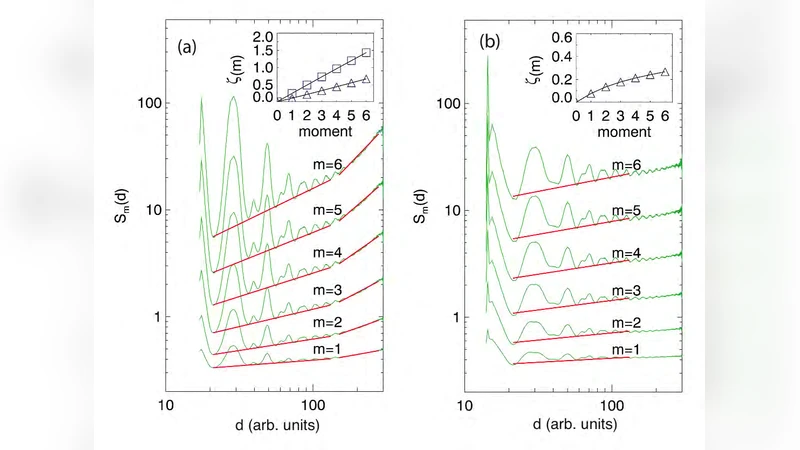
Statistical analysis proceeds on two fronts. First, structure functions Sₘ(d)=⟨|v(r+d)−v(r)|ᵐ⟩ are computed for orders m=1…6. In the experiment two scaling regimes appear: for separations d less than ~10 inter‑particle distances the exponent ζ≈0.1 (weak scaling), while for larger d a second regime with ζ≈0.25 emerges, reflecting the contribution of a coherent azimuthal flow. The simulation only exhibits the small‑scale regime (ζ≈0.1), lacking the large‑scale zonal component. This demonstrates that the many‑body model captures the microscopic cascade but not the emergent macroscopic flow.
Second, an avalanche (or “avalanche”) analysis is performed. A threshold on particle speed defines active particles; connected clusters in the three‑dimensional (x,y,t) space constitute avalanches. For each avalanche i the instantaneous area a_i(t) (number of active particles at time t), duration τ_i, and total size A_i=∫a_i(t)dt are measured. The authors find power‑law statistics: a(t)∝t^{h} with h≈0.6–0.8, survival probability F(τ)∝τ^{−δ} with δ≈1.5–1.9, and size distribution P(A)∝A^{−ν} with ν≈1.5–2.0. These exponents satisfy the scaling relation ν=(h+δ+1)/(h+1) expected for a SOC state, confirming that the dusty plasma flow behaves as a critical system. The same avalanche methodology applied to the 2D Navier‑Stokes simulation and to the Zhang sand‑pile model yields comparable exponent sets (see Table 1), reinforcing the universality of the cascade.
The authors also examine the probability density function (PDF) of global fluctuations, specifically the total kinetic energy in the dusty plasma, the total kinetic energy in the fluid simulation, and the total toppling activity in the sand‑pile model. In all three cases, for a moderate level of random forcing, the PDFs collapse onto the Bramwell‑Holdsworth‑Pinton (BHP) distribution, a non‑Gaussian form previously reported for a variety of critical and turbulent systems. However, systematic variations of the driving strength reveal that the BHP fit deteriorates for very weak or very strong forcing: weak driving produces stretched‑exponential tails, while strong driving yields a more symmetric, near‑Gaussian shape. This sensitivity suggests that the BHP universality is limited to a specific range of non‑equilibrium conditions.
Overall, the study demonstrates that a scale‑free vortex cascade can arise in a strongly coupled, driven many‑body system through purely stochastic, small‑scale forcing. The cascade exhibits hallmark SOC features (avalanche power laws) while simultaneously displaying turbulence‑like structure‑function scaling and an inverse‑energy cascade characteristic of 2D flows. The convergence of results across the dusty‑plasma experiment, many‑body simulations, fluid turbulence, and sand‑pile models points to a deeper connection between turbulence and criticality, implying that traditional Navier‑Stokes descriptions may need to be supplemented with concepts from non‑equilibrium critical phenomena. Future work should explore the role of forcing spectra, dissipation mechanisms, and three‑dimensional extensions to delineate the precise conditions under which universal non‑Gaussian global fluctuation PDFs emerge.
Comments & Academic Discussion
Loading comments...
Leave a Comment