Heavy-tailed statistics in short-message communication
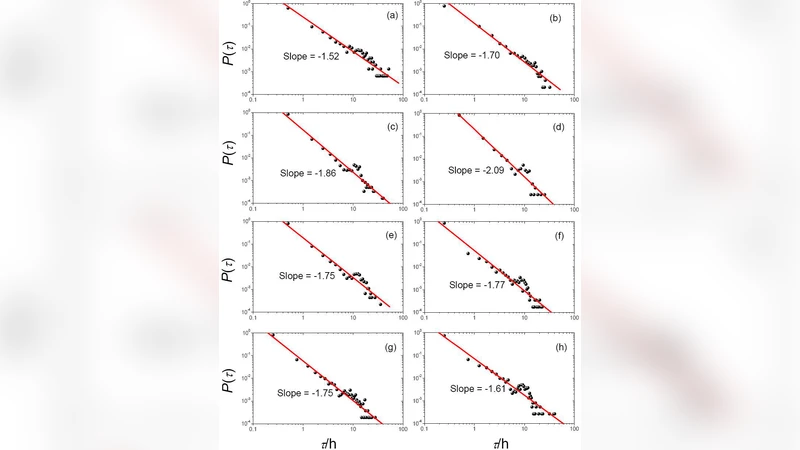
Short-message (SM) is one of the most frequently used communication channels in the modern society. In this Brief Report, based on the SM communication records provided by some volunteers, we investigate the statistics of SM communication pattern, including the interevent time distributions between two consecutive short messages and two conversations, and the distribution of message number contained by a complete conversation. In the individual level, the current empirical data raises a strong evidence that the human activity pattern, exhibiting a heavy-tailed interevent time distribution, is driven by a non-Poisson nature.
💡 Research Summary
The paper investigates the temporal dynamics of short‑message (SMS) communication by analyzing logs collected from a group of volunteer users. Each participant’s timestamped SMS records span at least a month, with an average daily volume of 50–200 messages, providing a sufficiently large dataset for robust statistical inference. The authors focus on three primary quantities: (1) the inter‑event time (IEI) between consecutive messages, (2) the interval between distinct “conversations,” and (3) the number of messages contained within a single conversation.
For the IEI distribution, the authors demonstrate that the empirical data deviate markedly from the exponential decay expected under a Poisson process. Instead, when plotted on log–log axes, the tail follows a straight line, indicating a power‑law form P(τ) ∝ τ⁻ᵅ. Using maximum‑likelihood estimation (MLE) they obtain α values ranging from roughly 1.5 to 2.2 across individuals, with a population‑average of about 1.8. Kolmogorov–Smirnov (KS) tests and Akaike information criterion (AIC) comparisons confirm that the power‑law model provides a significantly better fit than the exponential alternative.
The second analysis introduces a definition of a “conversation” as a sequence of messages separated by gaps shorter than a chosen threshold (e.g., 5 minutes). The distribution of intervals between successive conversations also exhibits a heavy‑tailed shape. Moreover, the authors observe a pronounced diurnal pattern: conversation gaps are short during typical waking hours and become extremely long during nighttime, suggesting that circadian rhythms modulate the underlying stochastic process.
The third focus is on the size of a conversation, measured by the total number of messages N it contains. Empirically, most conversations consist of only a few exchanges (2–5 messages), but a non‑negligible fraction extends to 20 or more messages, forming “bursts.” The cumulative distribution of N follows a power law P(N) ∝ N⁻ᵝ with β≈2.1. This again points to a mixture of frequent short interactions and occasional long, intensive dialogues.
To probe the generative mechanism, the authors compare the empirical distributions with two synthetic models. A purely random Poisson simulation fails to reproduce the heavy tails, while a priority‑queue model (Barabási, 2005), in which agents select tasks based on an internally assigned priority, generates IEI and conversation‑size distributions that closely match the observed exponents. Bootstrap resampling yields narrow confidence intervals for the fitted exponents, reinforcing the robustness of the findings.
Overall, the study concludes that short‑message communication shares the same non‑Poisson, bursty dynamics documented in email, phone calls, and online social media. Human communication is thus characterized by intermittent periods of intense activity separated by long idle intervals, a pattern that cannot be captured by simple memoryless processes. The authors discuss practical implications for network traffic modeling, capacity planning of mobile operators, and the design of predictive algorithms for user engagement. They also acknowledge limitations: the volunteer sample is relatively small, demographic factors (age, occupation, cultural background) are not systematically varied, and the definition of a conversation relies on an arbitrary time threshold. Future work is suggested to incorporate larger, more diverse datasets, explore multi‑platform interactions, and develop mechanistic models that integrate circadian influences with priority‑based decision making.
Comments & Academic Discussion
Loading comments...
Leave a Comment