Nonlocal surface dipoles and vortices
We predict the existence and address the stability of two-dimensional surface solitons featuring topologically complex shapes, including dipoles, vortices, and bound states of vortex solitons, at the interface of nonlocal thermal media. Unlike their …
Authors: Fangwei Ye, Yaroslav V. Kartashov, Lluis Torner
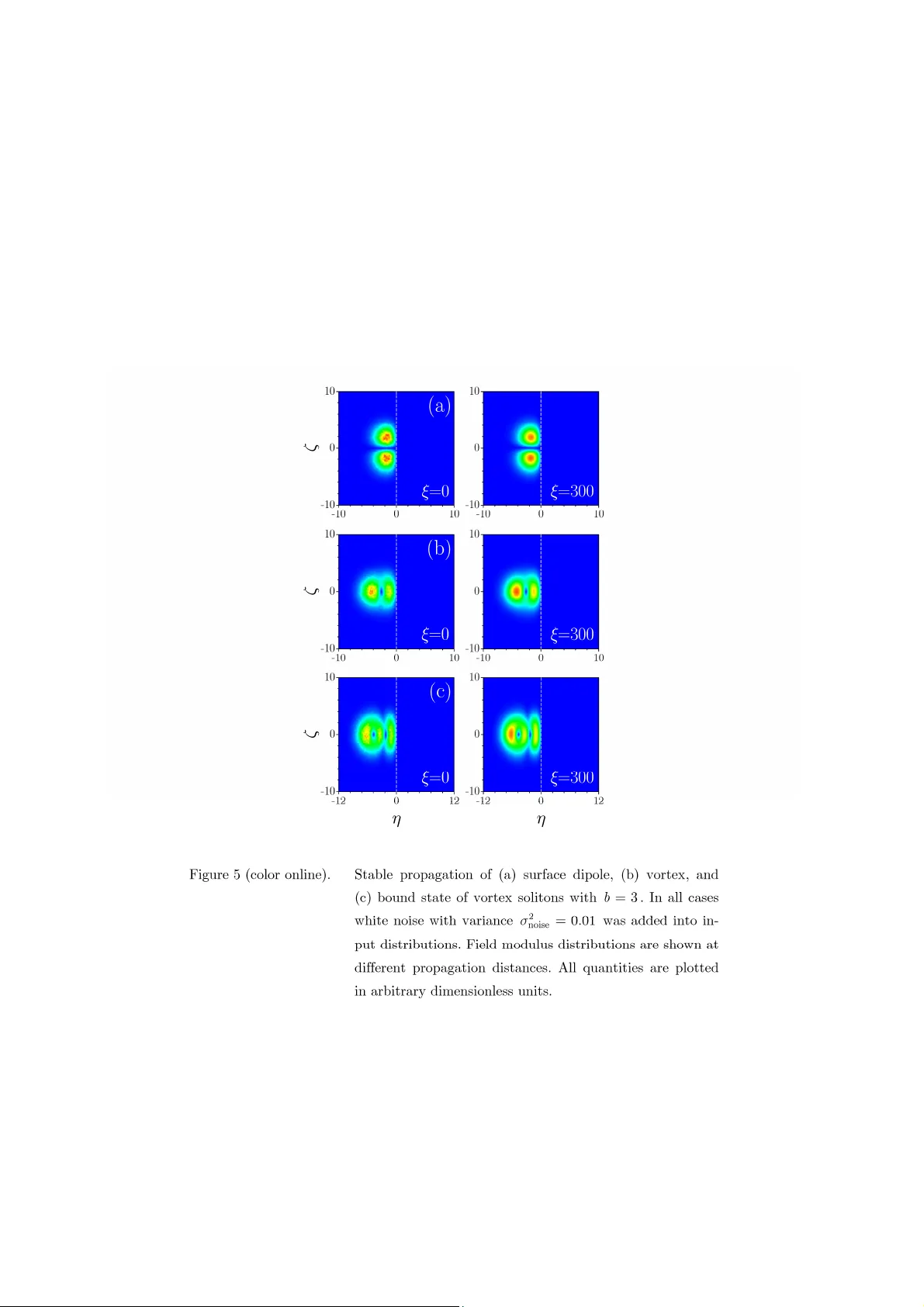
1 Nonloca l surface dipoles and vortices Fangwei Ye, Yaroslav V. Kartashov, and Lluis Torner ICFO-Institut de Ciencies Fotoniq ues, and Universitat Politecnica de Catalunya, Mediterranean Technology Park, 08860 Castellde fels (Barcelona), Spain We predict the existence and address th e stability of two-dimensional surface solito ns featuring topologicall y complex shapes, includin g dipol es, vortices, and bound states of vortex s olitons, at the interface of nonlocal th ermal media. Unlike their counterparts in bul k media, surface dipoles are found to be stable in the entire existence domain. Surface vortices are found to ex hibit strongly asymmetric intensity and phase distributions, and are shown to be stable, too. Bound states of s urface vortex solitons belong to a novel class of surface solit ons havin g no counterparts in bulk media. Such state s are found t o be stabl e provi ded that their energy flow does no t exceed an upper threshold. Our findings constitut e the first known exa mple of to pologically complex solitons located at nonlocal two-dimensional interfaces. PACS numbers: 42.65.Tg, 42.65.Jx, 42.65.Wi. Nonlocality of the nonlinear response is a generic propert y of a variety of nonlinear materials. Nonlocality arises when such nonlinearity mechanisms as diffusion of carriers, reorientation of molecules, heat transfer, etc., are involved [1]. N onlocality m a y give rise to various no nlinear sta- tionary light states [2-17] with n o counterpart i n local media. Especially rich sit uation is encoun- tered i n t wo-dimensional ge ometries, where materials with different types of nonl ocal response c an 2 support st ationary multipoles [7-11], stable vortices [12-16], rotatin g [17,18] and spiralin g [19,20] soliton states. Thus, thermal n onlinearities ar isin g due to heat transfer phenomena [15] may result in stabilization of rin g-shaped vortices with char ges one and two [15,16 ]. Thermal media hav e been also utilized to dem onstrate stationary multipole-mo de solitons [7]. Such multipoles are weakly unstable, althou gh the possibili ty o f th eir stabilization by settin g them i nto r otation was suggested [17]. Importantl y, n ote th at all t ypes o f soli tons mentioned above have b een stu died in b ulk media. Nevertheless, the presence of interfaces in the n onlocal medium m ay substantially affect so liton properties and co nditions re quired for th eir excitation. Under app ropriate conditi ons light can at- tach to the interface resultin g in the formation of specific sur face waves. Stationary s urface waves propagating alon g the interface of t wo different optical mate rials exhibit unique properties, which h ave b een co mprehensively st udied in local media. Sur face wav es in n onlocal media have been addressed only recently. An important result that has been uncovered is that th e geometry of nonlocal sample may play a ke y role in th e surface wave exi stence [15,21]. Surface waves at the i nterface of two Ke rr-t y pe materials, characterized by a finite d egree of nonlocality, were studied in Refs. [22,23]. In focusin g thermal media where the nonlocalit y r ange is determined b y the transverse extent of the ver y thermal sa mple, two-dimension al fundamental sur- face waves were observed in Ref. [24]. Defocusin g thermal materials c an also support surface waves under appropriate conditions [25]. However, to d ate no co mplex surface solito ns with rich internal structure have been reported in two-di mensional nonlocal m aterials. Therefore, a funda- mental q uestion arises: Which t ypes of hi gher-order surface states could exist at interfaces of two- dimensional nonlocal med ia, and h ow their prope rties would differ from the p roperties of higher- order solitons in uniform nonlocal media? In this paper we predict the existence and stud y t he stabili ty of different so liton st ates with nontrivial topological structures supported by the interface of thermal medium. This includes sur- 3 face dipoles, vortices, as well as bound states of surface vortex soliton. W e fin d that s urface dipoles are stable in their entire exi stence domain, in clear contrast to dipoles in uniform thermal medium. Surface v ortices feature s trongly an isotropic and noncanonical shapes and can also be completely stable. Nonlocal th ermal interface can suppo rt a nove l stationa ry bound state of v ortices with no counterpart in uniform media. We start our anal ysis by considering a laser beam propagating along the ξ axis in the vicinit y of the interface formed b y the n onlocal ther mal medium and a linear medium. The propagation o f laser bea m is descri bed by the s ystem of equ ations for dimensionless complex field amplitude q and nonlinear contribution to the refractive index n (see, e.g., Ref. [24] fo r a detailed description of the model): 2 d 1 2 in therma l m edium 1 in linea r medium 2 q i q nq n q q i q n q ξ ξ ⊥ ⊥ ⊥ ∂ = − ∆ − ∂ ∆ = − ∂ = − ∆ − ∂ (1) Here 2 4 1/ 2 0 0 0 ( / ) q k r n A αβ κ = is the dimensionless light field amplitude; 2 2 0 0 0 / n k r n n δ = is propor- tional to the nonlinear change n δ in the refractive ind ex 0 n (note that the nonlinear refractive index change is given b y n T δ β = , where T is t he temperature variation, that obe ys the Laplace equation T I κ α ⊥ ∆ = ); , , α β κ are th e optical absorption, thermo-optic, and ther mal conductivity coefficients, resp ectivel y; I is the light int ensity; 0 k is th e wavenumber; 2 2 2 2 / / η ζ ⊥ ∆ = ∂ ∂ + ∂ ∂ is the t ransverse Laplacian; the transverse , η ζ and lo ngitudinal ξ coordinates are scaled t o charac- 4 teristic beam width 0 r and diffraction length 2 0 0 k r , respectively ; th e parameter d 0 n < describes the difference between the unperturbed refractive index 0 n of th ermal medium and refractive in- dex of less opticall y dense li near medium. We assume that the thermal medium o ccupies the spa- tial region / 2 0 L η − ≤ ≤ and /2 /2 L L ζ − ≤ ≤ , where L is the ζ -width of the sample. Nonlocal thermal responses are oft en described as exhibiting an infinite range of the nonlo- cality, because t he conditions imposed at th e boundaries of the sa mple greatly affect the entire refractive ind ex distrib ution. This effect enters the model via the second of Eqs. (1), whi ch is a Laplace equation fo r the no nlinear refractive shift, with a source te rm proportional to the lig ht intensity. The solution of t his equation strongly depends on the bound ary co nditions. Here w e assume that th e thermal medium is in contact with a linear medium at 0 η = and that the thermal conductivity d κ of the linear medium i s much s maller than that of the the rmal medium. Ph y si- cally, this means that the interf ace at 0 η = is t hermally insulating and that the thermal flux through this inter face is neg ligible, i.e., vanishing ( 0) / 0 n η η ∂ = ∂ = . Three other boun daries /2 L η = − , / 2 L ζ = ± of the thermal sample are maintained at t he sam e temperature so that one can assume that 0 n = at these b oundaries. Note that, formall y, in t he model considered h ere the re- fractive index can always be set to zero because adding a const ant background in the refractive index is equivale nt to introducing a shift of the solito n p ropagati on constant. W e set 40 L = , d 100 n = − , which correspond to t ypical experimental conditions. Note that when d 1 n ≫ the su r- face waves residing in the vicinity of 0 η = interface penetrate into the linear m edium only slightl y . The s ystem (1) conserves the total energ y flow 2 . U q d d η ζ ∞ −∞ = ∫ ∫ (2) 5 On phy sical grounds , a l aser b eam l aunched in the vicinity of the interface of the thermal medium experiences slight absor ption upon prop agation and thus raises the tempera ture of the surrounding material. Due to diffusion of heat that occur s predominan tly in the direction of the insulating su rface, a therma l lens forms inside the medium as a r esult of the thermo-optic effect (see, e.g., Ref. [24]). This therm al lens results in the deflection of the l aser beam towards the in- sulating surface, a phenomenon th at under appropriate conditions ma y result in t he formation of stationary surface wav e. W e search ed for surface solitons o f Eq. (1) that exhibit to polog ically complex inter nal structure s, such as dipole solitons that have the form ( , , ) exp( ) q w i b η ζ ξ ξ = , and vortex solitons whose field can be written i n the form r i ( , , ) ( ) exp( ) q w iw ib η ζ ξ ξ = + . Here ( , ) w η ζ and r,i ( , ) w η ζ are real functions independent of the p ropagati on distance ξ , while b is the propaga- tion consta nt. Substitution i nto t he second of Eqs. (1) leads t o t he two-dimensional nonlinear re- fract ive index profile ( , ) n η ζ corresp onding to the stationa ry solution. The su rface solutions were found numer ically by a standard relaxation method. In all cases analyzed i n this paper, the method converged t o a s tationary solution after severa l iterations provided that a suitable initial gue ss for field distribution (real i n the case of dipoles or complex in the case of vortices) and re- fract ive index are selected. In all cases the continuity con ditions 0 0 ( , ) ( , ) w w η η η ζ η ζ →+ →− = , 0 0 ( , ) / ( , ) / w w η η η ζ η η ζ η →+ →− ∂ ∂ = ∂ ∂ are sat isfied at t he int erface at 0 η = . The ob tained su rface solitons are characterized by complex t opological internal structures. Thus , dipole so lutions con- sist of two out-of-phase bri g ht spots wi th a nodal (zero-intensit y) line separati ng them. We have found two different t ypes of dipole solitons residin g in the vicinit y o f the interface: the nodal 6 lines i n solitons of the fi rst t ype ar e almost parallel to the interface, wh ile in solit ons o f the sec- ond t ype the y are perpendicular to the interface. Here we concentrate on soliton solutions of the second type bec ause of thei r enhanced stabili ty. The amplitude, phase, and induced refractive in- dex profile for dipol e sol iton are depicted in Fig. 1. One can resolve two maxi ma in the refractive index distribution whose positio ns a pproximat ely corr espond t o peaks in the in tensit y distribu- tion, but it should be point ed ou t that due t o s trongly n onlocal ch aracter of the thermal respons e, the nonli near refractive ind ex d oes not v anish even in t he zero-intensit y regions b etween bri ght spots forming dipole; rather, it i s only sli ghtly reduced the re. The r efractive index distribution width l argely exceeds th at of solitons. Thus, even th ough they are lo cated in close proxi mity to the int erface, the dipole soli tons mod ify the refra ctive index in the entir e thermal medium [Fig. 1(c)]. The poles of sol itons are slightl y asymmetric in η direction. We also found a famil y of surface vortex solitons [Figs. 2(a)-(c)]. Such states carry phase singularit y wh ere li ght intensit y vanish es. In t he vortex soluti on depicted i n Fig. 2, th e phas e in- creases by 2 π upon winding around the sin gularit y along an y closed contour, so that the topo- logical charge o f such v ortex equals to o ne. I n contrast t o t heir counterp arts in uniform media, surface vortex solitons feature noncanonical in tensit y and p hase distributions [2 6]. Thus, two maxima located on η -axis are cle arly reso lvable in the intensit y distribution , while the maximum located farth er fro m the in terface is more pronoun ced. The vortex inten sity modulation becomes more prono unced wit h increasing energy f low. Unlike in canonical radiall y s ymmetric vo rtices featuring constant phase gradi ents / d d θ φ (here θ is t he vortex phase and φ is azim uthal angle), for our su rface vo rtices / d d θ φ is azimuthall y depend ent [ Fig. 4(c)]. The phase increases most rapidly around / 2 φ π = and 3 / 2 π , while / d d θ φ is minimal in th e vicini ty of the intensit y 7 maxima. Lik e dipole solito ns, surface vort ices modif y the refractive in dex distri bution in th e en- tire sample [Fi g. 2(c)]. In additio n to surface dipo les and v ortices, we found a n ovel t ype of stationar y surface soli - ton in the f orm of a boun d st ate of two vortices (see Fig. 3). Such bound st ates wer e also found in the form r i ( , , ) ( ) ex p( ) q w iw ib η ζ ξ ξ = + . To t he best of our knowledge, such station ary nonrotat- ing bound states h ave not been encount ered previ ously in bulk nonlocal materials. Th erefore, the surface geometry appe ars to be necessary for their exi stence. One can clea rl y se e from Fig. 3 (b) that vortices formin g the bound state have the sa me to pological cha rge. The vortex located closer to the inter face experiences much stronger shape defor mation. Th e refractiv e in dex distributio n is more elongated along the η -axis for bound state of vortices t han for d ipole and usu al v ortex soli- tons [this is readil y visible in Fig. 3(c)]. The intensit y maximum located f arther fro m the interface is always more pronoun ced t han other two max ima lying on η -axis. Figure 4( a) sh ows the ener gy flo w as a function of the propagation constan t for dipo le su r- face solitons . The correspo nding dependen ce for surface vortic es is quite s imilar and ther efore we do not sho w it here. One can see that for both surface dip oles and vortice s the energy flow is a monotonicall y in creasing function of the propagati on constant. With incre asing en ergy flow, su r- face solitons become m ore localized: for dipoles the distance between p oles along η -axis and their widths decrease, wh il e for vortices the int egral width o f th e to tal complex intensit y distribu- tion also decreases. The distance betwe en the vort ex p hase singularity and the interfa ce graduall y decreases with U . Fo r solitons of all ty pes discussed here, the energy flow vanishes wh en 0 b → . To elucidate the d ynamical stabili ty of t he co mpl ex surface so litons, we performed co m- prehensive simulations of propagation of su rface states perturbed b y input noise with v ariance 8 2 noise 0.01 σ = . Importantl y, we fo und that surfac e d ipoles are s table in the entire exi stence do main. A represen tative ex ample o f the typical evolutio n dynamics is show n in Fig. 5(a). The consid er- able input pert urbations cause onl y s mall oscillations o f amplitudes of the two poles forming the dipole, b ut th e dipoles preserve their in ternal structures o ver hu ge distan ces, ex ceeding the ex- perimentall y available cr ystal len gths b y several orders of m agnitude. This is in contrast to di- poles in bulk t hermal mediu m, wh ere weak in put perturbations c ause slow but progressivel y in- creasing oscillations of bright spots f ormin g dip ole resulting t y picall y in their slow d ecay into fundamental solitons . T herefore, we conclude that the presen ce o f thermall y insulati ng interface results in stab ilization of dipo le solitons. Surface vortices featuring stron gl y asymmetric a nd noncanonical s hapes are also found to be completely stable i n the entire ex istence domain, in analog y with their radially s ymmetric counterparts in bulk geometries [see Fig. 5 (b) sh owing t he st able propaga tion of a perturb ed s ur- face vortex so liton]. Since boundary effects pla y a crucial role in the pro perties of solitons in thermal mediu m, it is important to elucidate whether the aforem entioned stab ilit y of complex sur- face solitons (dipoles , in particul ar) is associated wi th surface effects. We thus varied th e trans- verse size of th ermal medi um and the ratio of its η and ζ dimensions (r ecall, that t his ratio was 1 / 2 in all previous simulations, i.e. the s ample was rectangular) and tested th e stabilit y of dip ole and vortex soli tons in each case. Our ex tensive simulations co nfirmed that both d ipole an d vort ex solitons remain stable in their entire ex istence domain, irrespectivel y of t he overall geometr y o f the sample. Finally, strongl y as ymmetric bound states of vortex so litons were also found t o be stable [see an example o f stable ev olution in F i g. 5( c)], pro vided that the ener gy fl ow does not ex ceed a certain cri tical value. The s table and unstable b ranches for vo rtex bound st ates ar e depicted in Fig. 9 4(b), showing the ( ) U b dependence with conti nuous and dashed lines, respectiv ely. We found that t he width of the stabilit y domain for s uch bound states st rongly depends on the overall ge- ometry of the ther mal sample (i.e., th e aspect rati o, as described above ). With a lase r at the wav elength 500 n m ∼ and beam wi dth 50 m µ ∼ , observatio n of t he sur- face states rep orted above requires nonli near co ntributi ons to the r efractive in dex of t he ord er of 5 10 n δ − ∼ . I n a typ ical thermal mediu m, such as lead glass, with 0 1.8 n = , 5 1 10 K β − − ∼ , 1 0.01 cm α − ∼ , and -1 -1 1 Wm K κ ∼ [15,24], such non linear contributions are readily achievable with input li ght powers of th e order o f 1 W . With these parameters 100 d n = − corresponds to a refractive ind ex differen ce betw een the t hermal medium and the surrounding linear material of about 4 10 − ∼ . No tice th at this small difference in l inear indices justifies the assumption of equal diffraction coefficients in the thermal and lin ear media in Eq. (1), since t he relative differenc e in the diffraction co efficient s is of the same order as the refractive index difference. W e emphasize that ou r findin gs remain valid as long as d 1 n ≫ , sin ce in this case surface wav es almost do n ot penetrate into th e lin ear material and al most all p ower is conc entrated within the thermal mediu m. Also, increasing d n does not chan ge this picture. Summarizing, w e predic ted the existence of a variet y of surfac e solitons with nontrivi al topological structures at thermally insulating interfaces between ther mal and linear media. We found that surface dipol es and vortices are alwa ys stable at such inter faces, while compl ex bound states of vortex solitons can be s table b elow certain ener gy threshold . We also uncovered t he ex - istence of b ound states of surface vortex s olitons with no counterpart s in bulk media. Our find- ings constitut e th e first known example of stable topologicall y co mplex surface solito ns sup- ported by two-di mensional interfaces lo cated in nonlocal m edia. 10 This work has been partially supported b y t he Government o f Spain through gr ant TEC2005-0781 5 and b y the Ramon-y-Cajal program. 11 References 1. W. Kroli kowski, O. Bang, N. I. Nikolov, D. Nesh ev, J. Wy ll er, J. J. Rasmus sen, and D. Edmundson, “Modulatio nal ins tability, solitons a nd beam propagation in s patiall y nonlocal nonlinear media,” J. Opt. B: Quantum and Semiclass . Opt. 6 , S288 (2004). 2. M. Peccianti, C . Conti, and G. Assanto, “Interpla y between nonlocali ty and n onlinearit y in nematic liquid crystals,” Opt. Lett. 30 , 415 (2005) . 3. X. Hutsebaut, C. Cambournac, M. Haelterman, A. Adamski, and K. Neyts, “Single- component hi gher-order mode soliton s in liquid crystals,” Opt. C ommun. 233 , 211 (2004 ); Z. Xu, Y. V. Kartash ov, and L. Torne r, “Upper th reshold for stabilit y of multip ole-mode solitons in nonlocal nonlinear media, ” Opt. Lett. 30 , 3171 (2005) . 4. M. Peccianti, K. A. Brzdakiewicz, and G. Assanto , “Nonlocal spatial solito n interactions in nematic liquid crystals,” Opt. Lett. 27 , 1460 (2002 ). 5. N. I. Nikolov, D. Neshev, W. Krolikowski, O. Ban g, J. J. Rasmussen, and P. L. Christiansen, “Att raction of nonlo cal dark optical solitons, ” Opt. Lett. 29 , 286 (2004). 6. A. Dreischuh, D. N eshev, D. E. Petersen, O. Bang, and W. Krolikows ki, “Observation of attraction between dark solitons,” Ph ys. Rev. Lett. 96 , 043901 (2006). 7. C. Rots child, M. Segev, Z. Xu, Y . V. Kartashov, L. Torner, and O. C ohen, “Two- dimensional multi pole solitons in nonlocal nonlin ear media,” Opt. Lett. 31 , 3312 (2006). 8. S. Skupin, O. B ang, D. Edmunds on, and W. Krolikowski, “Stability of two -dimensional spatial solit ons in nonlo cal nonlinear media,” Phys. R ev. E 73 , 066603 (2006). 9. A. I. Yaki menko, V. M. Lashkin, and O. O. Pri khodko, “D ynamics of two-dimens ional co- herent structures in nonlocal nonlinear medi a,” Phys. Rev. E 73 , 066605 (20 06). 12 10. Y. V. Kartashov, L. Torner, V. A. V ysloukh, and D. Mihal ache, "Multipole vector sol itons in nonlocal nonlinear media," Opt. Lett. 31 , 1483 (2006); D. Buccoliero, A . S. Des yatnikov, W. Krolikows ki, and Y. S. Kivshar, “ Laguerre and Hermite soliton clu sters in no nlocal nonlinear media,” Ph ys. Rev. Lett. 98 , 053901(200 7). 11. V. M. La shkin, “Two-dimensio nal nonlocal v ortices, multipole solit ons, and rotatin g multi- solitons in dipolar Bose-Einstein condensates,” P hys. Rev. A 75 , 043607 (2007). 12. V. I. Kruglov, Y. A. Logvi n, and V. M. Volkov, “ The theor y of spiral laser bea ms in nonlinear media,” J. Mod. Opt. 39 , 2277 (1992). 13. D. Bri edis, D. Petersen, D. Edmundson, W. Krolikowski, and O. Bang, “Ring vortex soli- tons in nonlo cal non-linear media,” Opt . Express 13 , 435 (2005). 14. A. I. Yakimenko, Y. A. Z aliznyak, and Y. S. Kivshar, “Stable vortex solit ons in nonlocal self-focusing nonlin ear media,” Ph ys. Rev. E 71 , 06 5603R (2005). 15. C. Ro tschild, O. C ohen, O. Manela, M. Segev, an d T. Carmon, “Solitons in nonli near media with an infini te range of nonlocalit y: first observation of coherent ellipt ic solitons and of vortex-ring solitons ,” Phys. Rev. Lett. 95 , 213904 (2005). 16. Y. V. Kartashov, V. A. Vyslo ukh, and L. Torn er, “Stabilit y of vortex so litons in thermal nonlinear media with cylindrical s ymmetry,” Opt. Express 23 , 9378 (2007). 17. S. Lopez-A guayo, A. S. Des yatnikov, Y. S. Kivsh ar, S. Skupin, W. Krolikowski, and O. Bang, “Stable rotatin g dipole solit ons in nonl ocal optical media,” Opt. Lett. 31 , 1100 (2006). 18. S. Lopez-A guayo, A. S. Des yatnikov, and Y. S. Kivshar, “Azimuthons in no nlocal nonlin- ear media,” Opt. Ex press 14 , 7903 (2006). 19. C. Ro tschild, B . Alfassi, O. Cohen, and M. Segev, “Long-range in teractions between optical solitons,” Nature Ph ys. 2 , 769 (2006). 13 20. A. Fratalocchi, A. Picc ardi, M. Pecciant i, and G. Assanto, “Nonlinearly co ntrolled angular momentum of solit on clusters,” Opt. Lett. 32 , 1447 (2007 ). 21. B. Alf assi, C. Rotsch ild, O. Manela, M. Se gev, and D. Ch ristodoulides, “B oundary force effects exerted on soli tons in hi ghly nonlocal nonlinear media,” Opt. Lett. 32 , 154 (2007). 22. D. R. Andersen, “Surface -wave excit ation at the interface betw een diffusive Kerr -like nonlinear and linear media,” Phys. Rev. A 37 , 189 (1988); P. Varatharajah , A. Aceves, J. V. Molone y , D. R. H eatle y , and E. M. Wright, “Statio nary nonlinear surface waves and their stabilit y in diffusiv e Kerr media,” Opt. Lett. 13 , 69 0 (1988). 23. Y. V. Kartashov, L. Torner, and V. A. V ysloukh, "Lattice-supported s urface soli tons in nonlocal nonli near media," Opt. Lett. 31 , 2595 (2006). 24. B. Alf assi, C. Rotsch ild, O. Manela, M. Se gev, and D. N. C hristodoulides, “Nonl ocal sur- face-wave solitons ,” Phys. Rev. Lett. 98 , 213901 (2007). 25. Y. V. Kartashov, F. Ye, V. A. V ysloukh, and L. Torner, “Sur face waves i n defocusing thermal media,” Opt. Lett. 32 , 2260 (2007). 26. G. Molin a-Terriza, E. M. Wright, and L. Torner, “Propagation and control of noncanonic al optical vortices,” Opt. Lett. 26, 163 (2001). 14 Figure captions Figure 1 (color onlin e). (a) Field modulus, (b) phase, and ( c) refractive index profile for sur- face dipole at 3 b = . W hite d ashed line indicates interface posi tion. All quantiti es are plotted in arbitrar y dimensionless units . Figure 2 (color onlin e). (a) Field modulus, (b) phase, and ( c) refractive index profile for sur- face vortex at 3 b = . All quantities are plo tted in arbitrar y dimen - sionless unit s. Figure 3 (color onlin e). (a) F i eld modulus, (b) phase, and (c) refractive index profile for bound state of surface vortex solitons at 3 b = . All quantities are plotted in arbitrar y dimensionless units. Figure 4 (color onlin e). Energy fl ow versus prop agation constant for (a) surface dipole and (b) boun d state of v ortex so litons. Points marked with so lid-line cir- cles co rrespond to so liton s shown in Figs. 1 and 3. Con tinuous curve corresponds to stable branch, d ashed cu rve corresponds to u n- stable bran ch. ( c) Nonc anonical phase dist ribution for vortex sur- face soliton defined on a closed contour surroundin g phase sin gular- ity at 3 b = . All quantities are plotted in arbitrar y dimensionless units. 15 Figure 5 (color onlin e). Stable pro pagation of (a ) s urface dipole, (b ) vortex , and (c) bo und state of v ortex solitons with 3 b = . In all cases whit e no ise with variance 2 noise 0.01 σ = was ad ded into in put distributio ns. Field modulus distributions are shown at di fferent propagation distances. All quantiti es are plotted in arbitrar y dimensionless units . 16 17 18 19 20
Original Paper
Loading high-quality paper...
Comments & Academic Discussion
Loading comments...
Leave a Comment