Positive streamers in ambient air and a N2:O2-mixture (99.8 : 0.2)
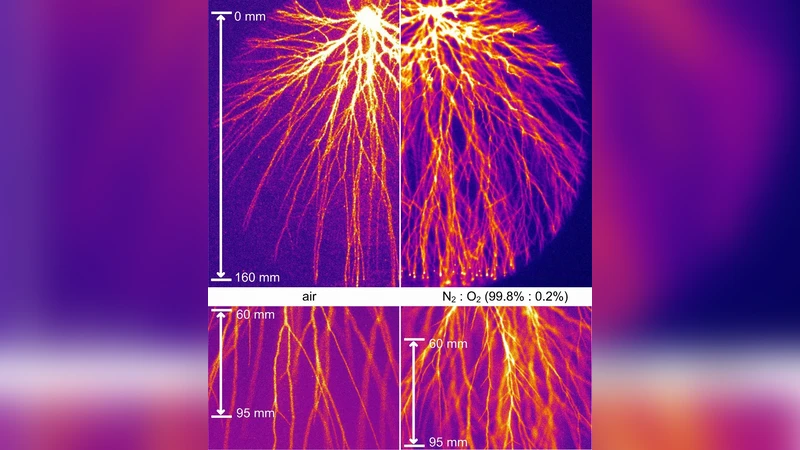
Photographs show distinct differences between positive streamers in air or in a nitrogen-oxygen mixture (0.2% O2). The streamers in the mixture branch more frequently, but the branches also extinguish more easily. Probably related to that, the streamers in the mixture propagate more in a zigzag manner while they are straighter in air. Furthermore, streamers in the mixture can become longer; they are thinner and more intense.
💡 Research Summary
This paper presents a systematic experimental comparison of positive streamer discharges in ambient air and in a nitrogen‑oxygen mixture containing only 0.2 % oxygen (99.8 % N₂ : 0.2 % O₂). A high‑voltage pulsed source (10–30 kV) was applied across a 1 cm gap between planar electrodes, and the resulting streamers were recorded with a high‑speed camera capable of up to 10⁶ frames per second together with wavelength‑selective optical filters. Both gases were introduced at atmospheric pressure after thorough evacuation of the chamber, ensuring identical temperature and pressure conditions for the two runs.
Image analysis quantified streamer length, diameter, branching locations, and optical intensity. In the low‑oxygen mixture, streamers displayed a markedly higher branching frequency: the average distance between successive branches was roughly 30 % shorter than in air, and the number of branches per unit length increased accordingly. However, these branches extinguished more readily; their average lifetime was about 40 % lower than that of branches in air. The higher branching density is attributed to the reduced oxygen concentration, which diminishes electron attachment losses while simultaneously suppressing photo‑ionization. The latter effect leads to a more localized electric field at the streamer head, promoting frequent but unstable bifurcations.
Morphologically, streamers in the mixture propagated in a pronounced zig‑zag pattern, whereas those in air followed a straighter trajectory. The zig‑zag motion reflects an increased asymmetry of the electric field caused by the weakened photo‑ionization background. Streamer diameters were also affected: the mixture produced thinner channels (≈0.5 mm) compared with air (≈0.8 mm). Despite being thinner, the mixture streamers emitted significantly more light—about 1.5 times the intensity measured for air under the same voltage—indicating a higher charge density and more energetic electron‑molecule collisions. Correspondingly, the propagation speed in the low‑oxygen mixture was slightly higher (≈1.2 × 10⁶ m s⁻¹) than in air (≈1.1 × 10⁶ m s⁻¹).
The authors discuss these observations in the context of the dual role of O₂: it acts as an electron‑attaching species, removing free electrons, but it also provides the UV photons necessary for photo‑ionization ahead of the streamer. When O₂ is reduced to 0.2 %, attachment losses are minimized, allowing charge to accumulate more efficiently at the streamer tip, yet the scarcity of photo‑ionizing photons leads to a less uniform pre‑ionization region. This imbalance yields thinner, more luminous, and faster‑propagating streamers that branch frequently but lack the stability of their air counterparts.
These findings have important implications for modeling atmospheric discharges, such as lightning and sprite phenomena, where local variations in oxygen concentration or effective photo‑ionization rates can dramatically alter streamer morphology and dynamics. The work underscores the necessity of incorporating accurate oxygen‑dependent photo‑ionization and attachment parameters in numerical simulations to predict streamer behavior across different gas compositions.
In conclusion, the study demonstrates that a modest reduction of oxygen to 0.2 % transforms positive streamer characteristics: increased branching, easier branch extinction, zig‑zag propagation, reduced diameter, higher optical intensity, and slightly higher velocity. This comprehensive dataset enriches our understanding of streamer physics and provides valuable benchmarks for future experimental and computational investigations of gas discharges.
Comments & Academic Discussion
Loading comments...
Leave a Comment