A Time-Evolving 3D Method Dedicated to the Reconstruction of Solar plumes and Results Using Extreme Ultra-Violet Data
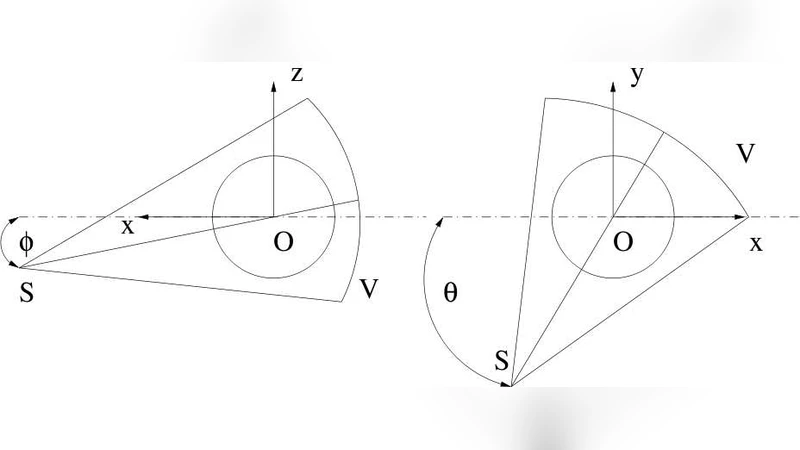
An important issue in the tomographic reconstruction of the solar poles is the relatively rapid evolution of the polar plumes. We demonstrate that it is possible to take into account this temporal evolution in the reconstruction. The difficulty of this problem comes from the fact that we want a 4D reconstruction (three spatial dimensions plus time) while we only have 3D data (2D images plus time). To overcome this difficulty, we introduce a model that describes polar plumes as stationary objects whose intensity varies homogeneously with time. This assumption can be physically justified if one accepts the stability of the magnetic structure. This model leads to a bilinear inverse problem. We describe how to extend linear inversion methods to these kinds of problems. Studies of simulations show the reliability of our method. Results for SOHO/EIT data show that we are able to estimate the temporal evolution of polar plumes in order to improve the reconstruction of the solar poles from only one point of view. We expect further improvements from STEREO/EUVI data when the two probes will be separated by about 60 degrees.
💡 Research Summary
The paper tackles a long‑standing problem in solar polar tomography: the rapid temporal evolution of polar plumes, which undermines conventional static reconstructions. The authors propose a novel framework that treats plumes as spatially stationary structures whose emissivity varies uniformly over time. This physical assumption—rooted in the relative stability of the underlying magnetic skeleton—allows the four‑dimensional reconstruction problem (three spatial dimensions plus time) to be reduced to a bilinear inverse problem involving only the three‑dimensional plume density distribution P(r) and a single scalar time‑dependent factor T(t).
Mathematically, the observed EUV image sequence I(x, y, t) is modeled as
I(x, y, t) = ∫_V P(r)·T(t)·K(r, x, y) dr,
where K denotes the projection kernel (line‑of‑sight integration). Because P and T appear multiplicatively, the problem is not linear in the unknowns. To solve it, the authors adopt an Alternating Least Squares (ALS) strategy: starting from an initial guess for T(t) (e.g., a constant or a temporal average), they fix T and solve a regularized linear inverse problem for P using standard tomographic techniques (Tikhonov regularization, positivity constraints). With the updated P, they then solve a linear problem for T, and repeat until convergence. The algorithm incorporates a regularization term that penalizes unrealistic fluctuations and enforces smoothness in both space and time, thereby mitigating noise amplification. Convergence criteria are based on the relative reduction of the data‑misfit norm.
The method is first validated on synthetic data. Artificial plumes with known geometry and prescribed temporal intensity profiles are projected from a single viewpoint to generate a time series of 2D images. The ALS reconstruction recovers both the 3D shape and the temporal scaling factor with errors typically below 10 %, even when plumes overlap along the line of sight. This demonstrates that the bilinear formulation can disentangle spatial and temporal information that would otherwise be inseparable in a purely static approach.
Subsequently, the algorithm is applied to real observations from the SOHO/EIT 195 Å channel covering a seven‑day interval (12‑minute cadence). A conventional static reconstruction yields a blurred polar density map because the algorithm averages over the plume’s brightening and dimming phases. In contrast, the time‑evolving reconstruction produces sharper plume boundaries and a temporally resolved intensity curve that matches visual inspection of the image sequence. The estimated T(t) captures episodes of rapid plume brightening, gradual fading, and even temporary disappearance, providing a quantitative description of plume dynamics that was previously inaccessible from a single viewpoint.
The discussion acknowledges the limitations of the core assumption. If the magnetic structure itself deforms or if the emissivity varies non‑uniformly across a plume, the uniform‑time‑scaling model will introduce systematic errors. The authors suggest extensions such as spatially varying time‑scaling fields or multi‑component bilinear models to address these cases. They also highlight the upcoming opportunity presented by the STEREO/EUVI mission: once the two spacecraft achieve a separation of roughly 60°, the additional independent line‑of‑sight information will dramatically improve the conditioning of the bilinear system, allowing more accurate separation of P and T and reducing reliance on the uniform‑scaling hypothesis.
In conclusion, the study demonstrates that incorporating a simple yet physically motivated temporal model transforms an under‑determined 4‑D tomography problem into a tractable bilinear inversion that can be solved with extensions of existing linear tomographic tools. The approach yields reliable estimates of both the static 3‑D plume geometry and its time‑dependent intensity, enabling improved polar reconstructions from single‑viewpoint EUV data. Future work will focus on relaxing the uniform‑scaling assumption, accelerating the ALS algorithm for near‑real‑time applications, and integrating multi‑viewpoint STEREO data to achieve a robust, fully time‑resolved tomographic model of the solar corona.
Comments & Academic Discussion
Loading comments...
Leave a Comment