The Network of Commuters in London
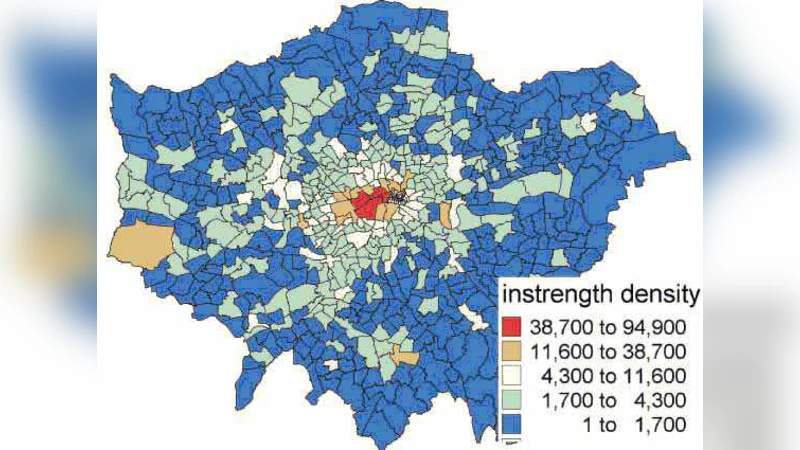
We study the directed and weighted network in which the wards of London are vertices and two vertices are connected whenever there is at least one person commuting to work from a ward to another. Remarkably the in-strength and in-degree distribution tail is a power law with exponent around -2, while the out-strength and out-degree distribution tail is exponential. We propose a simple square lattice model to explain the observed empirical behaviour.
💡 Research Summary
The paper constructs a directed, weighted network in which each vertex corresponds to a London ward and a directed edge from ward i to ward j carries a weight equal to the average daily number of commuters traveling from i to j. Using the 2011 UK Census “Journey to Work” data, the authors obtain a network of 625 vertices (a 25 × 25 grid) and roughly 30 000 directed edges. For every vertex they compute four basic quantities: in‑strength (total inbound commuters), out‑strength (total outbound commuters), in‑degree (number of distinct origin wards) and out‑degree (number of distinct destination wards).
Statistical analysis of the empirical distributions reveals a striking asymmetry. The tails of the in‑strength and in‑degree distributions follow a power‑law form, P(k) ∝ k^{‑γ}, with an estimated exponent γ ≈ 2.0 (±0.1). In contrast, the out‑strength and out‑degree distributions decay exponentially, P(k) ∝ e^{‑λk}, with λ≈0.05 for both quantities. In other words, a small set of wards—principally the central business district and major transport hubs—receive a disproportionately large inflow of commuters, while the outflow from any ward is limited and spreads more evenly across destinations.
To explain this non‑symmetric pattern the authors propose a minimalist spatial model. They place nodes on a square lattice, assign each node i an “activity” A_i proportional to its population and employment levels, and define the probability of a directed link i → j as
P_{ij}=C·(A_i·A_j)·exp(‑α·d_{ij}),
where d_{ij} is the Manhattan distance between the two lattice sites, α is a distance‑decay parameter, and C normalises the probabilities. This formulation is a variant of the classic gravity model, combining a size term (product of activities) with an exponential distance penalty. By calibrating α and the distribution of A_i to match the observed spatial heterogeneity of population and jobs, the model reproduces the empirical findings: the simulated network exhibits a power‑law tail in the in‑strength and in‑degree (exponent close to –2) while the out‑strength and out‑degree remain exponentially bounded.
The authors further interpret these results in the context of urban planning. High in‑strength nodes correspond to the central business district and major railway stations, acting as “attractors” that concentrate commuter inflows. The limited out‑strength of peripheral wards reflects the fact that residential areas can only disperse commuters to a finite set of workplaces, constrained by distance, transport capacity, and job availability. This asymmetry suggests targeted policy measures: expanding high‑capacity public‑transport links into the central attractors to alleviate congestion, and promoting micro‑mobility or local employment opportunities in outlying wards to reduce the necessity of long‑distance commuting.
The paper also discusses limitations. The lattice abstraction ignores the true topology of London’s road and rail networks, and the model does not capture temporal variations (peak vs. off‑peak) or emerging commuting patterns such as remote work and gig‑economy jobs, which are absent from the census data. The authors propose future work that integrates multi‑modal transport layers, dynamic flow modelling, and real‑time mobility data (e.g., from mobile phones or smart‑card systems) to build a more comprehensive predictive framework.
In summary, the study provides a clear empirical characterization of London’s commuter network—highlighting a power‑law inbound distribution versus an exponential outbound distribution—and offers a parsimonious spatial gravity‑type model that successfully reproduces these features. The findings deepen our understanding of how urban structure shapes mobility patterns and offer concrete insights for transportation planning and policy design.
Comments & Academic Discussion
Loading comments...
Leave a Comment