Diophantine Networks
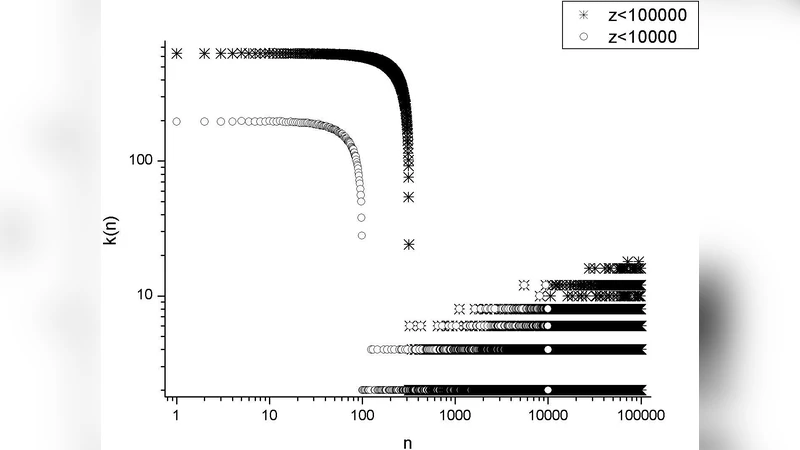
We introduce a new class of deterministic networks by associating networks with Diophantine equations, thus relating network topology to algebraic properties. The network is formed by representing integers as vertices and by drawing cliques between M vertices every time that M distinct integers satisfy the equation. We analyse the network generated by the Pythagorean equation $x^{2}+y^{2}= z^{2}$ showing that its degree distribution is well approximated by a power law with exponential cut-off. We also show that the properties of this network differ considerably from the features of scale-free networks generated through preferential attachment. Remarkably we also recover a power law for the clustering coefficient.
💡 Research Summary
The paper introduces a novel deterministic framework for constructing complex networks by directly linking the solutions of Diophantine equations to graph topology. Vertices correspond to positive integers, and whenever a set of M distinct integers satisfies a given Diophantine equation, an M‑clique (a complete subgraph on those M vertices) is added. This “Diophantine network” paradigm replaces the usual stochastic or growth‑based mechanisms (e.g., Erdős–Rényi random graphs, Watts–Strogatz small‑world, Barabási–Albert preferential attachment) with a purely algebraic rule: the distribution of solutions governs the network’s structural properties.
The authors focus on the classic Pythagorean equation (x^{2}+y^{2}=z^{2}) as a concrete case study. For a chosen bound (N) (ranging from a few thousand up to ten thousand), they enumerate all integer triples ((x,y,z)) with (1\le x\le y<z\le N) that satisfy the equation. Each triple generates a 3‑clique linking the three corresponding vertices. The algorithm is deterministic; the order of processing triples does not affect the final graph.
Statistical analysis of the resulting graphs reveals several striking features:
- Degree Distribution – The probability (P(k)) that a vertex has degree (k) follows a hybrid form \