Virtual Laboratories and Virtual Worlds
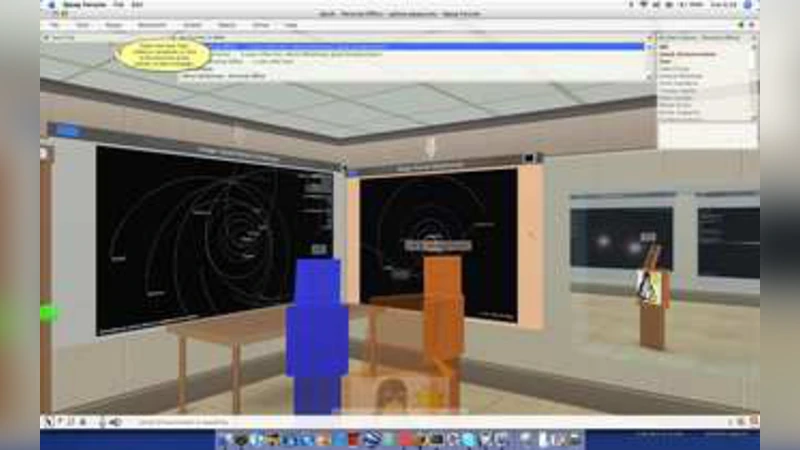
Since we cannot put stars in a laboratory, astrophysicists had to wait till the invention of computers before becoming laboratory scientists. For half a century now, we have been conducting experiments in our virtual laboratories. However, we ourselves have remained behind the keyboard, with the screen of the monitor separating us from the world we are simulating. Recently, 3D on-line technology, developed first for games but now deployed in virtual worlds like Second Life, is beginning to make it possible for astrophysicists to enter their virtual labs themselves, in virtual form as avatars. This has several advantages, from new possibilities to explore the results of the simulations to a shared presence in a virtual lab with remote collaborators on different continents. I will report my experiences with the use of Qwaq Forums, a virtual world developed by a new company (see http://www.qwaq.com)
💡 Research Summary
The paper surveys the evolution of astrophysical research from the early days of numerical simulations to the present moment, when three‑dimensional online environments allow scientists to “step inside” their virtual laboratories as avatars. Because stars and galaxies cannot be placed in a physical lab, astrophysicists have relied on code‑driven models for half a century, viewing results on flat screens and manipulating parameters with a keyboard and mouse. This workflow, while powerful, keeps the researcher physically detached from the phenomena being studied.
Recent advances in 3‑D online platforms—originally created for gaming and later adapted for scientific use—offer a way to overcome that separation. The author focuses on Qwaq Forums, a virtual‑world system that lets users design custom 3‑D spaces, import simulation outputs as manipulable objects, and interact with them in real time. Within Qwaq, an avatar can pick up a rendered galaxy, rotate it, zoom in on a star‑forming region, or adjust the initial conditions of a merger simulation on the fly. The immediate visual feedback transforms data exploration from a passive viewing experience into an active, embodied one, enabling researchers to spot subtle dynamical features that might be missed in static plots.
Beyond individual insight, the platform dramatically reshapes collaboration. Researchers located on different continents can meet in the same virtual lab, share a common visual context, and discuss findings via voice and text chat while simultaneously manipulating the same objects. This shared presence eliminates the latency and miscommunication inherent in traditional screen‑sharing meetings, fostering spontaneous idea generation and rapid consensus building. The paper also highlights educational applications: students can assume avatars, experiment with cosmological parameters, and observe the consequences in real time, thereby bridging the gap between abstract theory and tangible experience.
Technical challenges are examined in depth. Streaming large‑scale simulation data (often tens of gigabytes) requires high‑bandwidth connections and efficient compression schemes. Real‑time rendering of complex particle systems demands GPU acceleration and optimized graphics pipelines to avoid frame‑rate drops that would break immersion. Data security and provenance are also critical; storing research outputs on a third‑party server necessitates robust authentication, encryption, and version‑control mechanisms. The author proposes solutions such as cloud‑based rendering farms, distributed file systems, and modern OAuth‑style authentication to mitigate these issues.
In conclusion, the integration of avatar‑driven virtual worlds with astrophysical simulation offers three principal benefits: (1) a more intuitive, immersive mode of data analysis; (2) seamless, low‑latency collaboration across geographic boundaries; and (3) powerful pedagogical tools for training the next generation of scientists. While the approach promises to expand the reach of virtual laboratories across many scientific disciplines, its success hinges on addressing infrastructure, performance, and security concerns. Future work outlined includes coupling the environment with virtual‑reality headsets for deeper immersion, embedding AI‑assisted pattern recognition to guide users toward interesting parameter regimes, and developing open‑source frameworks that allow broader community adoption.
Comments & Academic Discussion
Loading comments...
Leave a Comment