Population stratification using a statistical model on hypergraphs
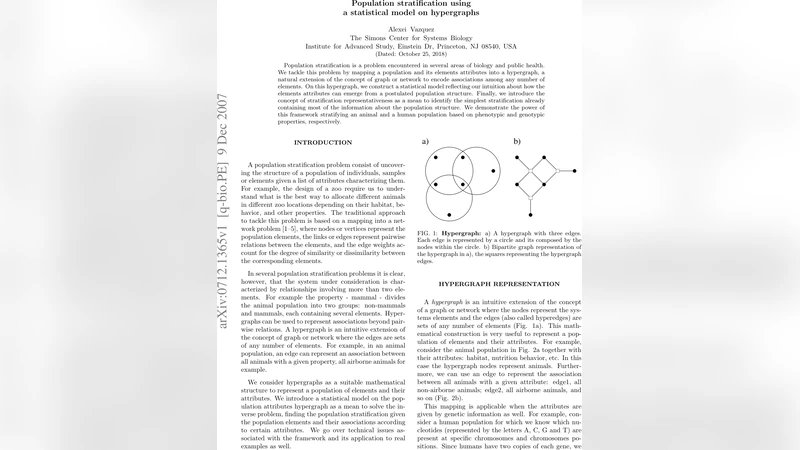
Population stratification is a problem encountered in several areas of biology and public health. We tackle this problem by mapping a population and its elements attributes into a hypergraph, a natural extension of the concept of graph or network to encode associations among any number of elements. On this hypergraph, we construct a statistical model reflecting our intuition about how the elements attributes can emerge from a postulated population structure. Finally, we introduce the concept of stratification representativeness as a mean to identify the simplest stratification already containing most of the information about the population structure. We demonstrate the power of this framework stratifying an animal and a human population based on phenotypic and genotypic properties, respectively.
💡 Research Summary
The paper addresses the longstanding challenge of population stratification by introducing a novel framework that combines hypergraph representations with a probabilistic statistical model. Traditional network‑based approaches model relationships as pairwise edges, which limits their ability to capture the complex, many‑to‑many associations that arise when individuals are described by multiple phenotypic, genotypic, and environmental attributes. To overcome this limitation, the authors map each individual to a vertex and each shared attribute set to a hyperedge, thereby constructing a hypergraph in which a single hyperedge can connect any number of vertices. This representation naturally encodes high‑order interactions among attributes without the need for ad‑hoc feature engineering.
On top of the hypergraph, the authors formulate a Bayesian mixture model. They posit K latent strata (clusters) and assign to each stratum k a set of hyperedge occurrence probabilities θ_{k,e}. The observed hypergraph is then generated by first sampling a stratum assignment z_i for each individual i and subsequently sampling hyperedges according to the θ parameters of the assigned stratum. Inference is performed using an Expectation‑Maximization (EM) scheme or variational Bayes, yielding posterior estimates of both the stratum memberships and the hyperedge probabilities. The number of strata K is selected by standard model‑selection criteria such as AIC, BIC, or cross‑validation, ensuring that the model balances fit and complexity.
A central methodological contribution is the introduction of “stratification representativeness,” a quantitative metric that evaluates how much of the total information contained in the hypergraph is captured by a given stratification. Representativeness is defined in terms of the reduction in entropy (or equivalently, the information gain) achieved when the hypergraph is summarized by the stratum‑specific hyperedge distributions. High representativeness indicates that a small number of strata can explain a large proportion of the variability in the data, allowing researchers to identify the simplest yet most informative partition of the population.
The authors validate the framework on two real‑world datasets. The first consists of a livestock (sheep) population characterized by multiple phenotypic traits such as weight, coat color, and behavioral scores. By constructing a hypergraph of shared trait combinations, the method discovers a small set of strata that separate individuals more cleanly than conventional K‑means or hierarchical clustering, with statistically significant differences in mean trait values across strata. The second dataset involves a human cohort for which genome‑wide single‑nucleotide polymorphism (SNP) data and disease phenotypes are combined into a hypergraph. The model identifies strata in which particular SNP‑phenotype hyperedges are highly concentrated, effectively isolating sub‑populations with elevated risk for specific diseases (e.g., a stratum enriched for a diabetes‑associated SNP pattern). This demonstrates the potential of the approach for early risk‑group detection and precision public‑health interventions.
Key contributions of the work are: (1) the proposal of a hypergraph‑based representation that captures high‑order attribute associations; (2) a Bayesian mixture model that infers latent population structure directly from the hypergraph; (3) the novel representativeness metric that guides the selection of parsimonious yet informative stratifications; and (4) empirical evidence that the method outperforms standard clustering techniques on both animal and human data in terms of cluster separation, interpretability, and information efficiency.
The paper also outlines promising avenues for future research. Extending the framework to dynamic hypergraphs would allow the modeling of temporal changes in attribute patterns (e.g., disease progression, seasonal environmental effects). Incorporating non‑structured metadata such as lifestyle factors or geographic information could further enrich the hypergraph and improve stratification accuracy. Finally, scaling the approach to massive genomic datasets will require efficient hyperedge extraction and compression algorithms, opening the door to real‑time epidemiological surveillance and personalized medicine applications.
Comments & Academic Discussion
Loading comments...
Leave a Comment