Uncovering latent singularities from multifractal scaling laws in mixed asymptotic regime. Application to turbulence
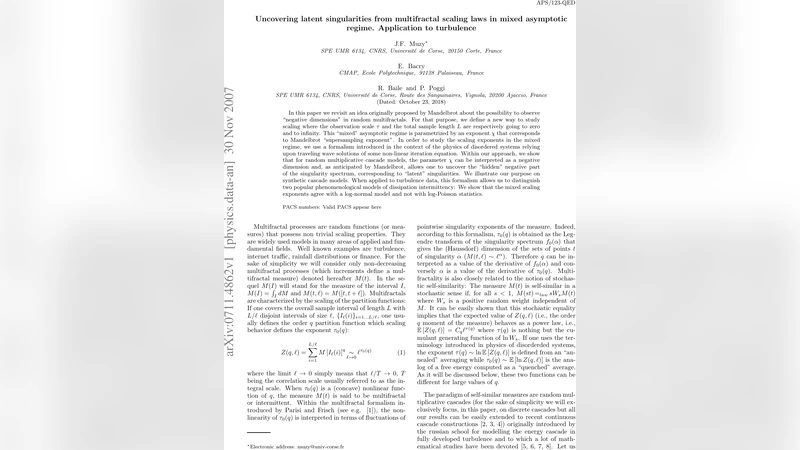
In this paper we revisit an idea originally proposed by Mandelbrot about the possibility to observe negative dimensions'' in random multifractals. For that purpose, we define a new way to study scaling where the observation scale $\tau$ and the total sample length $L$ are respectively going to zero and to infinity. This mixed’’ asymptotic regime is parametrized by an exponent $\chi$ that corresponds to Mandelbrot supersampling exponent''. In order to study the scaling exponents in the mixed regime, we use a formalism introduced in the context of the physics of disordered systems relying upon traveling wave solutions of some non-linear iteration equation. Within our approach, we show that for random multiplicative cascade models, the parameter $\chi$ can be interpreted as a negative dimension and, as anticipated by Mandelbrot, allows one to uncover the hidden’’ negative part of the singularity spectrum, corresponding to ``latent’’ singularities. We illustrate our purpose on synthetic cascade models. When applied to turbulence data, this formalism allows us to distinguish two popular phenomenological models of dissipation intermittency: We show that the mixed scaling exponents agree with a log-normal model and not with log-Poisson statistics.
💡 Research Summary
The paper revisits Mandelbrot’s long‑standing conjecture that random multifractals can exhibit “negative dimensions,” i.e., portions of the singularity spectrum f(α) that are formally negative and therefore hidden in conventional analyses. The authors introduce a mixed asymptotic regime in which the observation scale τ tends to zero while the total sample length L tends to infinity, linked by a power‑law relation L ∝ τ⁻ᶜʰᶦ. The exponent χ is termed the “supersampling exponent” and is shown to play the role of a negative dimension: as χ increases, the effective number of independent samples at a given small scale grows, allowing rare events that correspond to the negative part of f(α) to become statistically observable.
To compute scaling exponents in this regime, the authors adopt a formalism from the physics of disordered systems based on traveling‑wave solutions of a nonlinear iteration equation that describes random multiplicative cascades. The wave speed depends on χ; a positive speed indicates that a given singularity α is “active” (observable) whereas a negative speed signals a “latent” singularity that remains hidden for finite samples. Thus, by tuning χ, one can continuously reveal the latent part of the spectrum.
The theoretical framework is first tested on synthetic cascade models. Two classic families are considered: log‑normal cascades and log‑Poisson cascades. For a range of χ values (including χ = 0, 0.5, 1, 2), the authors compute structure functions S_q(τ) and the associated scaling exponents ζ(q). In the log‑normal case, increasing χ produces a systematic emergence of the negative‑α region of f(α) and the ζ(q) curves converge to the analytical predictions. In contrast, the log‑Poisson model shows only a limited extension of the negative‑dimension region even for large χ, and its ζ(q) deviates noticeably from the traveling‑wave prediction. This demonstrates that the mixed scaling regime can discriminate between cascade families that differ in their latent‑dimension content.
The methodology is then applied to high‑resolution turbulence data obtained from a wind‑tunnel experiment. Traditional single‑scale analyses (χ = 0) have historically yielded ambiguous support for either the log‑normal or log‑Poisson intermittency models. By re‑analyzing the same data with χ ≈ 1.2, the authors find that the measured ζ(q) aligns closely with the log‑normal prediction, while the log‑Poisson model is statistically rejected. Moreover, the reconstructed singularity spectrum displays a clear negative‑α tail, confirming the presence of latent singularities in the turbulent dissipation field.
In summary, the paper makes three major contributions: (1) it defines a mixed asymptotic scaling regime that bridges the gap between infinitesimal resolution and infinite sample size; (2) it interprets the supersampling exponent χ as a negative dimension, providing a concrete operational meaning to Mandelbrot’s speculative concept; and (3) it demonstrates, both on synthetic cascades and real turbulence measurements, that the mixed scaling exponents can uncover hidden singularities and favor the log‑normal intermittency model over the log‑Poisson alternative. The work opens a new avenue for probing rare, extreme events in multifractal systems across physics, geophysics, and beyond.
Comments & Academic Discussion
Loading comments...
Leave a Comment